Day 230 of 300 · Week 31
Childproof at crawling height
Last reviewed · 4 min read · 10 sources · Plain-text version
Gates at the top and bottom of the stairs, mounted to the studs, never accordion-style; windows opened from the top; outlets plugged; walkers skipped. The gate check, and one room a day.
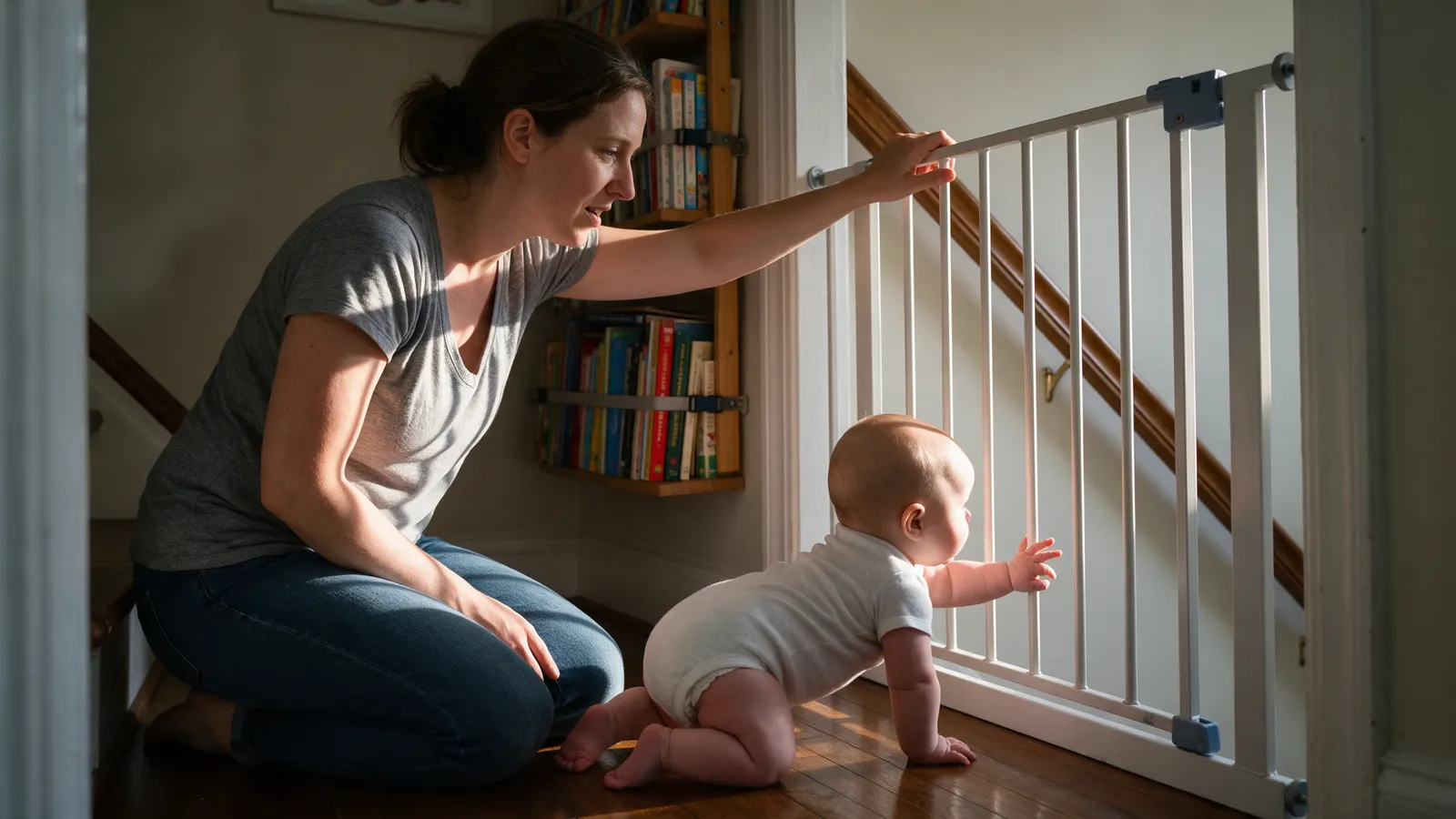
Crawling is close for some babies and months away for others. Either way, the house gets ready now, because the first trip across the floor doesn't send a warning.
Heart
Crawling is usually mastered between 7 and 10 months by the babies who crawl, though a few scoot on their bottoms or slither instead (AAP). It isn't on any CDC checklist (Kretch et al., 2022), and in the WHO's study of 816 healthy children, 4.3% never crawled on hands and knees at all (WHO Multicentre Growth Reference Study Group, 2006). So the day to childproof isn't the day your baby crawls; it's the day they can get anywhere by any means, and for a rolling, scooting thirty-one-week-old, that's today.
Head
The guide's list for this height is short (AAP). Gates at the top and bottom of stairs, mounted firmly to the wall studs, and no accordion-style gates, which can trap an arm or neck. Windows opened from the top or fitted with window guards; a screen won't stop a fall. Unused outlets plugged and cords out of reach; cordless window coverings are the only way to remove the strangulation risk from blind cords (CPSC). Floors and the gaps between cushions checked for coins, toy parts, and pen caps (AAP). The full section is Childproof at crawling height.
Body
And still no walker. Baby walkers don't help children learn to walk and can delay it, and they send thousands of children to hospitals each year, mostly from falls down stairs (AAP). The gate you install today makes the stairs safe; a walker gets a baby to them faster than you can follow. Safe floor space beats any gadget: filmed during free play, 12- to 19-month-olds averaged 2,368 steps and 17 falls per hour (Adolph et al., 2012).
Try today
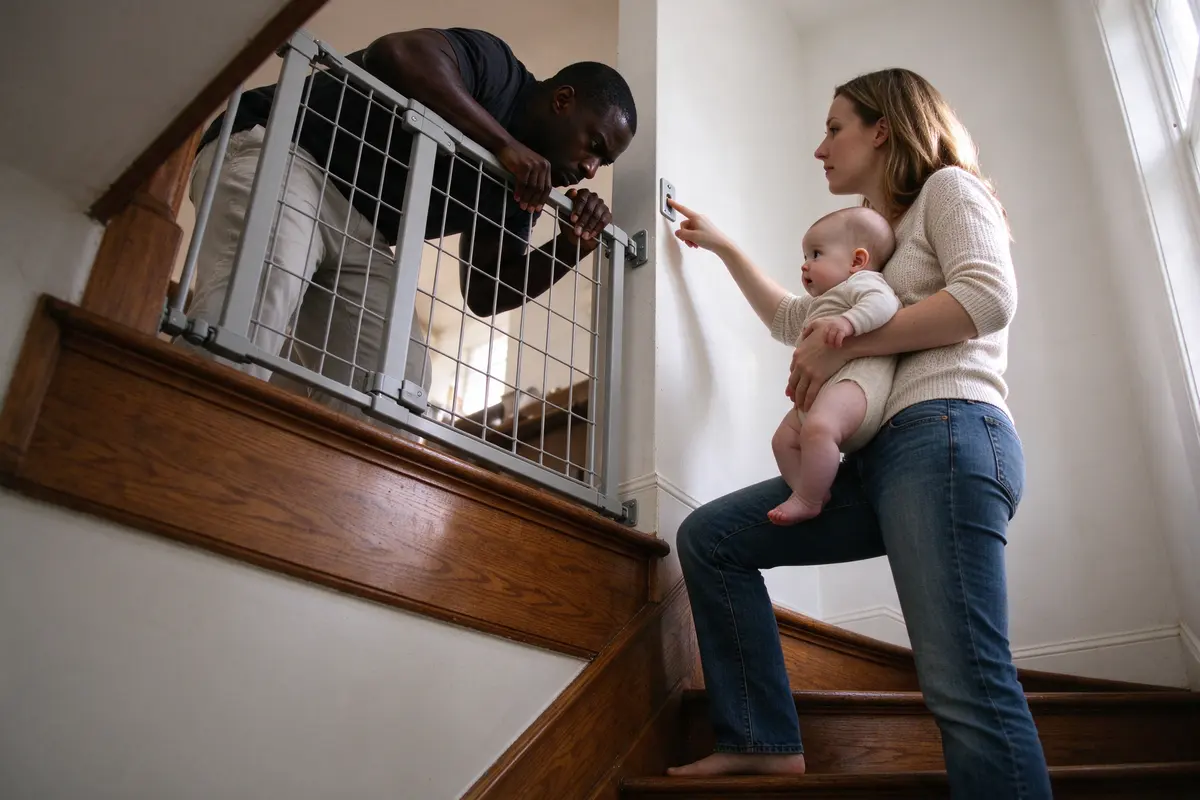
The gate check
Time: 20 minutes, with a screwdriver · Childproof at crawling height in the guide
Stand at the top of the stairs. If there's no gate, that's today's purchase: a hardware-mounted gate screwed into the studs (AAP).
If there is a gate, push on it hard with both hands, top and bottom, and shake it. If it moves at the wall, re-screw it into the stud today.
Look at the gate's shape. An accordion-style gate with V-shaped or diamond openings comes down and gets replaced (AAP).
Do the same at the bottom, then check the floor your baby plays on at their height: outlets plugged, cords up, nothing between the cushions (AAP).
Make it work:Latch the gate behind you every time, starting today, so the habit is older than the crawling.
Watch for
Normal
a baby who rocks on hands and knees and goes backward, or scoots on their bottom and never crawls; 4.3% of healthy children never crawl on hands and knees (WHO Multicentre Growth Reference Study Group, 2006).
Talk with your pediatrician
if your baby uses one arm or leg much more than the other, or doesn't seem to be moving normally (AAP).
Normal
a baby who gets stuck on the first step and cries for rescue.
Call your pediatrician
for any head injury in a baby under 1; call 911 for a seizure or if your baby was knocked out for more than a minute (AAP).
Normal
the gate's bars mouthed and rattled every time you walk by.
Call 911
if your baby is choking and can't breathe, cry, or make noise, turns bluish, or goes limp, and start back blows and chest thrusts while someone calls (AAP).
Normal
knowing this baby better than anyone alive.
Call anyway
if your baby just doesn't seem right to you. Trust your instincts; two hundred and thirty days have built them (Lurie Children's).
For you
One room a day. The AAP's home safety list is long enough to swallow a weekend (AAP), and the way to finish it is to refuse to do it all at once. Today was the stairs; tomorrow the living room, the day after the bathroom. Sit on the floor of each room for five minutes at your baby's eye level and write down only what you can see from there. That's the list for that room, and it's shorter than you fear.
If you're the partner: the screwdriver jobs are yours this week, and the gate at the top of the stairs is first. Tomorrow's note is the furniture; the straps for the bookcase and dresser are the same errand as the gate (AAP). Buy both today.
Sources
- American Academy of Pediatrics. "Movement Milestones in Babies 8 to 12 Months Old." HealthyChildren.org, updated 2021. https://www.healthychildren.org/English/ages-stages/baby/Pages/Movement-8-to-12-Months.aspx
- Kretch KS, Willett SL, Hsu LY, et al. "'Learn the Signs. Act Early.': Updates and Implications for Physical Therapists." Pediatric Physical Therapy, 2022. https://pubmed.ncbi.nlm.nih.gov/35876833/
- WHO Multicentre Growth Reference Study Group. "WHO Motor Development Study: windows of achievement for six gross motor development milestones." Acta Paediatrica Supplement, 2006. https://pubmed.ncbi.nlm.nih.gov/16817682/
- American Academy of Pediatrics. "Home Safety: Tips for Families With Young Children." HealthyChildren.org, updated 2022. https://www.healthychildren.org/English/safety-prevention/at-home/Pages/Home-Safety-Heres-How.aspx
- US Consumer Product Safety Commission. "Window Covering Cords." Accessed 2026. https://www.cpsc.gov/gocordless
- Bradin S. "Choking Prevention for Babies & Children: What Every Parent Needs to Know." HealthyChildren.org, updated 2026. https://www.healthychildren.org/English/health-issues/injuries-emergencies/Pages/Choking-Prevention.aspx
- American Academy of Pediatrics. "Baby Walkers: A Dangerous Choice." HealthyChildren.org, updated 2022. https://www.healthychildren.org/English/safety-prevention/at-home/Pages/Baby-Walkers-A-Dangerous-Choice.aspx
- Adolph KE, Cole WG, Komati M, et al. "How do you learn to walk? Thousands of steps and dozens of falls per day." Psychological Science, 2012. https://pubmed.ncbi.nlm.nih.gov/23085640/
- American Academy of Pediatrics. "Head Injury" (symptom checker). HealthyChildren.org, accessed 2026. https://www.healthychildren.org/English/tips-tools/symptom-checker/Pages/symptomviewer.aspx?symptom=Head+Injury
- Latimer T. "When to Call the Pediatrician for Your Newborn." Lurie Children's Hospital of Chicago, 2022. https://www.luriechildrens.org/en/blog/when-to-call-the-pediatrician-for-your-newborn/
This guide is general education that summarizes published research and guidance from groups like the American Academy of Pediatrics, the CDC, and the WHO. It isn’t medical advice, and every child develops on their own timeline. Your pediatrician knows your child; if something feels wrong, call them. In an emergency, call 911.
Get each day’s note the morning it applies
Add your baby to a free Chorevia household with their date of birth, and every morning for 300 days the day’s note arrives in the app and by email: what’s developing, one thing to try, what to watch for, and a word for you.
Create your household