Day 229 of 300 · Week 31
Night feeds: ask first
Last reviewed · 4 min read · 7 sources · Plain-text version
Many babies this age don't need to eat at night and some still do. The AAP's line on formula after 2 to 4 months, why growth comes first, and the one question to write down for the 9-month visit.
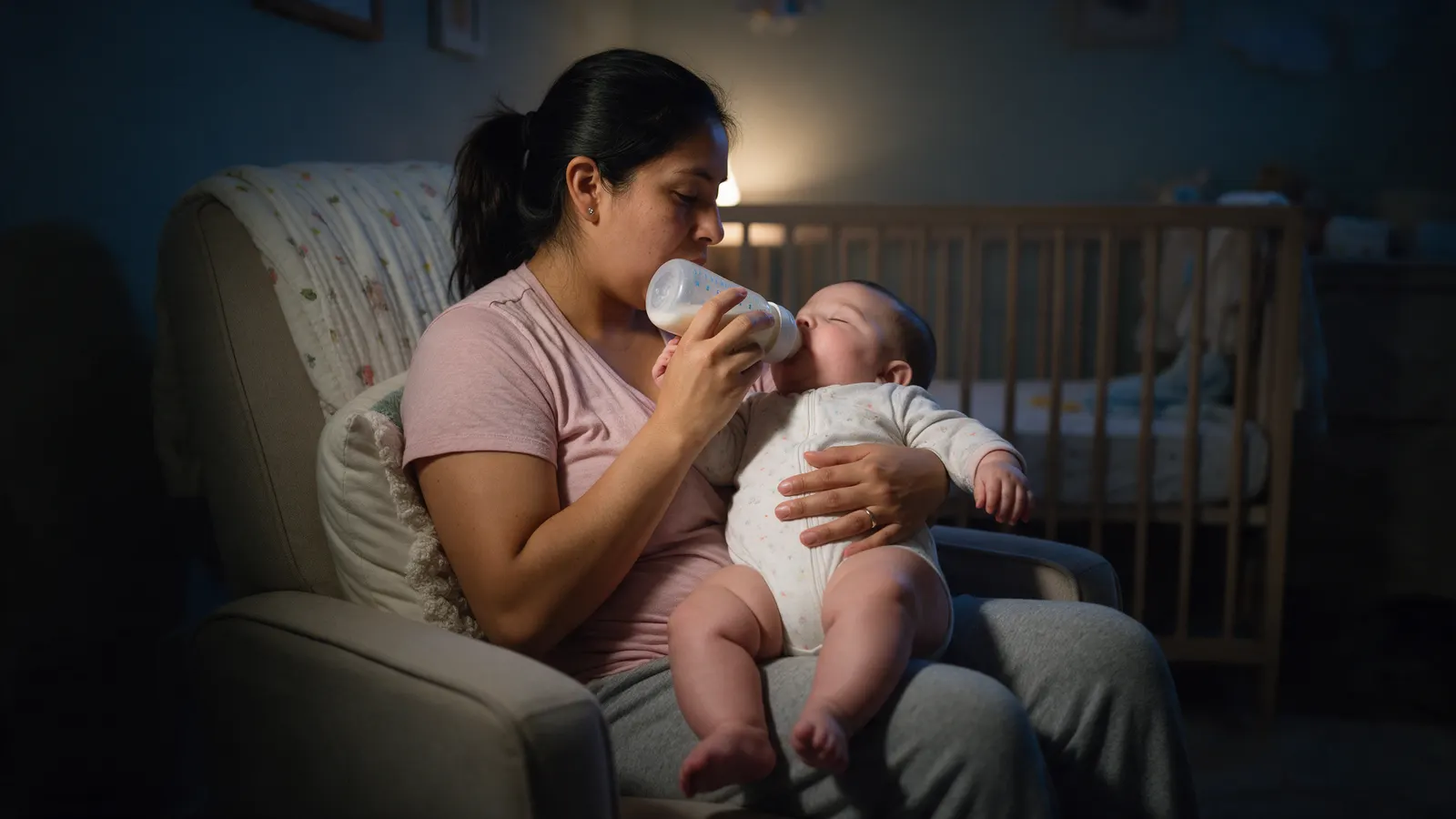
Yesterday was the waking that's about company. Today is the waking that might be about hunger, and the honest answer is that you ask before you decide.
Heart
Many babies this age don't need to eat at night, but some still do, so ask your pediatrician before cutting night feeds (AAP). The AAP's line for bottles is that most formula-fed babies no longer need a middle-of-the-night feeding after 2 to 4 months (AAP); "most" is not "all," and the people who know which group your baby is in have a growth chart. A thirty-one-week-old who takes a full feed at 3 a.m. may need it, or may have learned that 3 a.m. comes with a bottle. From the outside, those look the same.
Head
The reason to ask first is in the order of the checks. Check with your pediatrician before dropping night feeds if your baby isn't growing and gaining weight steadily (AAP). Growth comes before sleep. On the other side, night waking at this age is often caused by separation anxiety, and cuddling, feeding, or talking at every waking can prompt your baby to wake for that attention (Nemours KidsHealth). So the question for the 9-month visit has two halves: is my baby growing well, and if so, does the 3 a.m. feed still need to happen?
Body
Whatever the answer, two rules hold. Breast milk or formula is still the main drink, with 4 to 8 ounces of water a day alongside the solids (Muth, AAP), so a night feed that stays is a real feed, held in your arms, not a bottle propped in the crib. And never put your baby to bed with a bottle; sugary residue left in the mouth overnight promotes tooth decay (AAP). The guide's common question is Should my 9-month-old still wake up to eat at night?, and the visit it points to is next month's.
Try today
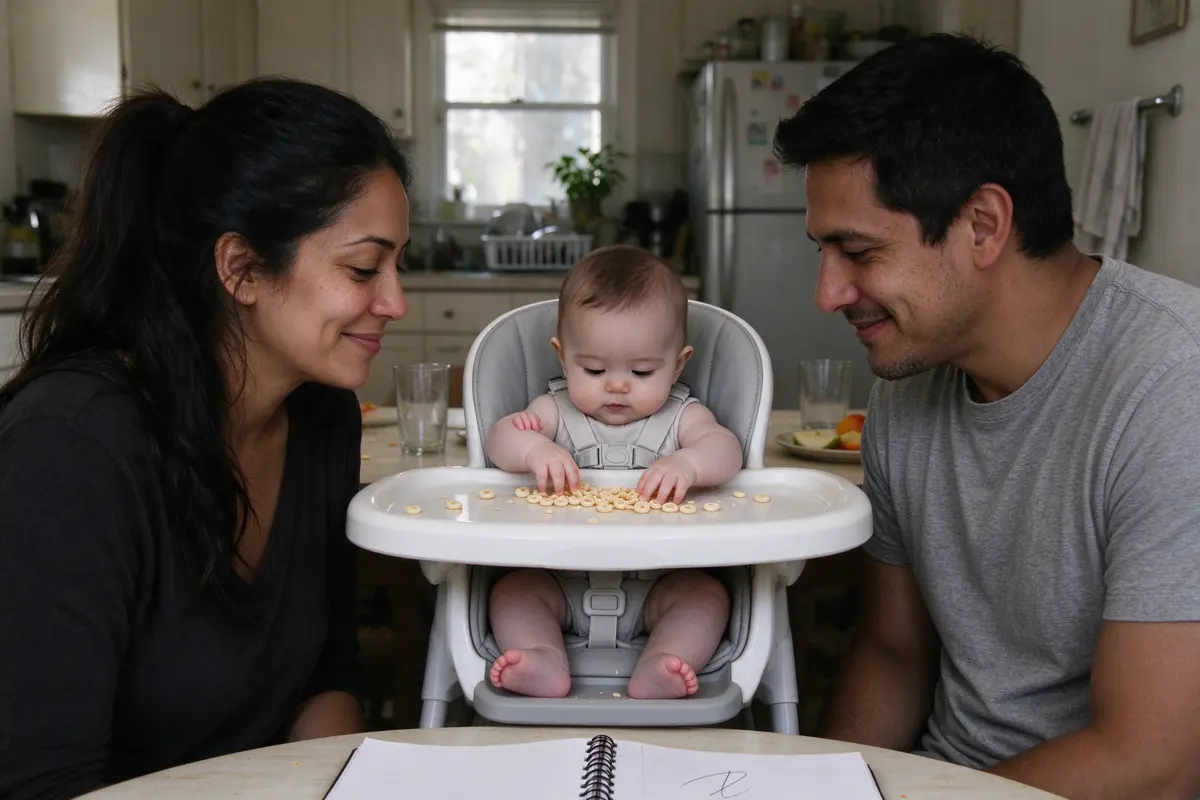
The night-feed question
Time: 5 minutes with a pen, in daylight
Write down what the last three nights actually looked like: when your baby woke, whether they fed, how much, and whether they went back down.
Under it, write the question in one line for the 9-month visit: "Is my baby growing well enough to drop the night feed, and if so, how?" (AAP)
Add the line you'd want checked first, so the visit starts there: weight and length against the chart, before any plan (AAP).
Put the page where the checkup list lives. If the visit is weeks away and the nights are hard, call the office with the question now.
Make it work:Until you've asked, keep feeding the baby who wakes hungry. "Ask first" means the feed stays until the answer comes.
Watch for
Normal
a full feed at 3 a.m. and a baby who sleeps till morning after it (AAP).
Talk with your pediatrician
before changing anything if your baby isn't growing and gaining weight steadily (AAP).
Normal
a wake that settles with a hand and no bottle, in a baby who ate well all day (Nemours KidsHealth).
Call your pediatrician right away
if your baby seems dehydrated: no urine in more than 8 hours, dark urine, a very dry mouth, or no tears (AAP).
Normal
a baby who falls asleep on the bottle in your arms and is moved to the bare crib on their back (Moon, AAP).
Call your pediatrician right away
if your baby has great trouble swallowing fluids or spit, or looks or acts very sick (AAP).
For you
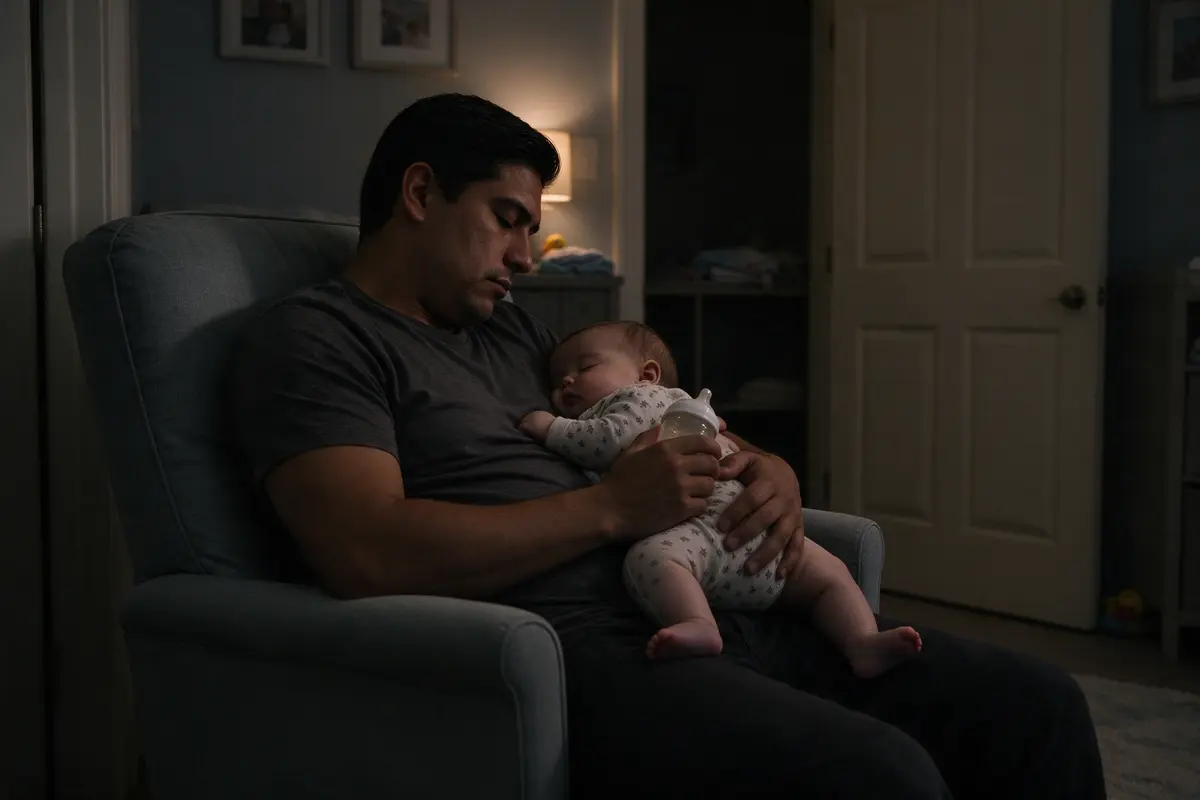
The question is allowed. Someone this month will imply that a baby still feeding at night is a parent who hasn't been firm enough, and the AAP's own page says the opposite: some babies this age still need to eat at night, and the way to find out is to ask (AAP). You're not asking permission to stop; you're asking whether stopping is right for this baby.
If you're breastfeeding, the night feed is also yours to count. Parents' sleep is at its shortest in the first 3 months after birth and improves from there (Richter et al., 2019), but "improves" is slow when one person does every night. Put that in the notebook too.
If you're the partner: if the answer is "keep the feed," then the feed can be yours on alternate nights, with pumped milk or formula, and she gets a door that stays closed.
Sources
- American Academy of Pediatrics. "Sleeping Through the Night." HealthyChildren.org, updated 2013. https://www.healthychildren.org/English/ages-stages/baby/sleep/Pages/Sleeping-Through-the-Night.aspx
- American Academy of Pediatrics. "Amount and Schedule of Baby Formula Feedings." HealthyChildren.org, updated 2022. https://www.healthychildren.org/English/ages-stages/baby/formula-feeding/Pages/amount-and-schedule-of-formula-feedings.aspx
- Nemours KidsHealth. "Baby Sleep: 8- to 12-Month-Olds." Reviewed 2025. https://kidshealth.org/en/parents/sleep812m.html
- Muth ND. "Recommended Drinks for Children Age 5 & Younger." HealthyChildren.org, updated 2023. https://www.healthychildren.org/English/healthy-living/nutrition/Pages/Recommended-Drinks-for-Young-Children-Ages-0-5.aspx
- American Academy of Pediatrics. "Fever" (symptom checker). HealthyChildren.org, accessed 2026. https://www.healthychildren.org/English/tips-tools/symptom-checker/Pages/symptomviewer.aspx?symptom=Fever
- Moon RY. "How to Keep Your Sleeping Baby Safe: AAP Policy Explained." HealthyChildren.org, updated 2026. https://www.healthychildren.org/English/ages-stages/baby/sleep/Pages/a-parents-guide-to-safe-sleep.aspx
- Richter D, Krämer MD, Tang NKY, Montgomery-Downs HE, Lemola S. "Long-term effects of pregnancy and childbirth on sleep satisfaction and duration of first-time and experienced mothers and fathers." Sleep, 2019. https://pubmed.ncbi.nlm.nih.gov/30649536/
This guide is general education that summarizes published research and guidance from groups like the American Academy of Pediatrics, the CDC, and the WHO. It isn’t medical advice, and every child develops on their own timeline. Your pediatrician knows your child; if something feels wrong, call them. In an emergency, call 911.
Get each day’s note the morning it applies
Add your baby to a free Chorevia household with their date of birth, and every morning for 300 days the day’s note arrives in the app and by email: what’s developing, one thing to try, what to watch for, and a word for you.
Create your household