Day 238 of 300 · Week 32
The urge to help
Last reviewed · 3 min read · 7 sources · Plain-text version
Chores are a year away, but the urge is starting: 12-month-olds point to help an adult find a lost object, and 18-month-olds help for nothing. Pass a toy, ask for a sock, say thank you.

It's too early for chores. It isn't too early for the thing chores grow out of, and you can watch it start.
Heart
In experiments, 12-month-olds pointed to show an adult where a lost object was, and did it more often when the adult hadn't seen where it went (Liszkowski et al., 2008). By 18 months, toddlers readily help adults reach their goals, with nothing in it for them (Warneken & Tomasello, 2006). Those are 12- and 18-month-olds; your baby is seven months and a few weeks. But the pieces are arriving: by 9 months, most babies move things from one hand to the other and lift their arms to be picked up (CDC), which is a request, answered.
Head
What the guide suggests for now is small. Pass a toy back and forth (CDC); ask your baby to hand you a sock or drop a block in the bin, and say a warm thank-you. Hand over a cup, a spoon, or a hairbrush and be an enthusiastic audience when your baby copies you, because "things have uses" is one of the big ideas of this stage (AAP). Letting go on purpose comes before any of it; once they can, dropping and throwing become favorite games (AAP). Today's hand-off may end with the sock in the mouth. That's the right answer for the age.
Body
The laundry is the best setup you own: soft, big, and already on the floor. A sock is too large to swallow and fine to gum. The thank-you is the part to practice, because it's the part that lasts; the helping games at this age haven't been studied, but turn-taking is what CDC suggests (CDC), and the turn you're teaching is: you give, I thank, I give back.
Try today
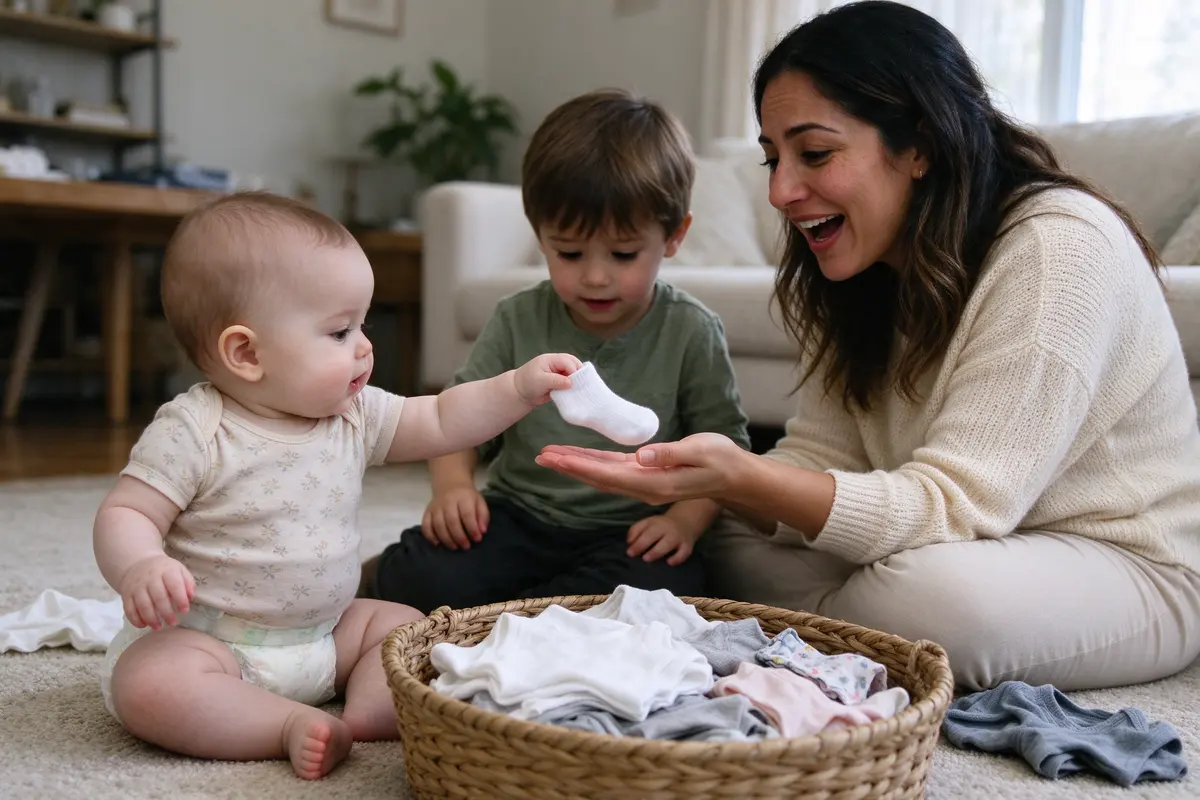
The sock hand-off
Time: 5 minutes beside the laundry basket · Hand it to me in the guide
Sit on the floor with the basket, your baby sitting in front of you, and hand them a clean sock.
Hold out your open hand and ask, "Can I have the sock?"
If it comes back, say "Thank you!" with your whole face, and hand it right back (Liszkowski et al., 2008).
If it goes to the mouth instead, let it, then try once more with a second sock; passing hand to hand is the skill underneath (CDC).
Drop one into the basket yourself and say "In!"; stop when they lose interest.
Make it work:An older sibling makes the best demonstrator; have them hand you a sock first and get the same thank-you.
Watch for
Normal
a sock that goes to the mouth instead of to you; everything still does (AAP).
Talk with your pediatrician
if your baby uses one arm or leg much more than the other (AAP).
Normal
a grip that won't let go; letting go on purpose comes later in this stage (AAP).
Call your pediatrician right away
if your baby won't move an arm or leg normally (AAP).
Normal
arms up the moment you kneel down, before you've said a word (CDC).
Bring it up
if your baby has lost skills they used to have (CDC).
For you
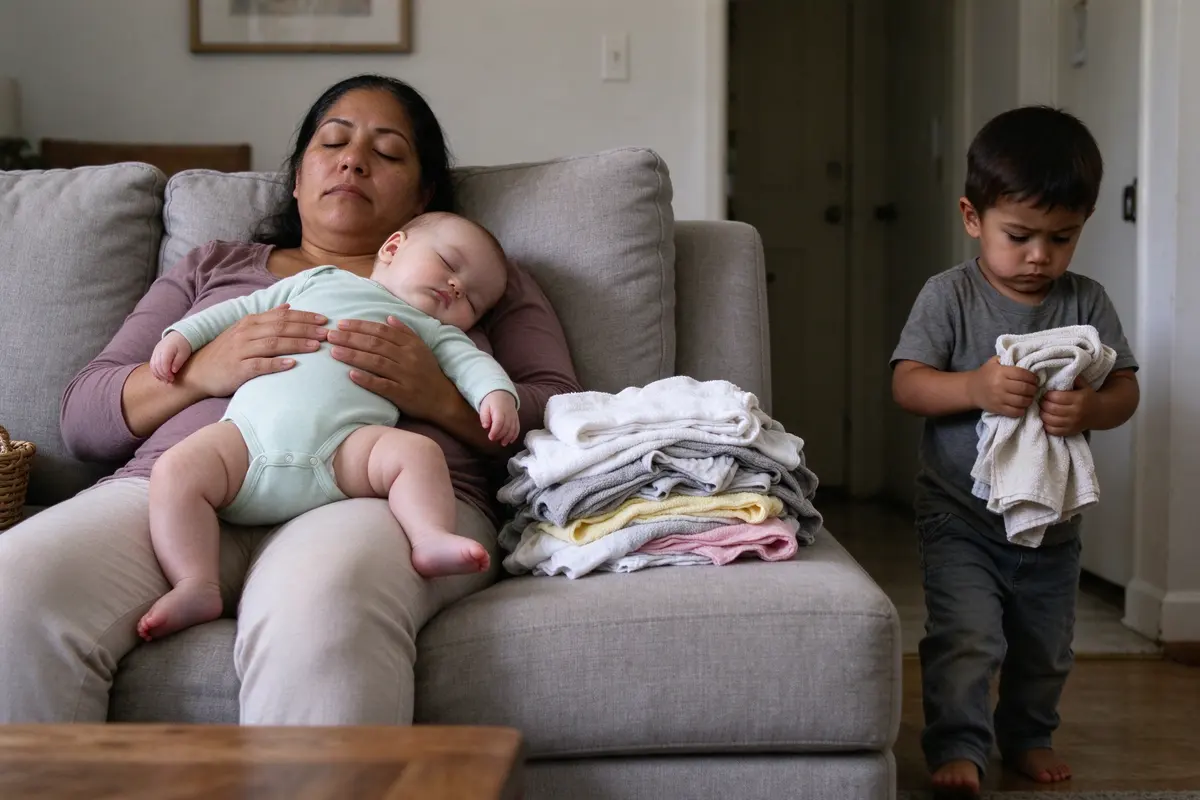
Chorevia's family jobs start at a year, and this is the seed. The toddlers who helped in the lab at 18 months did it with nothing in it for them (Warneken & Tomasello, 2006); the thank-you you practiced today isn't a reward, it's the turn. Nothing you did this afternoon has to be repeated on a schedule. It's the same serve-and-return you've run since the first month, pointed at a sock.
If you're the partner: fold the laundry on the floor tonight with the baby beside you, and ask for one sock.
Sources
- Liszkowski U, Carpenter M, Tomasello M. "Twelve-month-olds communicate helpfully and appropriately for knowledgeable and ignorant partners." Cognition, 2008. https://pubmed.ncbi.nlm.nih.gov/18721918/
- Warneken F, Tomasello M. "Altruistic helping in human infants and young chimpanzees." Science, 2006. https://pubmed.ncbi.nlm.nih.gov/16513986/
- Centers for Disease Control and Prevention. "Milestones by 9 Months." Learn the Signs. Act Early. program, updated 2026. https://www.cdc.gov/act-early/milestones/9-months.html
- American Academy of Pediatrics. "Cognitive Development in Infants: 8 to 12 Months." HealthyChildren.org, updated 2023. https://www.healthychildren.org/English/ages-stages/baby/Pages/Cognitive-Development-8-to-12-Months.aspx
- American Academy of Pediatrics. "Hand and Finger Skills." HealthyChildren.org, updated 2009. https://www.healthychildren.org/English/ages-stages/baby/Pages/Hand-and-Finger-Skills.aspx
- American Academy of Pediatrics. "Movement Milestones in Babies 8 to 12 Months Old." HealthyChildren.org, updated 2021. https://www.healthychildren.org/English/ages-stages/baby/Pages/Movement-8-to-12-Months.aspx
- American Academy of Pediatrics. "Fever" (symptom checker). HealthyChildren.org, accessed 2026. https://www.healthychildren.org/English/tips-tools/symptom-checker/Pages/symptomviewer.aspx?symptom=Fever
This guide is general education that summarizes published research and guidance from groups like the American Academy of Pediatrics, the CDC, and the WHO. It isn’t medical advice, and every child develops on their own timeline. Your pediatrician knows your child; if something feels wrong, call them. In an emergency, call 911.
Get each day’s note the morning it applies
Add your baby to a free Chorevia household with their date of birth, and every morning for 300 days the day’s note arrives in the app and by email: what’s developing, one thing to try, what to watch for, and a word for you.
Create your household