Day 152 of 300 · Week 21
Rolling both ways
Last reviewed · 3 min read · 11 sources · Plain-text version
Rocking, kicking, and swimming lead to rolling, tummy to back first for most. What the range looks like, what rolling changes about sleep, and a toy placed just past the shoulder to tempt a roll.

The rocking and kicking you've been watching is a rehearsal. Today is about the roll it leads to, and the one sleep rule it changes.
Heart
Around 5 months, babies often rock on their tummy, kick, and "swim" with their arms, warming up for rolling. By about 7 months, many roll both ways, usually tummy to back first, though back to tummy first is normal too (AAP). Rolling tummy to back is on CDC's 6-month list (CDC). The ranges for these big moves are wide: in a WHO study of 816 children in five countries, almost all healthy babies first sat alone somewhere between 3.8 and 9.2 months (WHO Multicentre Growth Reference Study Group, 2006). A baby who rolled at four months and one who rolls at seven are both on time.
Head
Rolling changes one sleep rule and leaves the rest alone. Always start your baby on their back, in your room but not your bed, on a firm, flat surface with only a fitted sheet; but once they roll both ways comfortably, you don't need to flip them back (AAP). Until then, turn them back. Swaddling ends the moment they try to roll, if it hasn't already, and a pacifier never hangs around the neck or clips to clothing for sleep (AAP).
Body
Floor time is what feeds the roll. A systematic review of 16 mostly observational studies linked tummy time to better gross motor development, including rolling (Hewitt et al., 2020). In a study of 351 babies, back sleepers rolled tummy to back later than tummy sleepers, though all were within the normal range (Davis et al., 1998); back sleeping stays, and awake tummy time makes up the difference. The AAP suggests a toy just out of reach as the lure (AAP).
Try today
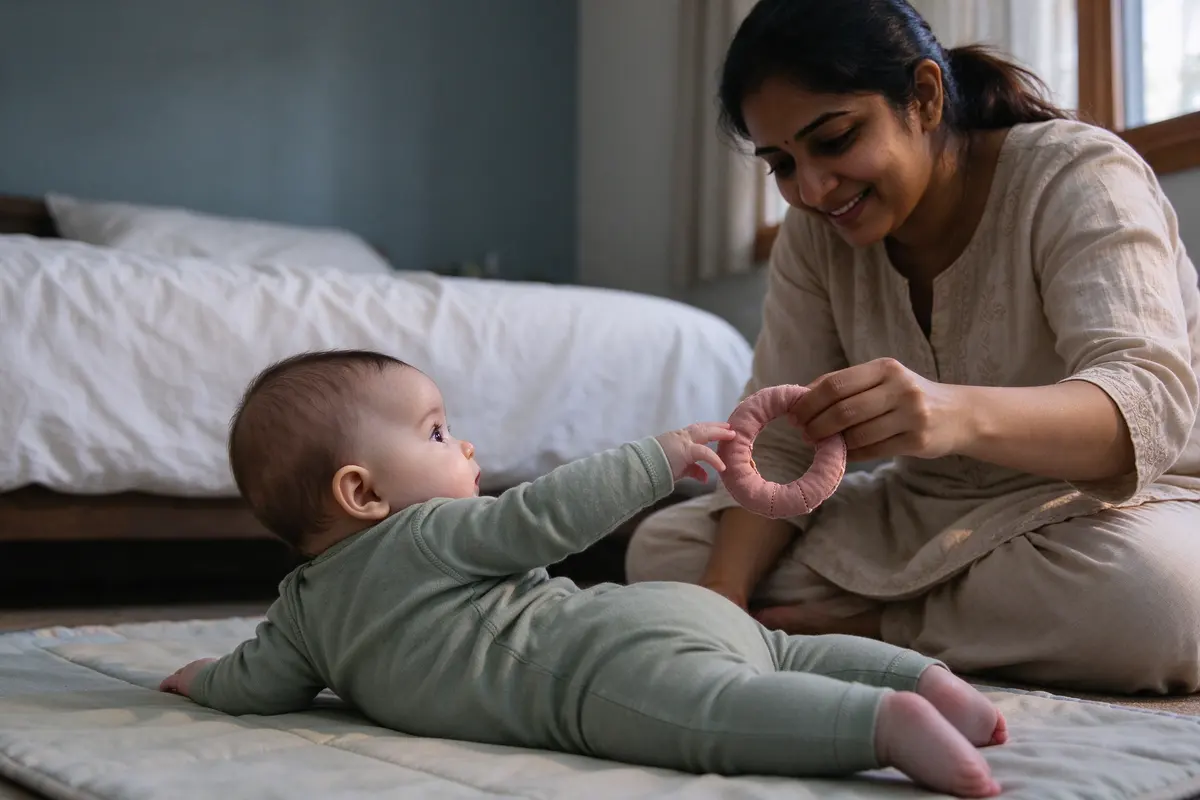
The roll-back toy
Time: 2 to 3 minutes, a few times today · Rolling and sitting in the guide
Lay your baby on their tummy on a blanket on the floor, and let them push up.
Hold a toy where they can see it, then move it slowly past one shoulder and set it on the floor just behind them.
Wait. Looking back over the shoulder shifts their weight; many babies tip onto their side, then their back (AAP).
Give them the toy whether they rolled or not, then try the other side.
Make it work:No pushing or pulling; the roll is theirs or it's nothing. A baby who only pivots today is doing the same work.
Watch for
Normal
a first roll in the crib, and finding your baby on their side or tummy after you laid them on their back.
Turn them back and ask your pediatrician
what to do next if your baby rolls one way but can't roll back yet (Moon, AAP).
Normal
pivoting in a circle on the mat without going anywhere.
Talk with your pediatrician
if your baby doesn't roll in either direction by 5 months (AAP).
Normal
a half-roll on the changing mat the second you reach for a wipe.
Call your pediatrician right away
after any head injury in a baby under 1, including a fall from a bed, couch, or changing table, even if your baby seems fine, and call 911 for a seizure afterward (AAP).
For you
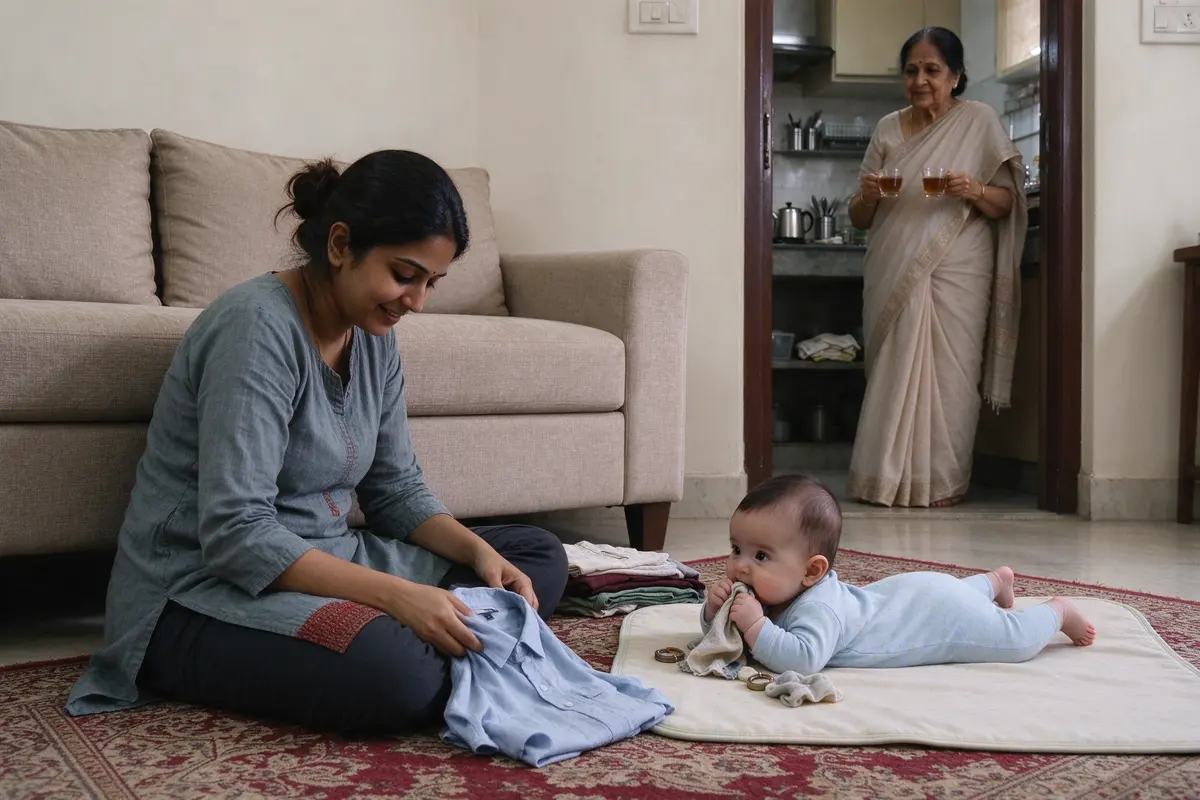
The floor is the safest place in the house now, and that is a relief, not a demotion. Don't leave your baby alone on a bed, sofa, or changing table, even for a second, and keep bouncy seats and car seats on the floor, not on a table or counter (NHS). Among young children hospitalized for furniture falls in one study, a third fell from beds (Pomerantz et al., 2012). So the diaper goes on the floor mat, the phone call happens with the baby on the floor mat, and you stop having to remember where you set them down. There is nowhere to fall from.
If you're the partner: the rule is the same for you, and for anyone who babysits. "Floor or arms" is the whole policy.
Sources
- American Academy of Pediatrics. "Movement Milestones: Babies 4 to 7 Months." HealthyChildren.org, updated 2021. https://www.healthychildren.org/English/ages-stages/baby/Pages/Movement-4-to-7-Months.aspx
- Centers for Disease Control and Prevention. "Milestones by 6 Months." Learn the Signs. Act Early. program, updated 2026. https://www.cdc.gov/act-early/milestones/6-months.html
- WHO Multicentre Growth Reference Study Group. "WHO Motor Development Study: windows of achievement for six gross motor development milestones." Acta Paediatrica Supplement, 2006. https://pubmed.ncbi.nlm.nih.gov/16817682/
- Moon RY. "How to Keep Your Sleeping Baby Safe: AAP Policy Explained." HealthyChildren.org, updated 2026. https://www.healthychildren.org/English/ages-stages/baby/sleep/Pages/a-parents-guide-to-safe-sleep.aspx
- Hewitt L, Kerr E, Stanley RM, Okely AD. "Tummy Time and Infant Health Outcomes: A Systematic Review." Pediatrics, 2020. https://pubmed.ncbi.nlm.nih.gov/32371428/
- Davis BE, Moon RY, Sachs HC, Ottolini MC. "Effects of sleep position on infant motor development." Pediatrics, 1998. https://pubmed.ncbi.nlm.nih.gov/9794945/
- American Academy of Pediatrics. "Back to Sleep, Tummy to Play: Give Your Baby a Safe, Strong Start." HealthyChildren.org, updated 2026. https://www.healthychildren.org/English/ages-stages/baby/sleep/Pages/back-to-sleep-tummy-to-play.aspx
- American Academy of Pediatrics. "Developmental Milestones: 7 Months." HealthyChildren.org, updated 2009. https://www.healthychildren.org/English/ages-stages/baby/Pages/Developmental-Milestones-7-Months.aspx
- American Academy of Pediatrics. "Head Injury" (symptom checker). HealthyChildren.org, accessed 2026. https://www.healthychildren.org/English/tips-tools/symptom-checker/Pages/symptomviewer.aspx?symptom=Head+Injury
- National Health Service (UK). "Baby and toddler safety." Accessed 2026. https://www.nhs.uk/baby/first-aid-and-safety/safety/baby-and-toddler-safety/
- Pomerantz WJ, Gittelman MA, Hornung R, Husseinzadeh H. "Falls in children birth to 5 years: different mechanisms lead to different injuries." Journal of Trauma and Acute Care Surgery, 2012. https://pubmed.ncbi.nlm.nih.gov/23026963/
This guide is general education that summarizes published research and guidance from groups like the American Academy of Pediatrics, the CDC, and the WHO. It isn’t medical advice, and every child develops on their own timeline. Your pediatrician knows your child; if something feels wrong, call them. In an emergency, call 911.
Get each day’s note the morning it applies
Add your baby to a free Chorevia household with their date of birth, and every morning for 300 days the day’s note arrives in the app and by email: what’s developing, one thing to try, what to watch for, and a word for you.
Create your household