Day 158 of 300 · Week 22
The eczema question
Last reviewed · 4 min read · 11 sources · Plain-text version
If your baby has severe eczema or an egg allergy, the peanut question is for now, not for the 6-month visit. The LEAP numbers, the three NIAID groups, and one sentence to write down.

Most of this month's food questions can wait for the 6-month visit. One of them can't, and today is about telling which kind yours is.
Heart
The peanut evidence is unusually strong. The LEAP trial randomly assigned 640 babies 4 to 11 months old with severe eczema, egg allergy, or both to eat peanut regularly or avoid it until age 5. Among the 530 whose skin tests were negative at the start, 13.7% of avoiders had peanut allergy at age 5, versus 1.9% of eaters (Du Toit et al., 2015). The protection lasted: at age 12, 15.4% of the original avoiders were allergic, versus 4.4% of the eaters (Du Toit et al., 2024). For high-risk babies, the 4-to-6-month window matters, and your baby is in it.
Head
US guidelines sort babies into three groups (NIAID). Severe eczema, egg allergy, or both: start peanut as early as 4 to 6 months, after checking with your pediatrician, who may order a blood test or send you to an allergist first. Mild to moderate eczema: peanut around 6 months. No eczema or food allergy: introduce peanut freely at home along with other solids. "Severe" has a definition: eczema that persists or keeps coming back and needs frequent prescription-strength treatment despite regular moisturizing (Togias et al., 2017). A dry patch that clears with cream is not that. A rash that needs the prescription tube every week is.
Body
Two more lines belong in the same question. The AAP advises checking with your pediatrician first if your baby has ever had an immediate reaction to a food (AAP). And holding allergens back doesn't help anyone: the AAP finds no evidence that delaying allergenic foods past 4 to 6 months prevents allergy (Greer et al., 2019). The full plan is in the guide's allergen section; tomorrow covers the other two groups.
Try today
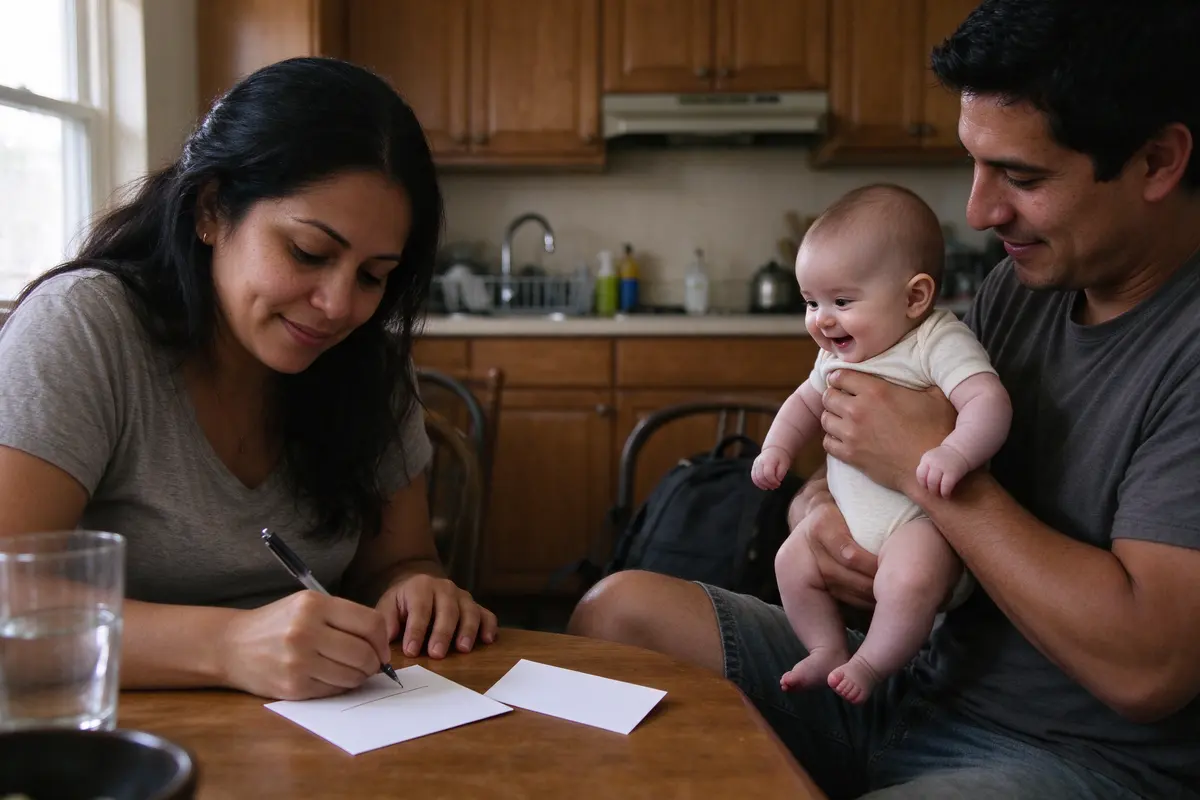
The allergen question, written down
Time: 5 minutes · Make an allergen plan now in the guide
Look at your baby's skin and your medicine cabinet. Does the eczema persist or keep coming back, and does it need frequent prescription-strength treatment despite regular moisturizing (Togias et al., 2017)?
Write one sentence on a card: "Which of the three groups is my baby in, and should peanut start before 6 months, with a test first or not?" (NIAID).
Add "and egg?" at the end; the 2021 consensus puts peanut and egg together (Fleischer et al., 2021).
If the answer to step 1 is yes, or your baby has an egg allergy, call the office today instead of saving the card for the visit (NIAID).
Make it work:Nothing goes in the mouth today. This is a question, not a first taste.
Watch for
Normal
dry, rough patches that settle with regular moisturizer.
Call your pediatrician now
to ask about peanut if your baby's eczema persists or keeps coming back and needs frequent prescription-strength treatment despite moisturizing, or if they have an egg allergy (NIAID; Togias et al., 2017).
Normal
a pink rash around the mouth and chin from drool (AAP).
Call your pediatrician right away
if your baby has had no urine in more than 8 hours, a very dry mouth, or no tears (AAP).
Normal
scratching at a patch during a change.
Go to the ER now
if your baby isn't alert when awake, or had a seizure with a fever (AAP).
For you
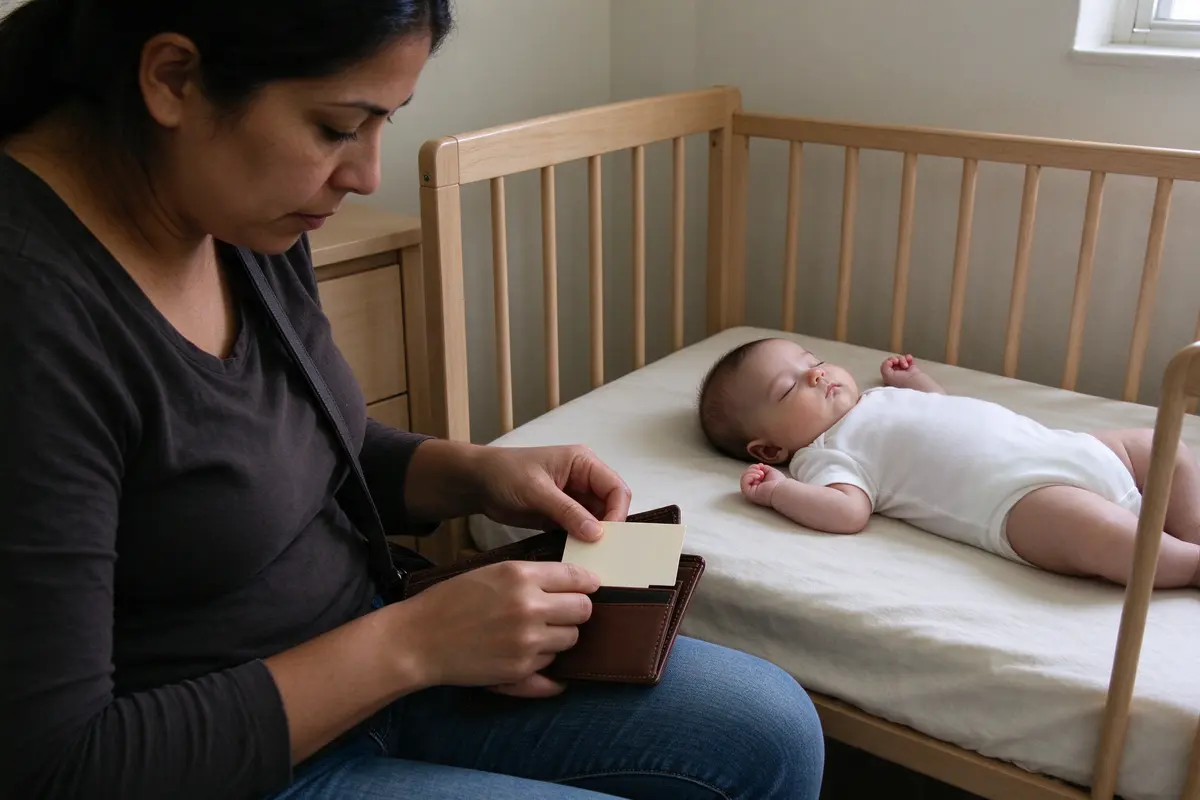
A question written down is a question that gets asked. In the room, with a baby on the table and a schedule behind the door, the thing you meant to raise is the first thing to go. The card in your wallet is the fix, and it has room for a second line about you: the pediatrician should ask how you're doing at the 6-month visit (Earls et al., 2019), and the checkup includes a check on how you're feeling (AAP). Write the honest answer under the peanut question now, while nobody is watching.
If you're the partner: carry a copy of the card. Two wallets, one question, twice the odds it gets asked.
Sources
- Du Toit G, Roberts G, Sayre PH, et al. "Randomized trial of peanut consumption in infants at risk for peanut allergy." New England Journal of Medicine, 2015. https://pubmed.ncbi.nlm.nih.gov/25705822/
- Du Toit G, Huffaker MF, Radulovic S, et al. "Follow-up to Adolescence after Early Peanut Introduction for Allergy Prevention." NEJM Evidence, 2024. https://pubmed.ncbi.nlm.nih.gov/38804779/
- National Institute of Allergy and Infectious Diseases. "Addendum Guidelines for the Prevention of Peanut Allergy in the United States: Summary for Parents and Caregivers." 2017. https://www.niaid.nih.gov/sites/default/files/peanut-allergy-prevention-guidelines-parent-summary.pdf
- Togias A, Cooper SF, Acebal ML, et al. "Addendum guidelines for the prevention of peanut allergy in the United States: Report of the National Institute of Allergy and Infectious Diseases-sponsored expert panel." Journal of Allergy and Clinical Immunology, 2017. https://www.niaid.nih.gov/sites/default/files/addendum-peanut-allergy-prevention-guidelines.pdf
- Cox A, Pistiner M. "When to Introduce Egg, Peanut Butter & Other Common Food Allergens to a Baby." HealthyChildren.org, updated 2025. https://www.healthychildren.org/English/healthy-living/nutrition/Pages/when-to-introduce-egg-peanut-butter-and-other-common-food-allergens-to-your-baby-food-allergy-prevention-tips.aspx
- Greer FR, Sicherer SH, Burks AW; AAP Committee on Nutrition, Section on Allergy and Immunology. "The Effects of Early Nutritional Interventions on the Development of Atopic Disease in Infants and Children." Pediatrics, 2019. https://pubmed.ncbi.nlm.nih.gov/30886111/
- Fleischer DM, Chan ES, Venter C, et al. "A Consensus Approach to the Primary Prevention of Food Allergy Through Nutrition." Journal of Allergy and Clinical Immunology: In Practice, 2021. https://pubmed.ncbi.nlm.nih.gov/33250376/
- American Academy of Pediatrics Section on Oral Health. "Teething Pain Relief: How to Soothe Your Baby's Discomfort." HealthyChildren.org, updated 2025. https://www.healthychildren.org/English/ages-stages/baby/teething-tooth-care/Pages/Teething-Pain.aspx
- American Academy of Pediatrics. "Fever" (symptom checker). HealthyChildren.org, accessed 2026. https://www.healthychildren.org/English/tips-tools/symptom-checker/Pages/symptomviewer.aspx?symptom=Fever
- Earls MF, Yogman MW, Mattson G, Rafferty J; AAP Committee on Psychosocial Aspects of Child and Family Health. "Incorporating Recognition and Management of Perinatal Depression Into Pediatric Practice." Pediatrics, 2019. https://pubmed.ncbi.nlm.nih.gov/30559120/
- American Academy of Pediatrics. "Checkup Checklist: 6 Months Old." HealthyChildren.org, updated 2023. https://www.healthychildren.org/English/ages-stages/Your-Childs-Checkups/Pages/Your-Checkup-Checklist-6-Months-Old.aspx
This guide is general education that summarizes published research and guidance from groups like the American Academy of Pediatrics, the CDC, and the WHO. It isn’t medical advice, and every child develops on their own timeline. Your pediatrician knows your child; if something feels wrong, call them. In an emergency, call 911.
Get each day’s note the morning it applies
Add your baby to a free Chorevia household with their date of birth, and every morning for 300 days the day’s note arrives in the app and by email: what’s developing, one thing to try, what to watch for, and a word for you.
Create your household