Day 180 of 300 · Six months
Six months
Last reviewed · 4 min read · 16 sources · Plain-text version
Half a year. What the next guide holds, first bites, gagging versus choking, the sleep-training research, and where the daily notes continue. Record the sit, then rest.

One hundred and eighty days. Today is the last note of this series and the first look at the next.
Heart
The next guide picks up where this month leaves off. The AAP recommends only breast milk for about the first 6 months, and the first spoonfuls, gagging versus choking, and what to put on the spoon are in the 6-month guide (AAP). So is the sleep-training research, for families who want it; in sleep diaries, half of 5-month-olds slept 10 p.m. to 6 a.m. without a parent and half didn't, and both patterns are normal (Henderson et al., 2010). When your baby is ready to start, the readiness signs haven't changed: sitting with support, good head control, opening for the spoon, and swallowing rather than pushing food out (CDC).
Head
What's coming, held loosely. Strings like "babababa" at 7 to 9 months, and looking up when you say their name in the same window (ASHA). Many babies roll both ways by about 7 months and stay upright in a sit by 6 to 8 (AAP). Stranger anxiety usually arrives at 7 to 12 months (AAP), so the baby who smiles at everyone now may hide in your neck next month; that's growth, not a step back. The daily notes continue at the seventh month.
Body
The half-year is also a line on the safety rules. Ibuprofen is only for babies over 6 months, and acetaminophen on a rough teething night is still a weight-based dose you ask your pediatrician about (AAP). Teething still doesn't cause a true fever (Massignan et al., 2016). And the floor is still the best gear you own: the WHO advises plenty of floor play and no more than 1 hour at a time strapped into a seat or carrier (WHO). Record today's sit from down there.
Try today
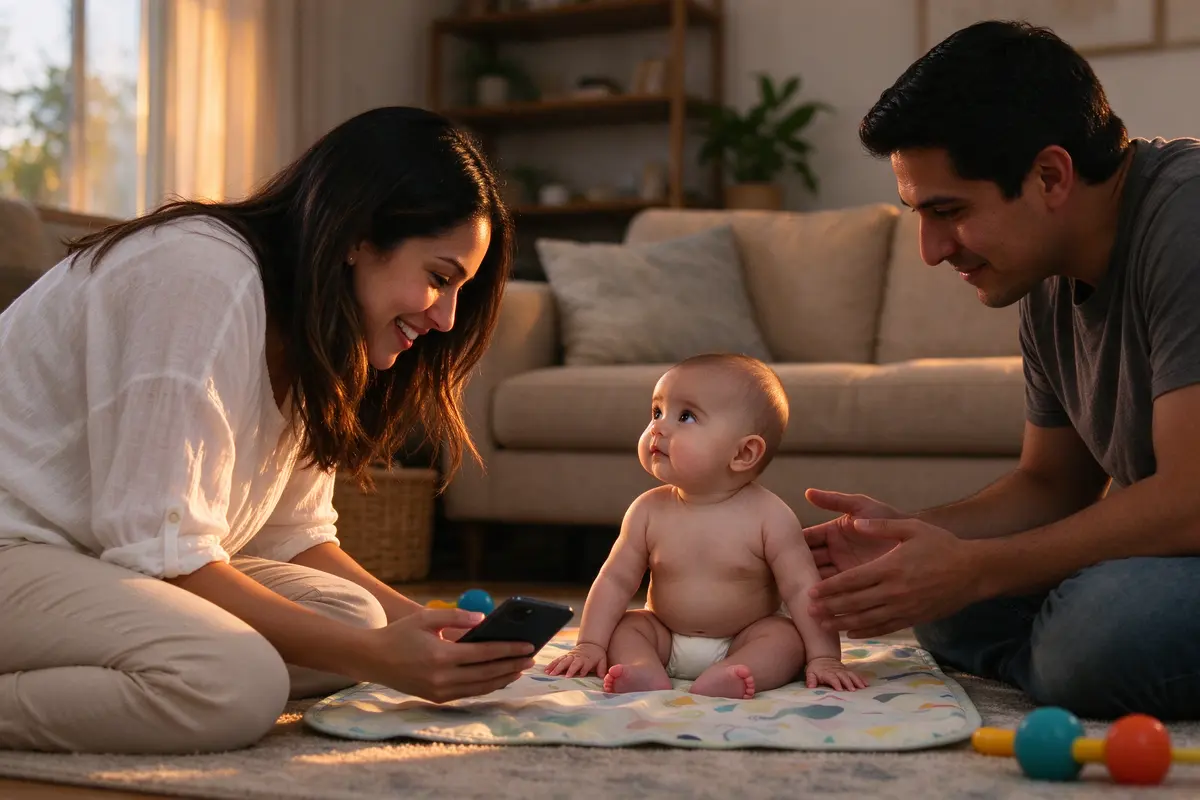
The sitting-up video
Time: 5 minutes · Rolling and sitting in the guide
Lay a blanket on the floor and set your baby in a tripod sit, both hands down, or on their tummy pushing up, with your hands an inch away.
Film from the floor, at their eye level, sideways so the whole body is in frame.
Say the date and their name out loud on the recording, then wait for the squeal or the topple.
Save it with the first-roll video, and send both to someone who has watched these six months with you.
Make it work:Film the attempt, not the achievement. Six months from now the wobble is the part you'll want.
Watch for
Normal
a sit that lasts ten seconds and ends face-first in the blanket.
Call your pediatrician
if your baby doesn't push up on their arms, hold their head steady, or bring hands to mouth, skills most babies have by 4 months (CDC).
Normal
a baby who takes no interest in food at the table yet, or who lunges for your plate.
Call 911
if your baby ever has swelling of the lips, face, or tongue, widespread hives, wheezing, or trouble breathing after a food (NIAID).
Normal
two naps, 3 to 4 hours of daytime sleep in all, and a brief wake or two at night (Nemours KidsHealth).
Call your pediatrician right away
if your baby has cried nonstop for more than 2 hours, or you're afraid someone might hurt or shake them (AAP).
Normal
knowing this baby better than anyone alive.
Call anyway
if your baby just doesn't seem right to you. Trust your instincts; six months have trained them (Lurie Children's).
For you

Half a year of this, done. One hundred and eighty mornings, each one answered. Nobody hands out the certificate; this is it.
Once more, lightly. Feelings that are severe or last longer than 2 weeks may be postpartum depression, and it responds to treatment (NIMH). The National Maternal Mental Health Hotline is 1-833-TLC-MAMA (1-833-852-6262), call or text, and 988 is for anyone (CDC). Put both in the phone next to Poison Help.
If you're the partner: you did it too. Say one thing she did this month that you noticed, and let her say one back. Then read what's next together: the 6-month guide.
Sources
- American Academy of Pediatrics. "When Can Babies Start Solid Foods? Readiness & Feeding Tips." HealthyChildren.org, 2026. https://www.healthychildren.org/English/ages-stages/baby/feeding-nutrition/Pages/Starting-Solid-Foods.aspx
- Henderson JM, France KG, Owens JL, Blampied NM. "Sleeping through the night: the consolidation of self-regulated sleep across the first year of life." Pediatrics, 2010. https://pubmed.ncbi.nlm.nih.gov/20974775/
- Centers for Disease Control and Prevention. "When, What, and How to Introduce Solid Foods." 2026. https://www.cdc.gov/infant-toddler-nutrition/foods-and-drinks/when-what-and-how-to-introduce-solid-foods.html
- American Speech-Language-Hearing Association. "Communication Milestones: Birth to 1 Year." Accessed 2026. https://www.asha.org/public/developmental-milestones/communication-milestones-birth-to-1-year/
- American Academy of Pediatrics. "Movement Milestones: Babies 4 to 7 Months." HealthyChildren.org, 2021. https://www.healthychildren.org/English/ages-stages/baby/Pages/Movement-4-to-7-Months.aspx
- American Academy of Pediatrics. "Making Baby Drop Off at Child Care Easier." HealthyChildren.org, 2022. https://www.healthychildren.org/English/family-life/work-and-child-care/Pages/making-baby-drop-off-at-child-care-easier.aspx
- DiMaggio D, Cernigliaro J. "Baby's First Tooth: 7 Facts Parents Should Know." HealthyChildren.org, 2022. https://www.healthychildren.org/English/ages-stages/baby/teething-tooth-care/Pages/Babys-First-Tooth-Facts-Parents-Should-Know.aspx
- Massignan C, Cardoso M, Porporatti AL, et al. "Signs and Symptoms of Primary Tooth Eruption: A Meta-analysis." Pediatrics, 2016. https://pubmed.ncbi.nlm.nih.gov/26908659/
- World Health Organization. "To grow up healthy, children need to sit less and play more." 2019. https://www.who.int/news/item/24-04-2019-to-grow-up-healthy-children-need-to-sit-less-and-play-more
- Centers for Disease Control and Prevention. "Milestones by 4 Months." Learn the Signs. Act Early., 2026. https://www.cdc.gov/act-early/milestones/4-months.html
- National Institute of Allergy and Infectious Diseases. "Appendix D: Instructions for Home Feeding of Peanut Protein for Infants at Low Risk of an Allergic Reaction to Peanut." 2017. https://www.niaid.nih.gov/sites/default/files/addendum_guidelines_peanut_appx_d.pdf
- Nemours KidsHealth. "Baby Sleep: 4- to 7-Month-Olds." Reviewed 2022. https://kidshealth.org/en/parents/sleep47m.html
- American Academy of Pediatrics. "Crying Child - 3 Months and Older" (symptom checker). HealthyChildren.org, 2026. https://www.healthychildren.org/English/tips-tools/symptom-checker/Pages/symptomviewer.aspx?symptom=Crying+Child+-+3+Months+and+Older
- Lurie Children's Hospital of Chicago. "When to Call the Pediatrician for Your Newborn." 2024. https://www.luriechildrens.org/en/blog/when-to-call-the-pediatrician-for-your-newborn/
- National Institute of Mental Health. "Perinatal Depression." 2023. https://www.nimh.nih.gov/health/publications/perinatal-depression
- Centers for Disease Control and Prevention. "Symptoms of Depression Among Women." 2024. https://www.cdc.gov/reproductive-health/depression/index.html
This guide is general education that summarizes published research and guidance from groups like the American Academy of Pediatrics, the CDC, and the WHO. It isn’t medical advice, and every child develops on their own timeline. Your pediatrician knows your child; if something feels wrong, call them. In an emergency, call 911.
Get each day’s note the morning it applies
Add your baby to a free Chorevia household with their date of birth, and every morning for 300 days the day’s note arrives in the app and by email: what’s developing, one thing to try, what to watch for, and a word for you.
Create your household