Day 174 of 300 · Week 24
Grabbing hands, hot drinks, small things
Last reviewed · 4 min read · 12 sources · Plain-text version
The three everyday hazards that arrive with a reaching, rolling baby: a fall from furniture, a mug within arm's reach, and anything small enough to swallow.

Everything within reach is now something your baby can get. Today is the short list of what that changes: where they lie, what you hold, and what's on the floor.
Heart
Don't leave your baby alone on a bed, sofa, or changing table, even for a second, and keep bouncy seats and car seats on the floor, not on a table or counter (NHS). You've heard it since the first month; now it's a description. A baby who rocks, kicks, rolls, and rakes at whatever they see (AAP) can leave a bed in the time it takes to reach for a wipe. Falls from furniture are a common cause of injury hospitalizations in young children, and beds top the list (Pomerantz et al., 2012); any head injury in a baby under 1 means a call to your pediatrician, even if they seem fine (AAP).
Head
Body
The third hazard is the smallest. Everything goes in the mouth now; putting things in their mouth to explore is a 6-month milestone, not a habit (CDC). Most children who die from choking are under 5, and two-thirds of those are babies under 1, so keep small objects, balls, and balloons out of reach (AAP). Toys that can be squeezed to fit in a mouth, button batteries, and coin batteries stay away from your baby, and the AAP suggests checking under cushions for coins and other small things (AAP). Lock up medicines and cleaning products, and save Poison Help, 1-800-222-1222 (AAP).
Try today
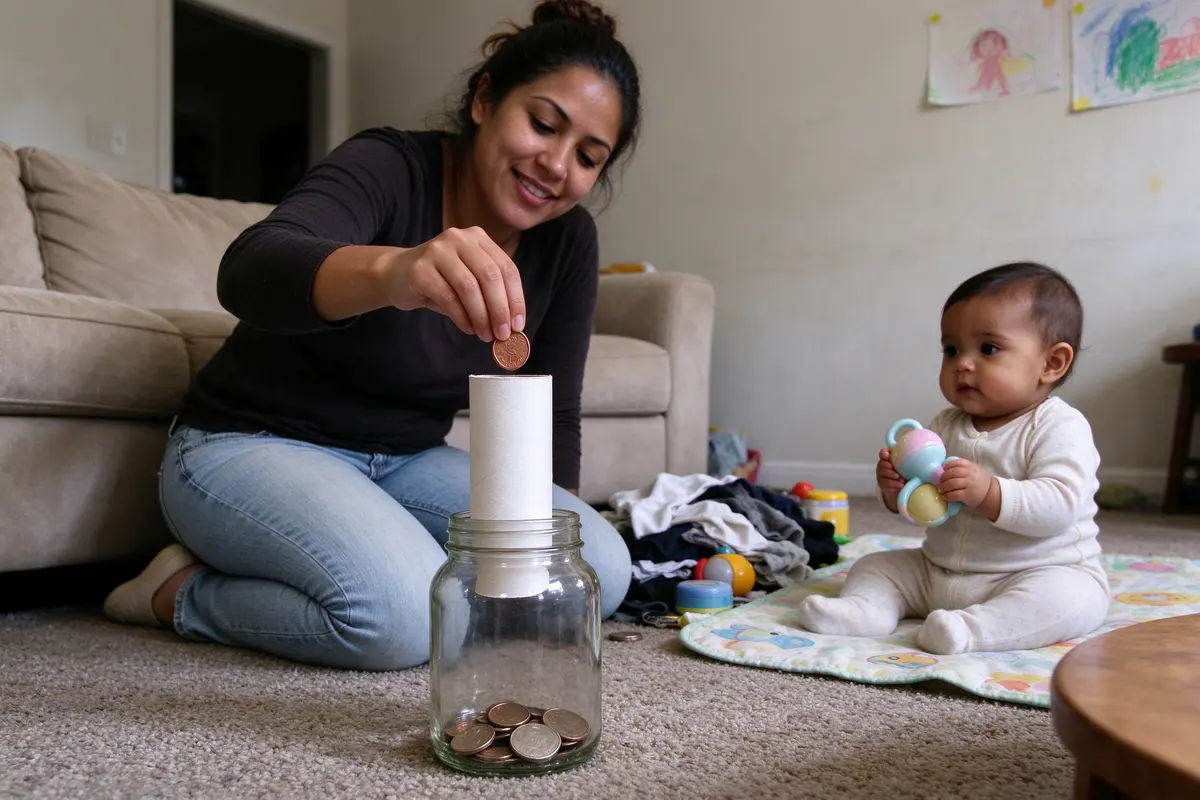
The toilet-roll test
Time: 15 minutes, at floor level · Falls, burns, choking, and poisons in the guide
Take an empty toilet-paper tube and get down on the floor where your baby plays. Federal rules test toys for children under 3 with a cylinder sized like a young child's throat (CPSC); household items aren't tested, so the tube is your rough stand-in, not the official test.
Anything that fits through the tube, or can be squeezed to fit in a mouth, goes up out of reach: coins, caps, beads, an older child's toy parts, and every button or coin battery (AAP).
Check under the sofa cushions and along the rug edge, where coins and small things collect (AAP).
Balloons, balls, and the bowl of nuts leave the room entirely (AAP).
Make it work:Keep the tube in the toy basket. When a new toy or a visitor's gift arrives, it gets the tube before it gets the baby.
Watch for
Normal
a lunge off your lap toward the table; reaching for a toy they want is a 6-month milestone (CDC).
Go to the ER now
after a fall if your baby vomits 2 or more times, cries nonstop, or seems "out of it" (AAP).
Normal
a gag on a teether pushed too far back, then a cough and a grin.
Call 911
if your baby is choking, with a weak or no cough, no sound, can't cry, or pale or blue skin; start back blows and chest thrusts (Red Cross).
Normal
a swallowed small object in a baby who seems fine, which still means
call your pediatrician now
; a button battery or magnet, swallowed or suspected, means go to the ER now (AAP).
For you
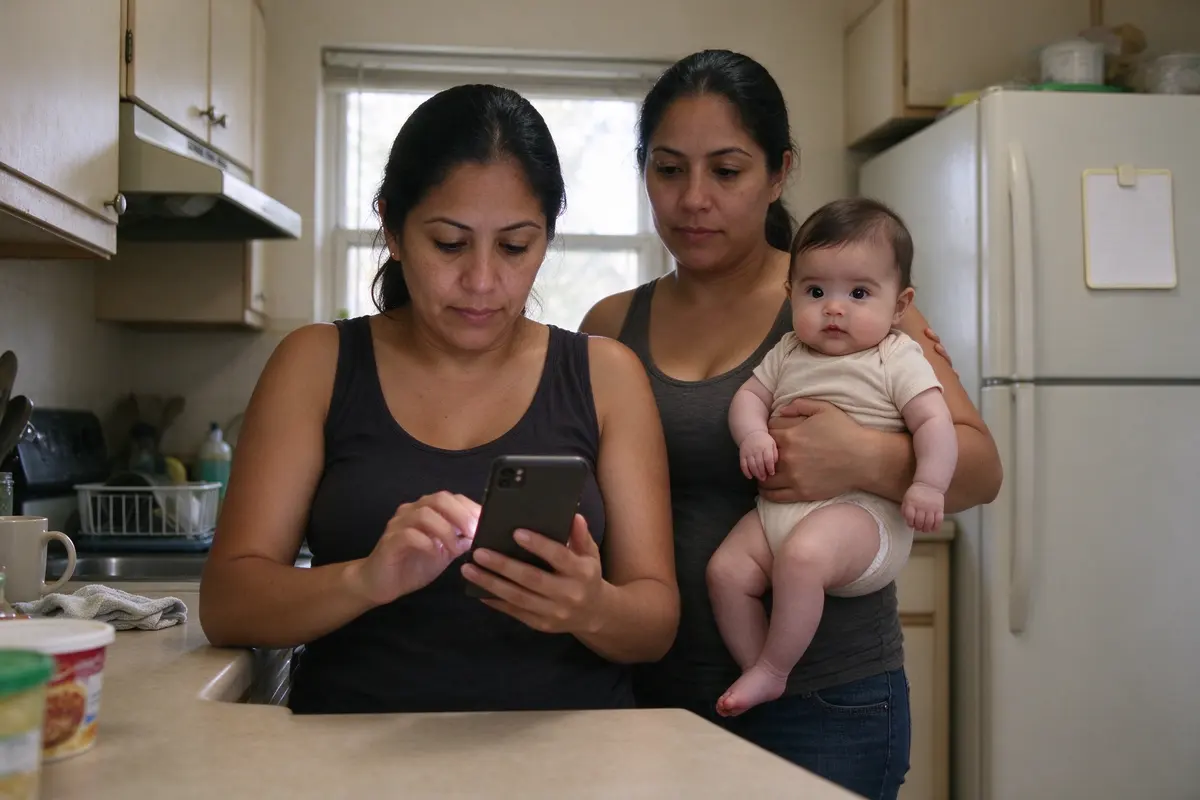
The Poison Help number in your phone, today: 1-800-222-1222 (AAP). Not on a fridge magnet you'll have to find one-handed; in the phone, under a name you'll think of in a panic, like "Poison." Then the partner's phone and the grandparents'.
None of today's three is about watching harder; you can't. It's three things set up once: the baby on the floor, the mug at the back of the counter, the small things in a jar on a high shelf.
If you're the partner: save the number now, before you finish reading. It takes ten seconds.
Sources
- National Health Service (UK). "Baby and toddler safety." Accessed 2026. https://www.nhs.uk/baby/first-aid-and-safety/safety/baby-and-toddler-safety/
- American Academy of Pediatrics. "Movement Milestones: Babies 4 to 7 Months." HealthyChildren.org, 2021. https://www.healthychildren.org/English/ages-stages/baby/Pages/Movement-4-to-7-Months.aspx
- American Academy of Pediatrics. "Head Injury" (symptom checker). HealthyChildren.org, 2026. https://www.healthychildren.org/English/tips-tools/symptom-checker/Pages/symptomviewer.aspx?symptom=Head+Injury
- American Academy of Pediatrics Council on Injury, Violence and Poison Prevention. "Infant Drowning Prevention & Water Safety: How to Protect Your Baby." HealthyChildren.org, 2026. https://www.healthychildren.org/English/safety-prevention/at-play/Pages/Infant-Water-Safety.aspx
- American Academy of Pediatrics. "Burn Treatment & Prevention Tips for Families." HealthyChildren.org, 2023. https://www.healthychildren.org/English/health-issues/injuries-emergencies/Pages/Treating-and-Preventing-Burns.aspx
- Centers for Disease Control and Prevention. "Milestones by 6 Months." Learn the Signs. Act Early., 2026. https://www.cdc.gov/act-early/milestones/6-months.html
- American Academy of Pediatrics. "Choking Prevention for Babies & Children: What Every Parent Needs to Know." HealthyChildren.org, 2026. https://www.healthychildren.org/English/health-issues/injuries-emergencies/Pages/Choking-Prevention.aspx
- American Academy of Pediatrics. "Poison Prevention & Treatment Tips for Parents." HealthyChildren.org, 2026. https://www.healthychildren.org/English/safety-prevention/all-around/Pages/Poison-Prevention.aspx
- US Consumer Product Safety Commission. "Small Parts Ban and Choking Hazard Labeling." Accessed 2026. https://www.cpsc.gov/Business--Manufacturing/Business-Education/Business-Guidance/Small-Parts-for-Toys-and-Childrens-Products
- Pomerantz WJ, Gittelman MA, Hornung R, Husseinzadeh H. "Falls in children birth to 5 years: Different mechanisms lead to different injuries." Journal of Trauma and Acute Care Surgery, 2012. https://pubmed.ncbi.nlm.nih.gov/23026963/
- American Red Cross. "Infant Choking: How To Help." Accessed 2026. https://www.redcross.org/take-a-class/resources/learn-first-aid/infant-choking
- American Academy of Pediatrics. "Swallowed Foreign Object" (symptom checker). HealthyChildren.org, 2026. https://www.healthychildren.org/English/tips-tools/symptom-checker/Pages/symptomviewer.aspx?symptom=Swallowed+Foreign+Object
This guide is general education that summarizes published research and guidance from groups like the American Academy of Pediatrics, the CDC, and the WHO. It isn’t medical advice, and every child develops on their own timeline. Your pediatrician knows your child; if something feels wrong, call them. In an emergency, call 911.
Get each day’s note the morning it applies
Add your baby to a free Chorevia household with their date of birth, and every morning for 300 days the day’s note arrives in the app and by email: what’s developing, one thing to try, what to watch for, and a word for you.
Create your household