Day 161 of 300 · Week 22
Iron and vitamin D
Last reviewed · 4 min read · 13 sources · Plain-text version
Milk is still the whole menu, and it carries almost everything. Two things it may not: iron, which runs low around now, and vitamin D. What the AAP says, and the one question to write down.

Breast milk or formula is still everything your baby eats and drinks, and it is enough. Today is about the two things it may not fully cover at this age, and the question that settles both.
Heart
Breast milk or formula is still all your baby needs until about 6 months (CDC), but the iron babies are born with runs low (AAP). What to do about it depends on how your baby is fed. Iron-fortified formula covers iron needs (CDC). For breastfed babies the AAP's advice on timing has shifted: its parent page says breastfed babies need iron drops from 4 months until iron-rich foods are in their diet (AAP), while its July 2026 clinical report says by 6 months for exclusively breastfed babies (AAP, 2026; Powers et al., 2026). Either way, the window is now, and the move is to ask.
Head
Vitamin D is the simpler one. Babies who get breast milk, or less than 32 ounces of formula a day, need 400 IU of vitamin D daily (AAP); if you've given drops since the early weeks, nothing changes today. Iron has a reason behind its timing: in a Cochrane review of 23 studies, babies breastfed exclusively for 6 months grew just as well and had fewer stomach infections than babies started on solids at 3 to 4 months, but where newborn iron stores may be low, iron status could suffer without drops (Kramer & Kakuma, 2012). The AAP's 4-month checkup page puts a number on it, a liquid iron supplement of 1 mg per kilogram a day for breastfed babies until iron-rich foods start at about 6 months (AAP). That is a conversation, not a shelf you shop from.
Body
Try today
The vitamin check
Time: 5 minutes · Ask about iron and vitamin D in the guide
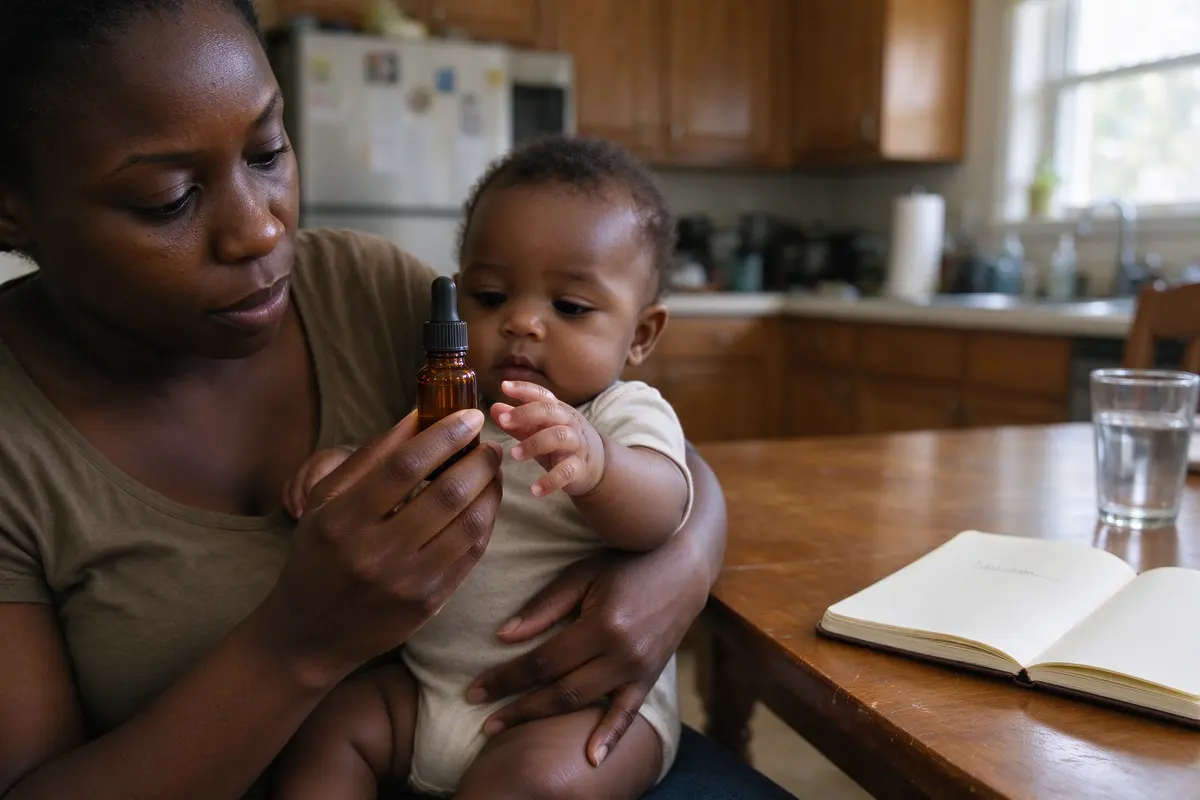
Find the drops you already give and read the label: for a breastfed baby, the dose should deliver 400 IU of vitamin D a day (AAP).
If you use formula, add up a typical day's ounces; under 32 ounces means the vitamin D rule still applies (AAP).
Write one line for the 6-month visit: "Does my baby need iron drops, and when?" (AAP, 2026).
Put the line wherever your checkup questions live, so it's there on the day.
Make it work:Don't start iron drops on your own; the dose depends on your baby's weight and feeding.
Watch for
Normal
a face at the taste of drops, and milk as the whole menu for a few more weeks (CDC).
Call your pediatrician right away
if your baby has had no urine in more than 8 hours, a very dry mouth, or no tears (AAP).
Normal
no interest in your plate yet; watching you eat and reaching for food are readiness signs that come at their own pace (AAP).
Go to the ER now
if your baby has a bulging or swollen soft spot, or a stiff neck (AAP).
Normal
a sleepy stretch after a big feed.
Call 911
if your baby is not moving or is very weak, or can't be woken up (AAP).
For you

Your own iron. If you were told you were anemic after the birth, or you bled heavily, the question on today's list has a twin: "What about mine?" Nobody checks it unless you ask. Overwhelming tiredness is on the CDC's list of urgent maternal warning signs, the kind to tell a provider about rather than push through, and the CDC's advice is to tell any provider you were pregnant within the last year (CDC). Twenty-three weeks of broken sleep explains a lot of tired, not all of it, and the only way to know is to say it to someone with a lab.
Eat today the way you'd want your baby fed: real food, sitting down, more than once (OWH).
If you're the partner: you give the drops tonight, and you write the second question on the list.
Sources
- Centers for Disease Control and Prevention. "Milestones by 4 Months." Learn the Signs. Act Early., 2026. https://www.cdc.gov/act-early/milestones/4-months.html
- American Academy of Pediatrics. "Where We Stand: Vitamin D & Iron Supplements for Babies." HealthyChildren.org, 2022. https://www.healthychildren.org/English/ages-stages/baby/feeding-nutrition/Pages/vitamin-iron-supplements.aspx
- Centers for Disease Control and Prevention. "Iron." Infant and Toddler Nutrition, 2026. https://www.cdc.gov/infant-toddler-nutrition/vitamins-minerals/iron.html
- American Academy of Pediatrics. "Iron Deficiency & Iron Deficiency Anemia: AAP Updates Screening, Prevention & Treatment Guidance." HealthyChildren.org, 2026. https://www.healthychildren.org/English/news/Pages/iron-deficiency-anemia-prevention-screening-treatment-AAP-updates-guidance.aspx
- Powers JM, Heeney MM, Hord J, et al. "Prevention, Screening, Diagnosis, and Treatment of Iron Deficiency and Iron Deficiency Anemia in Infants, Children, and Adolescents: Clinical Report." Pediatrics, 2026. https://pubmed.ncbi.nlm.nih.gov/42324084/
- American Academy of Pediatrics Section on Gastroenterology, Hepatology and Nutrition. "Vitamin D for Babies, Children & Adolescents." HealthyChildren.org, 2022. https://www.healthychildren.org/English/healthy-living/nutrition/Pages/vitamin-d-on-the-double.aspx
- Kramer MS, Kakuma R. "Optimal duration of exclusive breastfeeding." Cochrane Database of Systematic Reviews, 2012. https://pubmed.ncbi.nlm.nih.gov/22895934/
- American Academy of Pediatrics. "Checkup Checklist: 4 Months Old." HealthyChildren.org, 2023. https://www.healthychildren.org/English/ages-stages/Your-Childs-Checkups/Pages/Your-Checkup-Checklist-4-Months-Old.aspx
- American Academy of Pediatrics. "Checkup Checklist: 6 Months Old." HealthyChildren.org, 2023. https://www.healthychildren.org/English/ages-stages/Your-Childs-Checkups/Pages/Your-Checkup-Checklist-6-Months-Old.aspx
- American Academy of Pediatrics. "When Can Babies Start Solid Foods? Readiness & Feeding Tips." HealthyChildren.org, 2026. https://www.healthychildren.org/English/ages-stages/baby/feeding-nutrition/Pages/Starting-Solid-Foods.aspx
- American Academy of Pediatrics. "Fever" (symptom checker). HealthyChildren.org, 2026. https://www.healthychildren.org/English/tips-tools/symptom-checker/Pages/symptomviewer.aspx?symptom=Fever
- Centers for Disease Control and Prevention. "Urgent Maternal Warning Signs and Symptoms." HEAR HER, 2024. https://www.cdc.gov/hearher/maternal-warning-signs/index.html
- Office on Women's Health. "Recovering from birth." US Department of Health and Human Services, 2021. https://womenshealth.gov/pregnancy/childbirth-and-beyond/recovering-birth
This guide is general education that summarizes published research and guidance from groups like the American Academy of Pediatrics, the CDC, and the WHO. It isn’t medical advice, and every child develops on their own timeline. Your pediatrician knows your child; if something feels wrong, call them. In an emergency, call 911.
Get each day’s note the morning it applies
Add your baby to a free Chorevia household with their date of birth, and every morning for 300 days the day’s note arrives in the app and by email: what’s developing, one thing to try, what to watch for, and a word for you.
Create your household