Day 159 of 300 · Week 22
Peanut and egg, around six months
Last reviewed · 4 min read · 10 sources · Plain-text version
For most babies, peanut and egg come around 6 months, at home, with no test first, and the later servings matter most. The baby-safe forms, the two-hour watch, and a plan on the calendar.
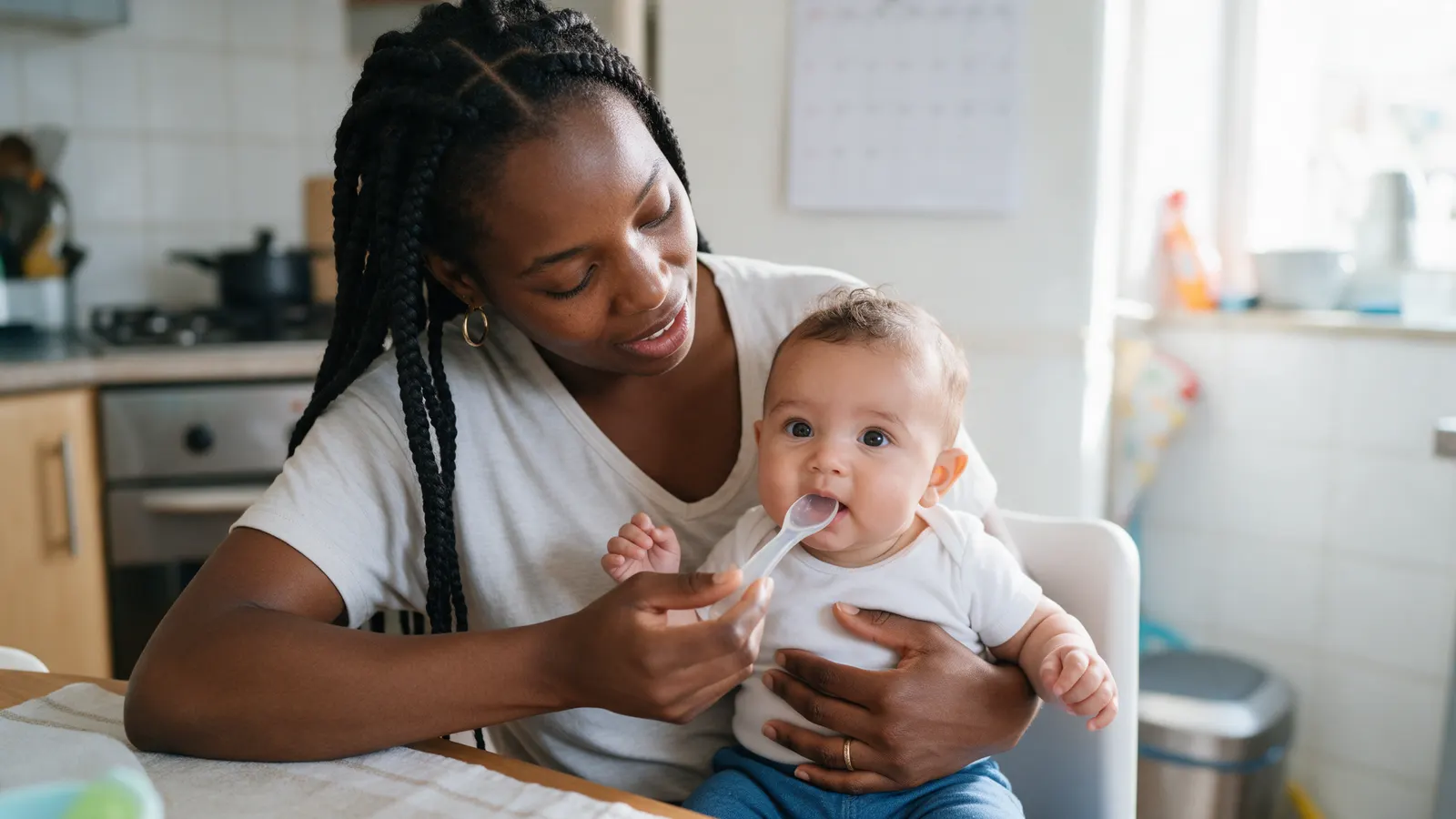
Yesterday was the question for high-risk babies. Today is the plan for everyone else, and it is short.
Heart
A 2021 consensus from US and Canadian allergy societies puts it plainly: introduce both peanut and egg around 6 months, not before 4, with no screening test required, and other allergens around the same time (Fleischer et al., 2021). For a baby with mild to moderate eczema, peanut comes around 6 months; for a baby with no eczema or food allergy, peanut goes in freely at home along with other solids (NIAID). Not today. Around the 6-month visit, once your baby is ready for solids at all.
Head
For babies who aren't high-risk, the benefit is real and modest, and it depends on keeping going. The EAT trial assigned 1,303 breastfed 3-month-olds in the UK to start six allergenic foods early or at about 6 months. Allergy developed in 5.6% versus 7.1%, a difference that could have been chance; families who stuck to the plan saw less peanut and egg allergy, but many found it hard (Perkin et al., 2016). In PreventADALL, a trial of 2,397 Scandinavian babies, tastes of peanut, milk, wheat, and egg from 3 months cut food allergy at age 3 from 2.3% to 0.9% (Skjerven et al., 2022). A meta-analysis rated the evidence for early egg and peanut as moderate certainty (Ierodiakonou et al., 2016). The lesson across all of it: regular servings matter more than the first one.
Body
When the time comes, start with a few low-allergy first foods, then add allergens one at a time in baby-safe forms, like 2 teaspoons of smooth peanut butter thinned into a puree or a third of a well-cooked egg, and keep serving them. Never give whole nuts (AAP). NIAID's home-feeding steps were written for higher-risk babies whose tests were reassuring, but they make a good habit for any baby: first tastes at home, on a day your baby is well, then watch for 2 hours (NIAID).
Try today
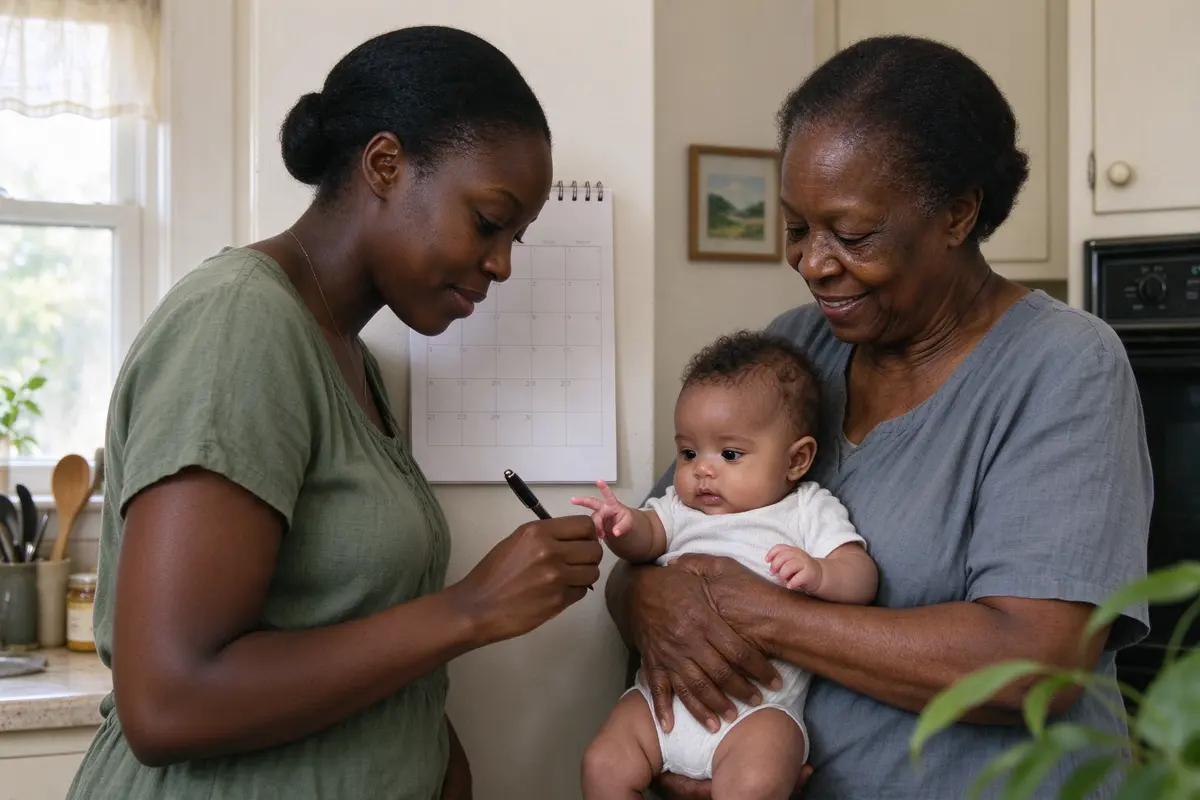
The first-tastes plan
Time: 10 minutes, with a calendar · Make an allergen plan now in the guide
Find the 6-month visit on the calendar and write "first tastes" on the week after it, pending the pediatrician's go-ahead and your baby's readiness (AAP).
Under it, write the two forms: 2 teaspoons of smooth peanut butter thinned into a puree; a third of a well-cooked egg. Never whole nuts (AAP).
Write the rule: at home, on a well day, then watch for 2 hours (NIAID).
Write the 911 line: swelling of the lips or face, widespread hives, vomiting, wheezing, or trouble breathing (NIAID).
Put the pen down. Nothing is eaten today.
Make it work:Write "again" on the two weeks after that. The plan is the servings, not the first spoon.
Watch for
Normal
a baby who lunges at your plate and grabs your fork; watching you eat and reaching for food are readiness signs (AAP).
Check with your pediatrician first
before any allergen if your baby has ever had an immediate reaction to a food (AAP).
Normal
a spoon handle pushed back out by the tongue; that's a baby who isn't ready yet (CDC).
Call 911
, now or any day after a food, for swelling of the lips, face, or tongue, widespread hives, vomiting, wheezing, repeated coughing, pale or blue skin, or sudden floppiness (NIAID).
Normal
a spit-up after a big feed.
Go to the ER now
if your baby has a bulging or swollen soft spot, or a stiff neck (AAP).
For you

The plan takes the dread out. Most of the fear around allergens is the fear of not knowing what you'd do, and you now have it in writing: no test needed first for most babies (Fleischer et al., 2021), a well day at home, 2 hours of watching, and the exact signs that mean 911 (NIAID). That is the whole emergency plan, and it fits on a calendar square.
If you're the partner: be home for the first tastes. Two adults, one watching the clock, one watching the baby.
Sources
- Fleischer DM, Chan ES, Venter C, et al. "A Consensus Approach to the Primary Prevention of Food Allergy Through Nutrition." Journal of Allergy and Clinical Immunology: In Practice, 2021. https://pubmed.ncbi.nlm.nih.gov/33250376/
- National Institute of Allergy and Infectious Diseases. "Addendum Guidelines for the Prevention of Peanut Allergy in the United States: Summary for Parents and Caregivers." 2017. https://www.niaid.nih.gov/sites/default/files/peanut-allergy-prevention-guidelines-parent-summary.pdf
- Perkin MR, Logan K, Tseng A, et al. "Randomized Trial of Introduction of Allergenic Foods in Breast-Fed Infants." New England Journal of Medicine, 2016. https://pubmed.ncbi.nlm.nih.gov/26943128/
- Skjerven HO, Lie A, Vettukattil R, et al. "Early food intervention and skin emollients to prevent food allergy in young children (PreventADALL): a factorial, multicentre, cluster-randomised trial." Lancet, 2022. https://pubmed.ncbi.nlm.nih.gov/35753340/
- Ierodiakonou D, Garcia-Larsen V, Logan A, et al. "Timing of Allergenic Food Introduction to the Infant Diet and Risk of Allergic or Autoimmune Disease: A Systematic Review and Meta-analysis." JAMA, 2016. https://pubmed.ncbi.nlm.nih.gov/27654604/
- Cox A, Pistiner M. "When to Introduce Egg, Peanut Butter & Other Common Food Allergens to a Baby." HealthyChildren.org, updated 2025. https://www.healthychildren.org/English/healthy-living/nutrition/Pages/when-to-introduce-egg-peanut-butter-and-other-common-food-allergens-to-your-baby-food-allergy-prevention-tips.aspx
- National Institute of Allergy and Infectious Diseases. "Appendix D: Instructions for Home Feeding of Peanut Protein for Infants at Low Risk of an Allergic Reaction to Peanut." 2017. https://www.niaid.nih.gov/sites/default/files/addendum_guidelines_peanut_appx_d.pdf
- American Academy of Pediatrics. "When Can Babies Start Solid Foods? Readiness & Feeding Tips." HealthyChildren.org, updated 2026. https://www.healthychildren.org/English/ages-stages/baby/feeding-nutrition/Pages/Starting-Solid-Foods.aspx
- Centers for Disease Control and Prevention. "When, What, and How to Introduce Solid Foods." 2026. https://www.cdc.gov/infant-toddler-nutrition/foods-and-drinks/when-what-and-how-to-introduce-solid-foods.html
- American Academy of Pediatrics. "Fever" (symptom checker). HealthyChildren.org, accessed 2026. https://www.healthychildren.org/English/tips-tools/symptom-checker/Pages/symptomviewer.aspx?symptom=Fever
This guide is general education that summarizes published research and guidance from groups like the American Academy of Pediatrics, the CDC, and the WHO. It isn’t medical advice, and every child develops on their own timeline. Your pediatrician knows your child; if something feels wrong, call them. In an emergency, call 911.
Get each day’s note the morning it applies
Add your baby to a free Chorevia household with their date of birth, and every morning for 300 days the day’s note arrives in the app and by email: what’s developing, one thing to try, what to watch for, and a word for you.
Create your household