Day 154 of 300 · Week 21
Babble back
Last reviewed · 3 min read · 12 sources · Plain-text version
Babble takes on the rhythm of your language, one favorite sound at a time. Why a reply that comes right after the babble matters, what strings like babababa mean, and why you need a reply today too.
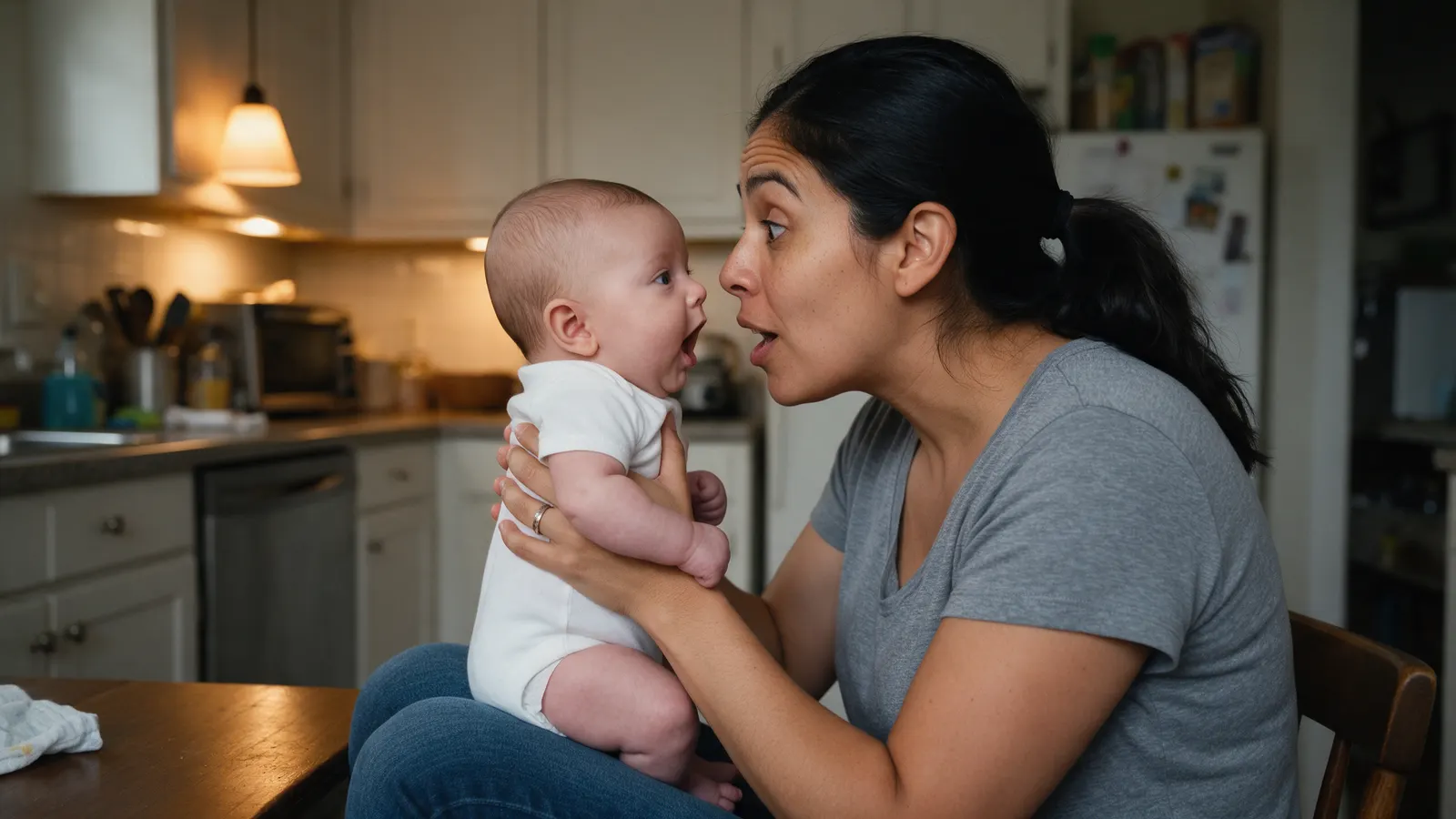
The sounds have changed. Today is about what they are, and about the reply.
Heart
Babbling usually starts around 4 months, with the rhythm of the language your baby hears, and a baby may repeat one favorite sound for days (AAP). From 4 to 6 months, babies giggle, blow raspberries, and make vowel sounds sometimes joined to a consonant, like "aaaagoo" or "daaaa"; strings like "babababa" come at 7 to 9 months (ASHA). Taking turns making sounds with you is on the 6-month list (CDC). So a baby who says "daaaa" forty times before lunch isn't stuck; they're practicing.
Head
The reply is where you come in, and timing is the whole trick. In a small study of 30 babies around 8 months old, replies that came right after the babble, not at random times, made the babies' sounds more speech-like (Goldstein et al., 2003). CDC suggests copying your baby's sounds (CDC), and the AAP's version is to add words around the syllable they land on: "bah" becomes "bottle," "box" (AAP). Naming what your baby sees builds language connections before they understand a word (Harvard Center on the Developing Child).
Body
Sounds are also a hearing check you run for free. If your baby doesn't babble or imitate any sounds by 7 months, tell your pediatrician, since it can signal a hearing problem (AAP). What matters now is that your baby turns toward your voice and makes sounds back (CDC). A squealer with a hoarse voice by evening is a baby who has been using the equipment.
Try today
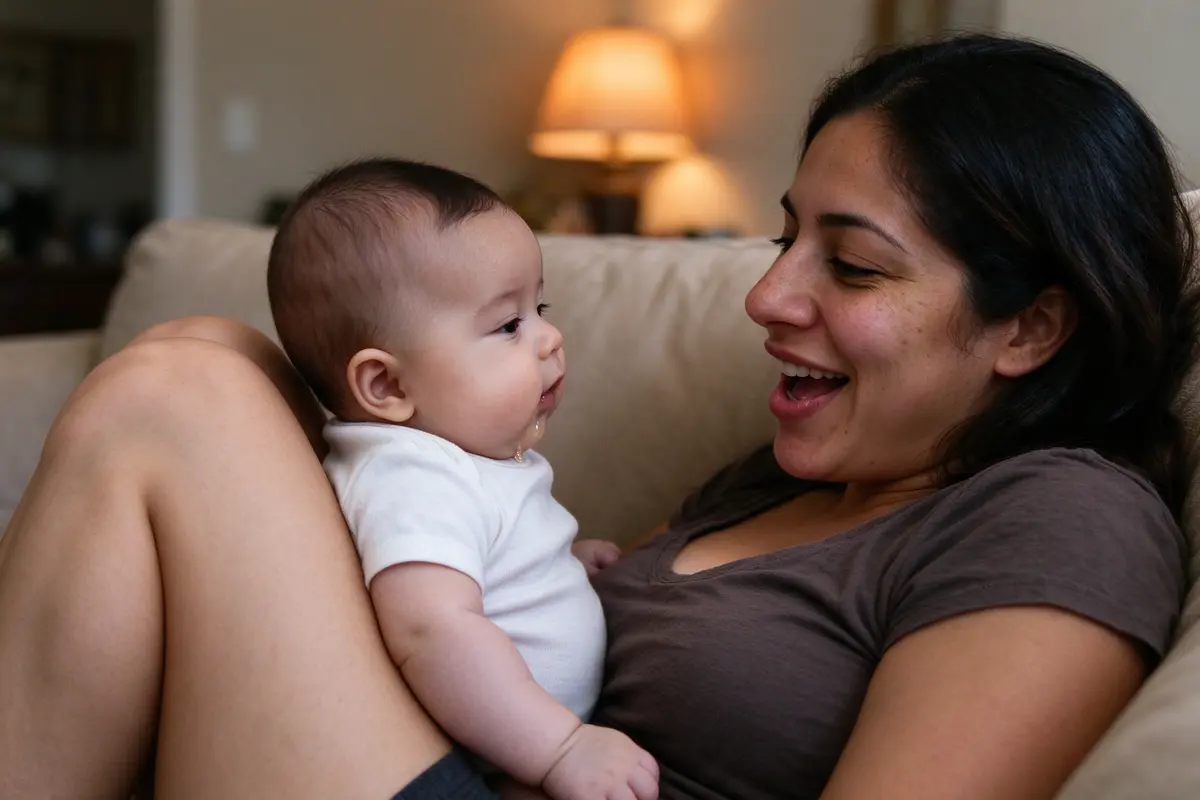
Babble back
Time: 2 to 5 minutes, during calm, alert times · Babble back in the guide
Wait for your baby to make a sound.
Copy it back, smiling, right away, then pause for their turn.
When they land on a syllable like "bah," add words with it: "bottle," "box" (AAP).
Stop when they look away; the turn is over.
Make it work:The reply has to follow the sound, not interrupt it. Count one beat of quiet, then go.
Watch for
Normal
days of one sound and nothing else, then a new one (AAP).
Normal
a hoarse voice after a day of squealing.
Call 911
if your baby is struggling for each breath, has stopped breathing, or has bluish lips or face (AAP).
Normal
a fussy stretch that turns into babble once you answer it.
Call your pediatrician right away
if your baby has cried nonstop for more than 2 hours, or you're afraid someone might hurt or shake them (AAP).
For you
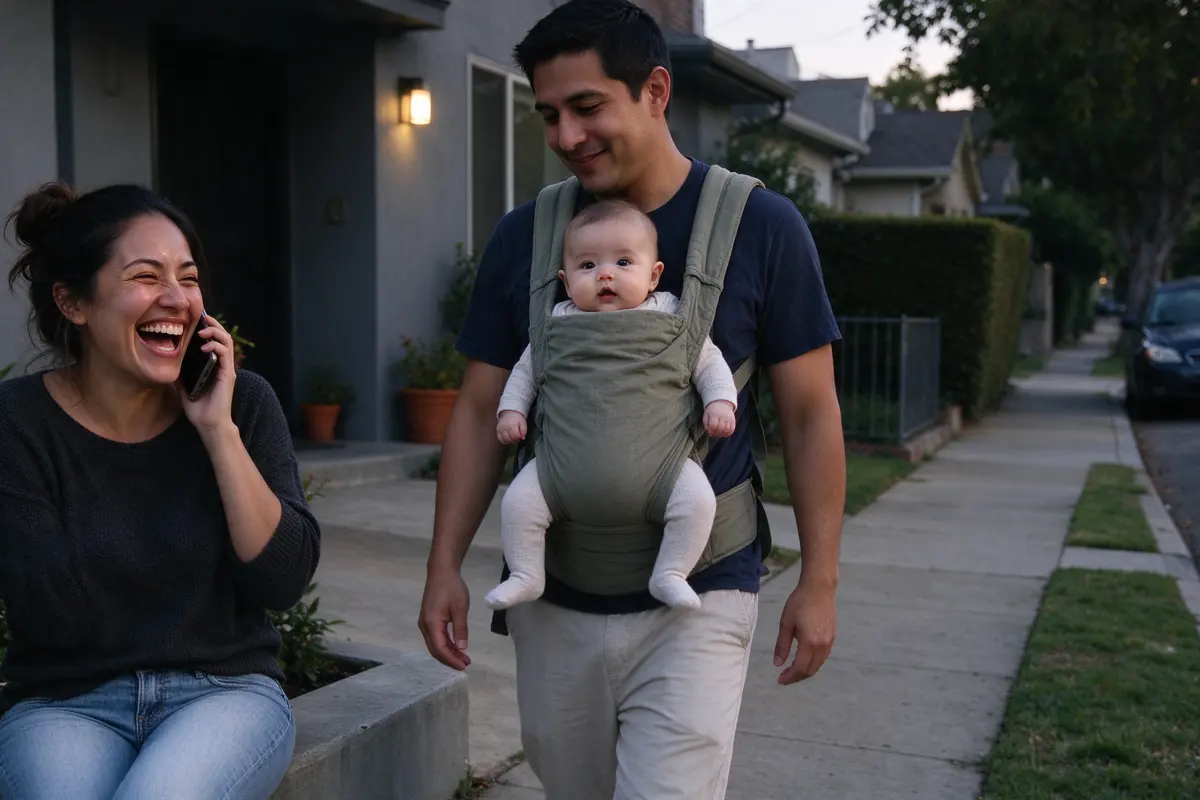
Talk to an adult today, too. Not about logistics; a real conversation, with pauses, where someone replies to what you said. The study above is about babies, but the principle is older than that: sounds that get answered become speech, and feelings that get said out loud become smaller. Low mood, anxiety, or emptiness that is severe or lasts more than 2 weeks may be postpartum depression, which usually doesn't improve without treatment but does respond to it (NIMH). Call or text 1-833-TLC-MAMA (1-833-852-6262) or 988 if the conversation you need is that one (CDC).
If you're the partner: in a meta-analysis of 74 studies, about 8% of fathers had depression around a birth (Cameron et al., 2016). Your conversation counts too.
Sources
- American Academy of Pediatrics. "Language Development: 4 to 7 Months." HealthyChildren.org, updated 2009. https://www.healthychildren.org/English/ages-stages/baby/Pages/Language-Development-4-to-7-Months.aspx
- American Speech-Language-Hearing Association. "Communication Milestones: Birth to 1 Year." Accessed 2026. https://www.asha.org/public/developmental-milestones/communication-milestones-birth-to-1-year/
- Centers for Disease Control and Prevention. "Milestones by 6 Months." Learn the Signs. Act Early. program, updated 2026. https://www.cdc.gov/act-early/milestones/6-months.html
- Goldstein MH, King AP, West MJ. "Social interaction shapes babbling: testing parallels between birdsong and speech." Proceedings of the National Academy of Sciences, 2003. https://pubmed.ncbi.nlm.nih.gov/12808137/
- Centers for Disease Control and Prevention. "Milestones by 4 Months." Learn the Signs. Act Early. program, updated 2026. https://www.cdc.gov/act-early/milestones/4-months.html
- Center on the Developing Child at Harvard University. "Serve and Return." Accessed 2026. https://developingchild.harvard.edu/key-concept/serve-and-return/
- Centers for Disease Control and Prevention. "Concerned About Your Child's Development?" 2026. https://www.cdc.gov/act-early/families/concerned.html
- American Academy of Pediatrics. "Breathing Trouble" (symptom checker). HealthyChildren.org, accessed 2026. https://www.healthychildren.org/English/tips-tools/symptom-checker/Pages/symptomviewer.aspx?symptom=Breathing+Trouble
- American Academy of Pediatrics. "Crying Child - 3 Months and Older" (symptom checker). HealthyChildren.org, accessed 2026. https://www.healthychildren.org/English/tips-tools/symptom-checker/Pages/symptomviewer.aspx?symptom=Crying+Child+-+3+Months+and+Older
- National Institute of Mental Health. "Perinatal Depression." Accessed 2026. https://www.nimh.nih.gov/health/publications/perinatal-depression
- Centers for Disease Control and Prevention. "Symptoms of Depression Among Women." 2024. https://www.cdc.gov/reproductive-health/depression/index.html
- Cameron EE, Sedov ID, Tomfohr-Madsen LM. "Prevalence of paternal depression in pregnancy and the postpartum: An updated meta-analysis." Journal of Affective Disorders, 2016. https://pubmed.ncbi.nlm.nih.gov/27475890/
This guide is general education that summarizes published research and guidance from groups like the American Academy of Pediatrics, the CDC, and the WHO. It isn’t medical advice, and every child develops on their own timeline. Your pediatrician knows your child; if something feels wrong, call them. In an emergency, call 911.
Get each day’s note the morning it applies
Add your baby to a free Chorevia household with their date of birth, and every morning for 300 days the day’s note arrives in the app and by email: what’s developing, one thing to try, what to watch for, and a word for you.
Create your household