Day 157 of 300 · Week 21
Twenty-two weeks: mirrors and faces
Last reviewed · 3 min read · 12 sources · Plain-text version
Your baby's brain is tuning in to the faces it sees most. What three lab studies found, why naming the people your baby meets is an easy habit, and a photo book of the faces that matter.

Twenty-two weeks. Your baby is starting to sort the world into familiar faces and everyone else, and today is about how that happens.
Heart
Knowing familiar people and liking to look at themselves in a mirror are both on the 6-month list (CDC). Behind that is a brain tuning itself to the faces it sees most. In a lab study, 6-month-olds could tell individual monkey faces apart; 9-month-olds and adults couldn't (Pascalis et al., 2002). Among 192 white British babies, 3-month-olds recognized faces from four ethnic groups, 6-month-olds from two, and 9-month-olds only from their own (Kelly et al., 2007). Your baby, right now, is in the middle of that narrowing.
Head
The narrowing isn't fixed. In a later lab study, babies shown monkey faces with a name for each from 6 to 9 months kept the skill (Scott & Monesson, 2009). Experience shapes what babies notice, which makes naming the people your baby meets an easy habit, though the long-term effects of doing it at home haven't been tested (Scott & Monesson, 2009). Naming what your baby sees builds language connections before they understand words anyway (Harvard Center on the Developing Child), so "That's Auntie Rose" costs nothing and may do two jobs.
Body
The mirror is the other face game this month. An unbreakable mirror is on the AAP's list of good toys for this age (AAP), and the baby in it is simply a very responsive face. Real new faces may get a cooler reception: stranger anxiety usually arrives at 7 to 12 months (AAP), but in a study of 1,285 twins, about 1 in 4 babies were already quite fearful of strangers at 6 months, and half of those became less fearful by age 3 (Brooker et al., 2013).
Try today
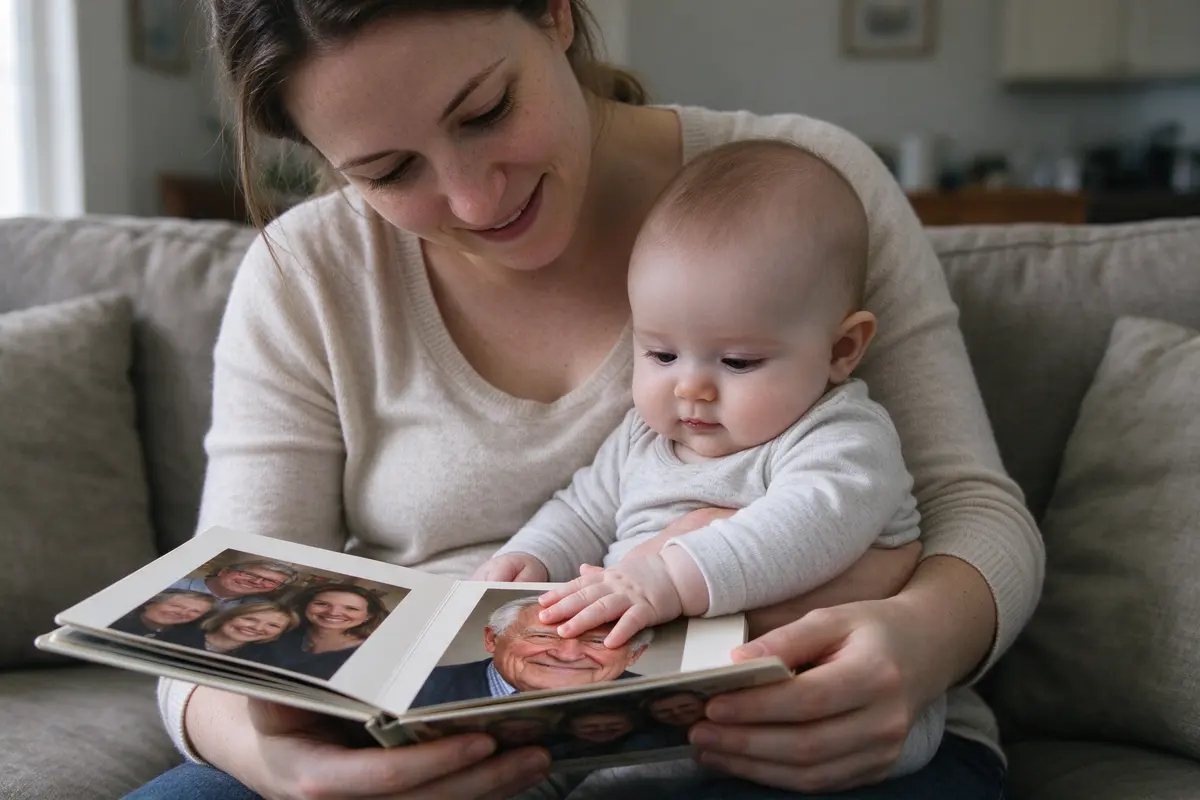
The people book
Time: 5 minutes · The people book in the guide
Make a small album of close-up photos of family, friends, and caregivers; printed pictures in a cheap pocket album, or a few photos on a board.
Look at it together and say each person's name.
When that person visits, show their photo and say their name again.
Make it work:Faces big, one per page, no captions needed. Let your baby pat and chew the pages; the book is theirs.
Watch for
Normal
a long, serious stare at a new face, or a wary turn into your shoulder; about 1 in 4 babies are quite fearful of strangers at 6 months (Brooker et al., 2013).
Normal
a baby who smiles at the mirror and ignores the grandparent beside it.
Go to the ER now
if your baby screams and can't be consoled, or cries when you touch or move them (AAP).
Normal
a blotchy red face after a crying spell that fades in minutes.
Call 911
if your baby has purple or blood-colored spots on the skin, or is struggling for each breath (AAP).
For you
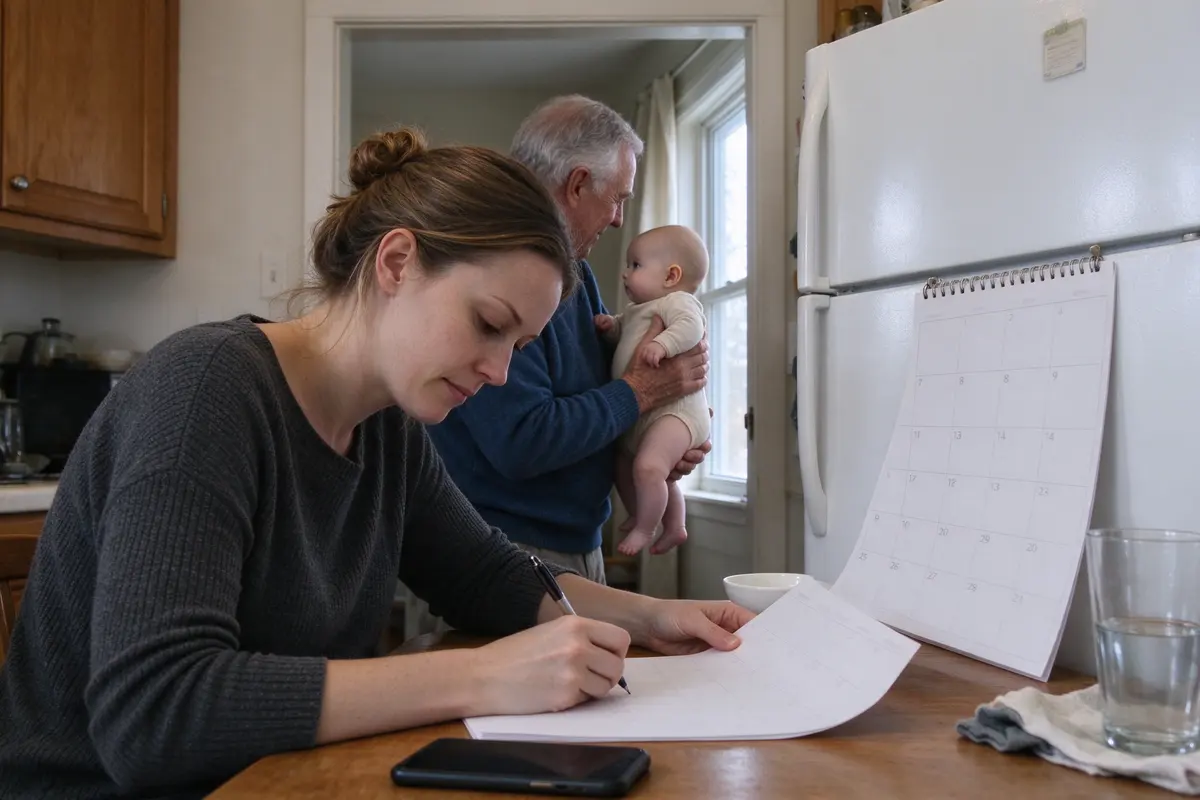
The people in your own week. Make your own version of the book: who did you actually see or talk to in the last seven days? If the list is the pediatrician's receptionist and a delivery driver, that's information, not a failing. In a study of 100 new mothers, unwanted thoughts about the baby being harmed were more common with high stress and little support (Fairbrother & Woody, 2008); support is not a luxury item. Pick one face for next week and put the name on the calendar.
If you're the partner: your face is on both lists. Then ask who else she'd like on hers, and make the call yourself if she's too tired to.
Sources
- Centers for Disease Control and Prevention. "Milestones by 6 Months." Learn the Signs. Act Early. program, updated 2026. https://www.cdc.gov/act-early/milestones/6-months.html
- Pascalis O, de Haan M, Nelson CA. "Is face processing species-specific during the first year of life?" Science, 2002. https://pubmed.ncbi.nlm.nih.gov/12016317/
- Kelly DJ, Quinn PC, Slater AM, et al. "The other-race effect develops during infancy: evidence of perceptual narrowing." Psychological Science, 2007. https://pubmed.ncbi.nlm.nih.gov/18031416/
- Scott LS, Monesson A. "The origin of biases in face perception." Psychological Science, 2009. https://pubmed.ncbi.nlm.nih.gov/19422630/
- Center on the Developing Child at Harvard University. "Serve and Return." Accessed 2026. https://developingchild.harvard.edu/key-concept/serve-and-return/
- American Academy of Pediatrics. "Movement Milestones: Babies 4 to 7 Months." HealthyChildren.org, updated 2021. https://www.healthychildren.org/English/ages-stages/baby/Pages/Movement-4-to-7-Months.aspx
- American Academy of Pediatrics. "Making Baby Drop Off at Child Care Easier." HealthyChildren.org, updated 2022. https://www.healthychildren.org/English/family-life/work-and-child-care/Pages/making-baby-drop-off-at-child-care-easier.aspx
- Brooker RJ, Buss KA, Lemery-Chalfant K, et al. "The development of stranger fear in infancy and toddlerhood: normative development, individual differences, antecedents, and outcomes." Developmental Science, 2013. https://pubmed.ncbi.nlm.nih.gov/24118713/
- Centers for Disease Control and Prevention. "Concerned About Your Child's Development?" 2026. https://www.cdc.gov/act-early/families/concerned.html
- American Academy of Pediatrics. "Crying Child - 3 Months and Older" (symptom checker). HealthyChildren.org, accessed 2026. https://www.healthychildren.org/English/tips-tools/symptom-checker/Pages/symptomviewer.aspx?symptom=Crying+Child+-+3+Months+and+Older
- American Academy of Pediatrics. "Fever" (symptom checker). HealthyChildren.org, accessed 2026. https://www.healthychildren.org/English/tips-tools/symptom-checker/Pages/symptomviewer.aspx?symptom=Fever
- Fairbrother N, Woody SR. "New mothers' thoughts of harm related to the newborn." Archives of Women's Mental Health, 2008. https://pubmed.ncbi.nlm.nih.gov/18463941/
This guide is general education that summarizes published research and guidance from groups like the American Academy of Pediatrics, the CDC, and the WHO. It isn’t medical advice, and every child develops on their own timeline. Your pediatrician knows your child; if something feels wrong, call them. In an emergency, call 911.
Get each day’s note the morning it applies
Add your baby to a free Chorevia household with their date of birth, and every morning for 300 days the day’s note arrives in the app and by email: what’s developing, one thing to try, what to watch for, and a word for you.
Create your household