Day 169 of 300 · Week 23
Floor over containers
Last reviewed · 4 min read · 13 sources · Plain-text version
Baby walkers sent an estimated 230,676 US children to emergency rooms over 25 years, mostly down stairs, and they don't teach walking. The floor does the job for free, and the WHO wants plenty of it.
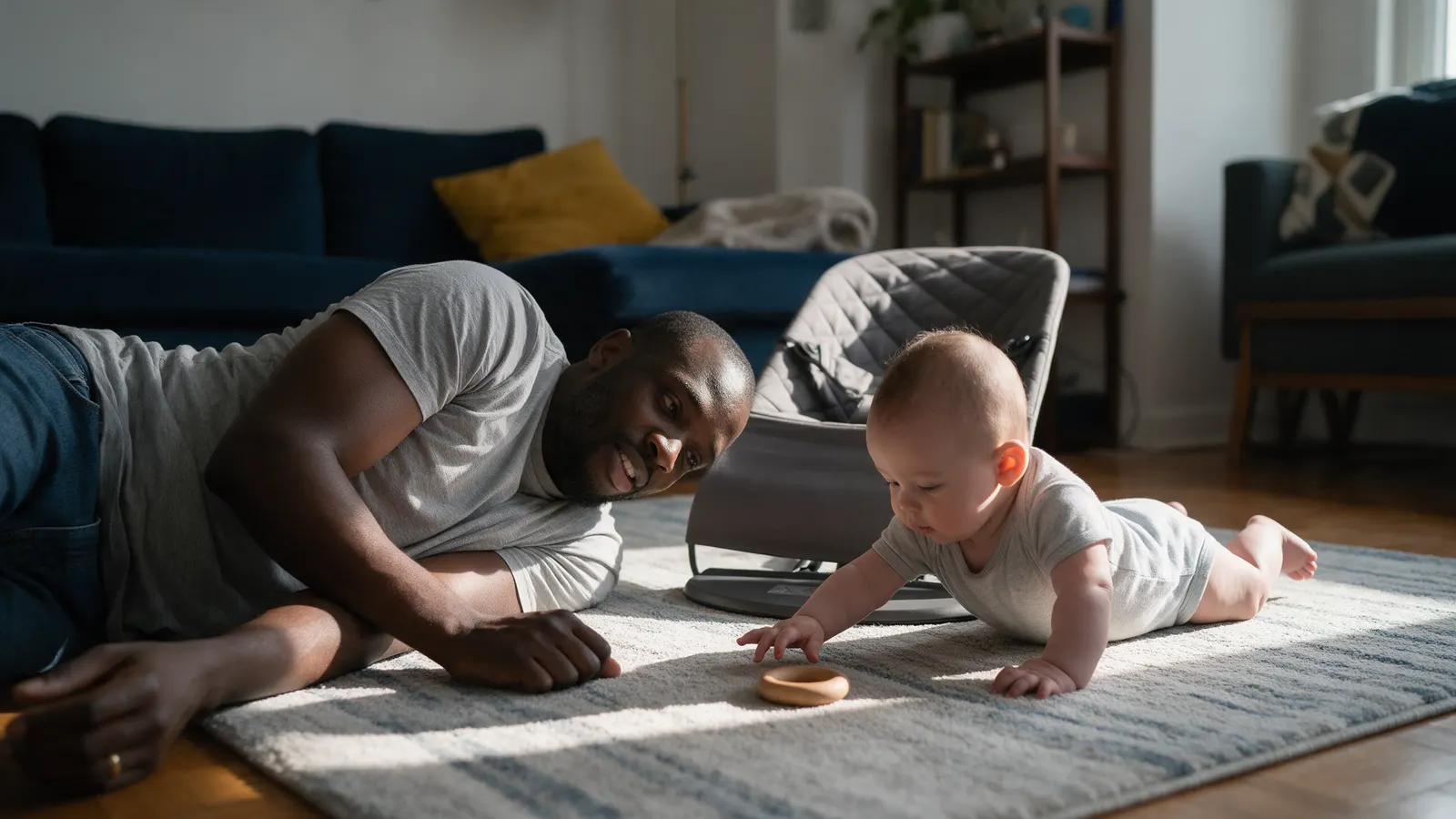
Somebody will offer you a walker this month, maybe with wheels, maybe one that bounces in a ring. Today is the case for the floor, with the numbers.
Heart
The WHO advises plenty of floor play and not keeping babies strapped into a stroller, high chair, or carrier for more than 1 hour at a time (WHO). Stationary activity centers are safer than walkers (AAP), but in a small study of 43 babies, more time in equipment went with lower motor scores at 8 months, a link that doesn't prove cause (Abbott & Bartlett, 2001), and a 2025 review flagged concerns about activity centers and motor and language development, along with gaps in the research (Khare, 2025). Use them for short breaks, if at all. The free, safe version of a jumper is your lap: the CDC suggests holding your baby under the arms while they stand (CDC).
Head
Walkers with wheels are a different matter. Among 109 babies, walker users sat, crawled, and walked later and scored lower on developmental tests (Siegel & Burton, 1999); in a Northern Ireland survey covering 190 babies, more walker use went with walking alone later (Garrett et al., 2002). Both are observational. The injury data are clearer: from 1990 to 2014, an estimated 230,676 US children under 15 months were treated in emergency rooms for walker injuries, 74.1% from falls down stairs (Sims et al., 2018). A baby in a walker can move more than 3 feet in a second, faster than an adult can react; walkers are banned in Canada (AAP), and the AAP has long called for a ban on their sale (AAP, 2001).
Body
What the floor teaches is on the 6-month list: pushing up on straight arms on the tummy, rolling tummy to back, and leaning on the hands to sit (CDC). A systematic review of 16 mostly observational studies linked tummy time to better gross motor development, including rolling (Hewitt et al., 2020), and the WHO suggests at least 30 minutes of it a day, spread out, for babies who aren't crawling yet (WHO). None of that happens in a seat.
Try today

Free floor play
Time: Several times a day · Free floor play in the guide
Clear a safe patch of floor and lay down a blanket or mat.
Offer two or three safe toys with your baby on their back, side, or tummy (CDC).
Let your baby explore and only step in when they need help.
Count the strapped-in minutes today, seat by seat, against the WHO's hour (WHO).
Make it work:Get down there too. A parent at floor level is the toy they reach for most.
Watch for
Normal
pivoting in a circle on the tummy and getting nowhere, or rolling one way only.
Normal
a protest after ten minutes on the mat.
Call your doctor right away
after any head injury, including a fall from a bed, couch, or changing table (AAP).
Normal
a toy swapped from hand to mouth to hand.
Go to the ER now
if your baby swallowed, or might have swallowed, a button battery or magnet (AAP).
For you
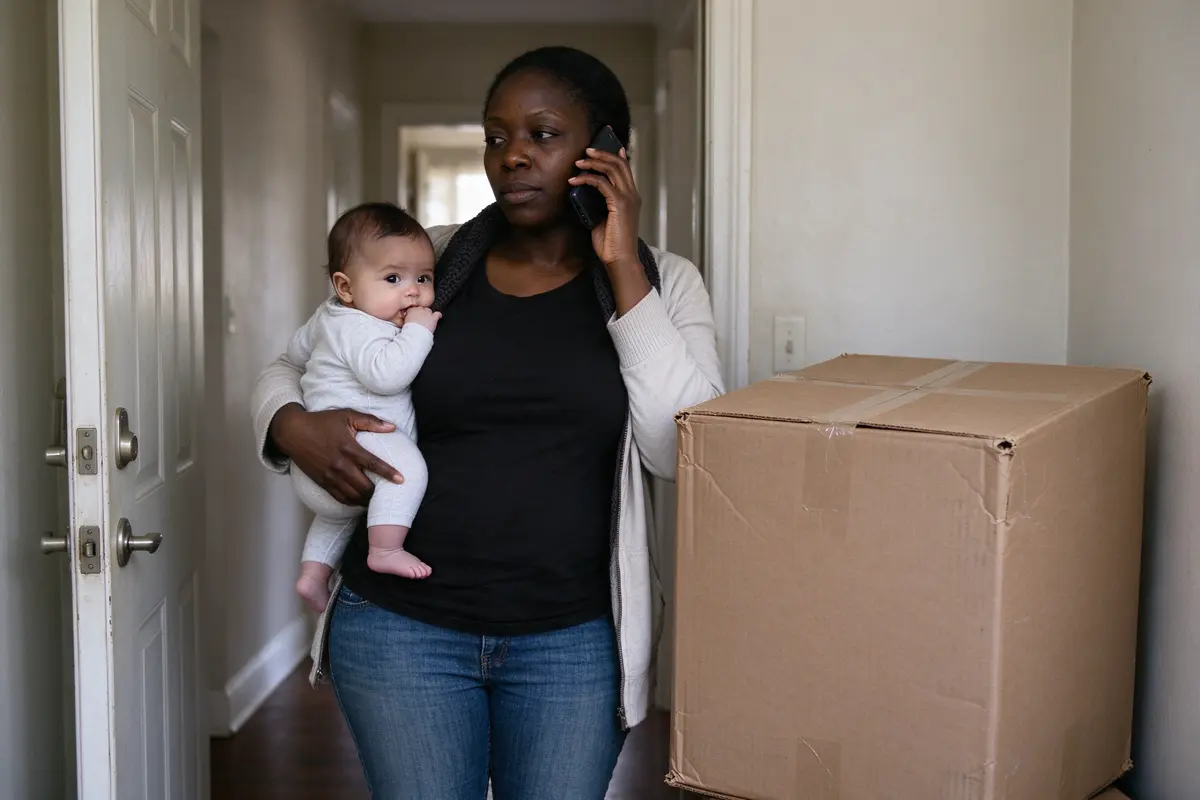
Say no to the walker gift, kindly. The person offering it probably used one with you, and nothing bad happened, and both of those things can be true alongside 230,676 emergency room visits (Sims et al., 2018). You don't need to argue the study. One sentence does it: "Thank you so much, but the pediatricians' group says walkers aren't safe and Canada has banned them, so we're sticking with the floor" (AAP). Then change the subject to what the baby did on the rug this morning, which is the better story anyway.
If you're the partner: if it's your side of the family, the sentence is yours to say.
Sources
- World Health Organization. "To grow up healthy, children need to sit less and play more." 2019. https://www.who.int/news/item/24-04-2019-to-grow-up-healthy-children-need-to-sit-less-and-play-more
- American Academy of Pediatrics. "Baby Walkers: A Dangerous Choice." HealthyChildren.org, 2022. https://www.healthychildren.org/English/safety-prevention/at-home/Pages/Baby-Walkers-A-Dangerous-Choice.aspx
- Abbott AL, Bartlett DJ. "Infant motor development and equipment use in the home." Child: Care, Health and Development, 2001. https://pubmed.ncbi.nlm.nih.gov/11350456/
- Khare S. "Exersaucers: a comprehensive review of their developmental and safety implications." Injury Prevention, 2025. https://pubmed.ncbi.nlm.nih.gov/40118461/
- Centers for Disease Control and Prevention. "Milestones by 6 Months." Learn the Signs. Act Early., 2026. https://www.cdc.gov/act-early/milestones/6-months.html
- Siegel AC, Burton RV. "Effects of baby walkers on motor and mental development in human infants." Journal of Developmental and Behavioral Pediatrics, 1999. https://pubmed.ncbi.nlm.nih.gov/10533994/
- Garrett M, McElroy AM, Staines A. "Locomotor milestones and babywalkers: cross sectional study." BMJ, 2002. https://pubmed.ncbi.nlm.nih.gov/12077035/
- Sims A, Chounthirath T, Yang J, Hodges NL, Smith GA. "Infant Walker-Related Injuries in the United States." Pediatrics, 2018. https://pubmed.ncbi.nlm.nih.gov/30224365/
- American Academy of Pediatrics Committee on Injury and Poison Prevention. "Injuries associated with infant walkers." Pediatrics, 2001. https://pubmed.ncbi.nlm.nih.gov/11533353/
- Hewitt L, Kerr E, Stanley RM, Okely AD. "Tummy Time and Infant Health Outcomes: A Systematic Review." Pediatrics, 2020. https://pubmed.ncbi.nlm.nih.gov/32371428/
- Centers for Disease Control and Prevention. "Concerned About Your Child's Development?" 2026. https://www.cdc.gov/act-early/families/concerned.html
- American Academy of Pediatrics. "Head Injury" (symptom checker). HealthyChildren.org, 2026. https://www.healthychildren.org/English/tips-tools/symptom-checker/Pages/symptomviewer.aspx?symptom=Head+Injury
- American Academy of Pediatrics. "Swallowed Foreign Object" (symptom checker). HealthyChildren.org, 2026. https://www.healthychildren.org/English/tips-tools/symptom-checker/Pages/symptomviewer.aspx?symptom=Swallowed+Foreign+Object
This guide is general education that summarizes published research and guidance from groups like the American Academy of Pediatrics, the CDC, and the WHO. It isn’t medical advice, and every child develops on their own timeline. Your pediatrician knows your child; if something feels wrong, call them. In an emergency, call 911.
Get each day’s note the morning it applies
Add your baby to a free Chorevia household with their date of birth, and every morning for 300 days the day’s note arrives in the app and by email: what’s developing, one thing to try, what to watch for, and a word for you.
Create your household