Day 156 of 300 · Week 21
Shake, bang, drop
Last reviewed · 3 min read · 7 sources · Plain-text version
Wave the rattle and it rattles; drop the spoon and you pick it up. Your baby is running experiments on cause and effect, and the endless game of fetch is the point, not the price.

The spoon hits the floor. You pick it up. It hits the floor again. Today is about why that is a lesson, not a test of patience.
Heart
Your baby is learning they can make things happen: wave the rattle and it rattles, drop the spoon and you pick it up (AAP). Shaking, banging, and dropping are experiments, run over and over because that's how experiments work (AAP). Reaching for a toy they want is on the 6-month list, and CDC suggests returning dropped toys to teach cause and effect (CDC). The repetition isn't a glitch. It's the method.
Head
This is also the month personality shows through. Between 4 and 7 months, many babies turn from fairly passive to eager and assertive, and their temperament becomes clearer (AAP). A baby who bangs the bowl harder when you laugh has discovered a second effect: you. Hiding games help babies learn over many months that hidden things still exist (AAP), and the dropped spoon is a hiding game too: it leaves the hand, it vanishes below the tray, and then, reliably, it comes back.
Body
The experiments go straight to the mouth, so the lab equipment matters. Use toys too big to swallow, light, and unbreakable (AAP). Most children who die from choking are under 5, two-thirds of them babies under 1, so keep small objects, balls, and balloons out of reach (AAP). A wooden spoon, a plastic bowl, and a see-through rattle are plenty.
Try today

Shake, bang, drop
Time: As long as it's fun · Shake, bang, drop in the guide
Offer a see-through rattle, a wooden spoon, or a plastic bowl.
Name the sound: "Bang! Shake, shake."
Pick up the dropped spoon, again and again.
Swap in a new object when the old one stops being interesting.
Make it work:Everything on offer is too big to swallow, light, and unbreakable (AAP).
Watch for
Normal
every toy soaked in drool and tested with the gums.
Call 911
if your baby is choking: a weak or no cough, no sound, can't cry, or pale or blue skin; start back blows and chest thrusts (Red Cross).
Normal
a bead found in the mouth and fished out, with nothing swallowed.
Call your pediatrician right away
if your baby swallowed a small object but seems fine, and go to the ER now if it was, or might have been, a button battery or magnet (AAP).
Normal
a baby who drops things without seeming to mean to; aiming comes later.
For you
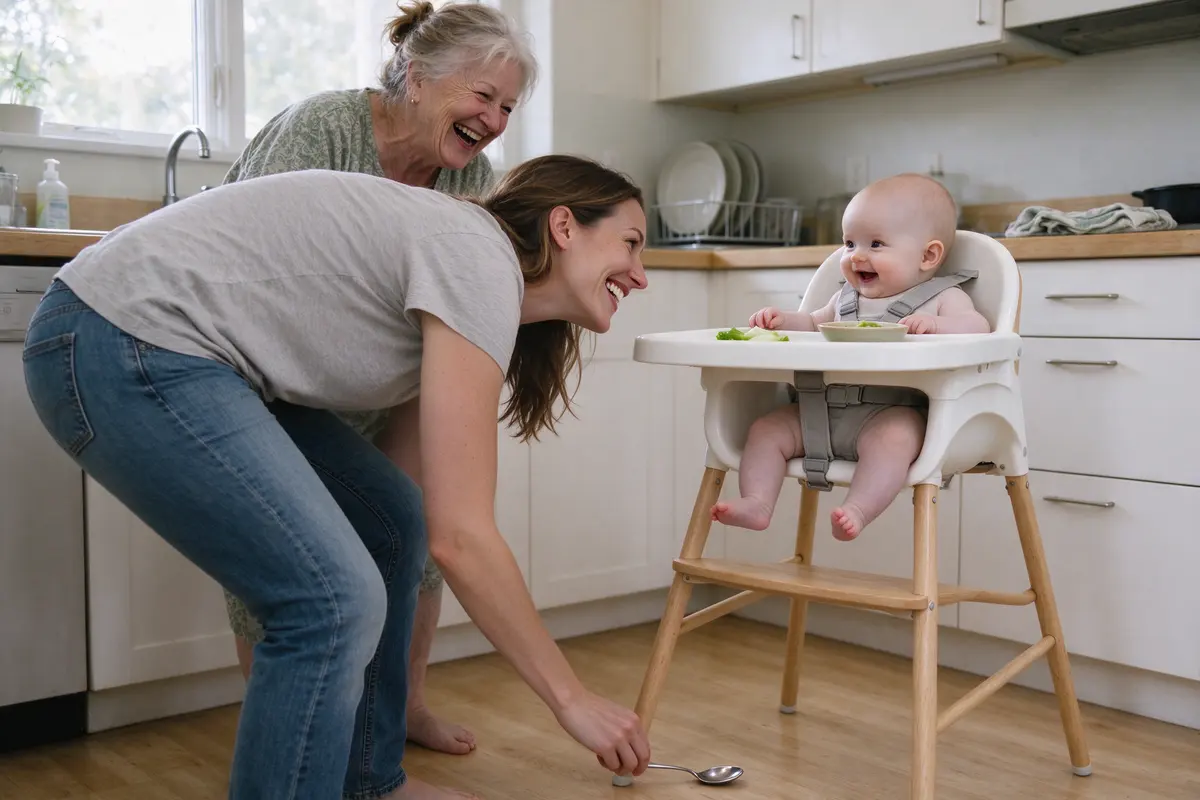
The game of fetch you didn't sign up for. Every parent reaches a moment, usually around the ninth retrieval, of wondering whether this is a joke at their expense. It isn't. Dropping the spoon and watching you pick it up is listed by the AAP as one of the ways babies learn that they can make things happen (AAP), and CDC's advice is the plain version: return the toy, teach the lesson (CDC). So the retrieval is the work, and you are allowed to find it both tedious and worth it. Keep two spoons on the table so you can hand over the second before you bend for the first. Or don't, and count the bending as the one exercise you reliably get.
If you're the partner: take the dinner shift of fetch. It's a real contribution with a real name now.
Sources
- American Academy of Pediatrics. "Cognitive Development in Infants: 4 to 7 Months." HealthyChildren.org, updated 2023. https://www.healthychildren.org/English/ages-stages/baby/Pages/Cognitive-Development-4-to-7-Months.aspx
- Centers for Disease Control and Prevention. "Milestones by 6 Months." Learn the Signs. Act Early. program, updated 2026. https://www.cdc.gov/act-early/milestones/6-months.html
- American Academy of Pediatrics. "Emotional and Social Development: 4 to 7 Months." HealthyChildren.org, updated 2009. https://www.healthychildren.org/English/ages-stages/baby/Pages/Emotional-and-Social-Development-4-7-Months.aspx
- American Academy of Pediatrics. "Choking Prevention for Babies & Children: What Every Parent Needs to Know." HealthyChildren.org, updated 2026. https://www.healthychildren.org/English/health-issues/injuries-emergencies/Pages/Choking-Prevention.aspx
- American Red Cross. "Infant Choking: How To Help." Accessed 2026. https://www.redcross.org/take-a-class/resources/learn-first-aid/infant-choking
- American Academy of Pediatrics. "Swallowed Foreign Object" (symptom checker). HealthyChildren.org, accessed 2026. https://www.healthychildren.org/English/tips-tools/symptom-checker/Pages/symptomviewer.aspx?symptom=Swallowed+Foreign+Object
- Centers for Disease Control and Prevention. "Concerned About Your Child's Development?" 2026. https://www.cdc.gov/act-early/families/concerned.html
This guide is general education that summarizes published research and guidance from groups like the American Academy of Pediatrics, the CDC, and the WHO. It isn’t medical advice, and every child develops on their own timeline. Your pediatrician knows your child; if something feels wrong, call them. In an emergency, call 911.
Get each day’s note the morning it applies
Add your baby to a free Chorevia household with their date of birth, and every morning for 300 days the day’s note arrives in the app and by email: what’s developing, one thing to try, what to watch for, and a word for you.
Create your household