Day 167 of 300 · Week 23
Naps and nights at five months
Last reviewed · 4 min read · 12 sources · Plain-text version
Twelve to 16 hours a day, at least two naps, and a night that half of 5-month-olds sleep through and half don't. Write today's naps on paper and look for the pattern, not the exceptions.
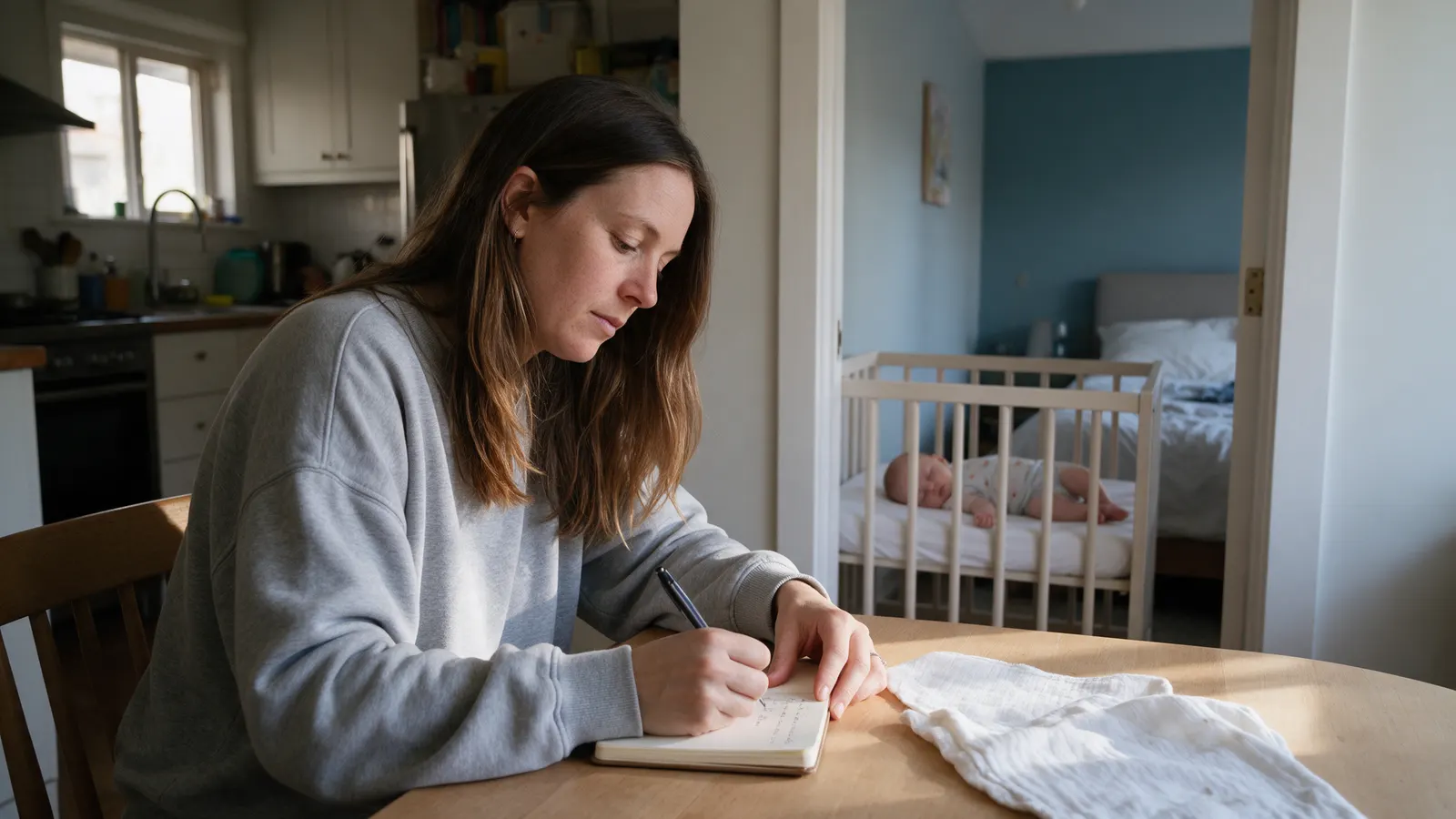
Sleep is the subject most 5-month-old parents are asked about, and the one with the least agreed-on answer. Today is about what's actually known, and about looking at your own baby's day on paper.
Heart
Sleep experts recommend 12 to 16 hours in 24 hours, naps included, for babies 4 to 12 months old (Paruthi et al., 2016). Most babies this age take at least two naps, about 3 to 4 hours of daytime sleep in all (Nemours KidsHealth), and brief night waking is still normal (AAP). As for "sleeping through": in sleep diaries for 75 babies, half slept from 10 p.m. to 6 a.m. without needing a parent by 5 months. At 12 months, 21 of the 75 still didn't (Henderson et al., 2010). Whichever half your baby is in, they have company.
Head
What the AAP suggests for babies 4 months and older is modest: put your baby down drowsy and give them a few minutes to resettle before rushing in, while still feeding or comforting them when they need it (AAP). A short, repeatable routine at a regular bedtime helps your baby know what comes next (AAP). That's the whole prescription at this age. Sleep training research and the options, if you want them, are in the 6-month guide; nothing about today requires a decision.
Body
One rule has changed since the newborn weeks, because of rolling. Always start your baby on their back, but once they roll both ways comfortably, you don't need to flip them back (Moon, AAP). Many babies roll both ways by about 7 months, usually tummy to back first (AAP), so most 5-month-olds are still in the "put them back" stage. Tomorrow's note is the rest of the rolling-and-sleep rules.
Try today
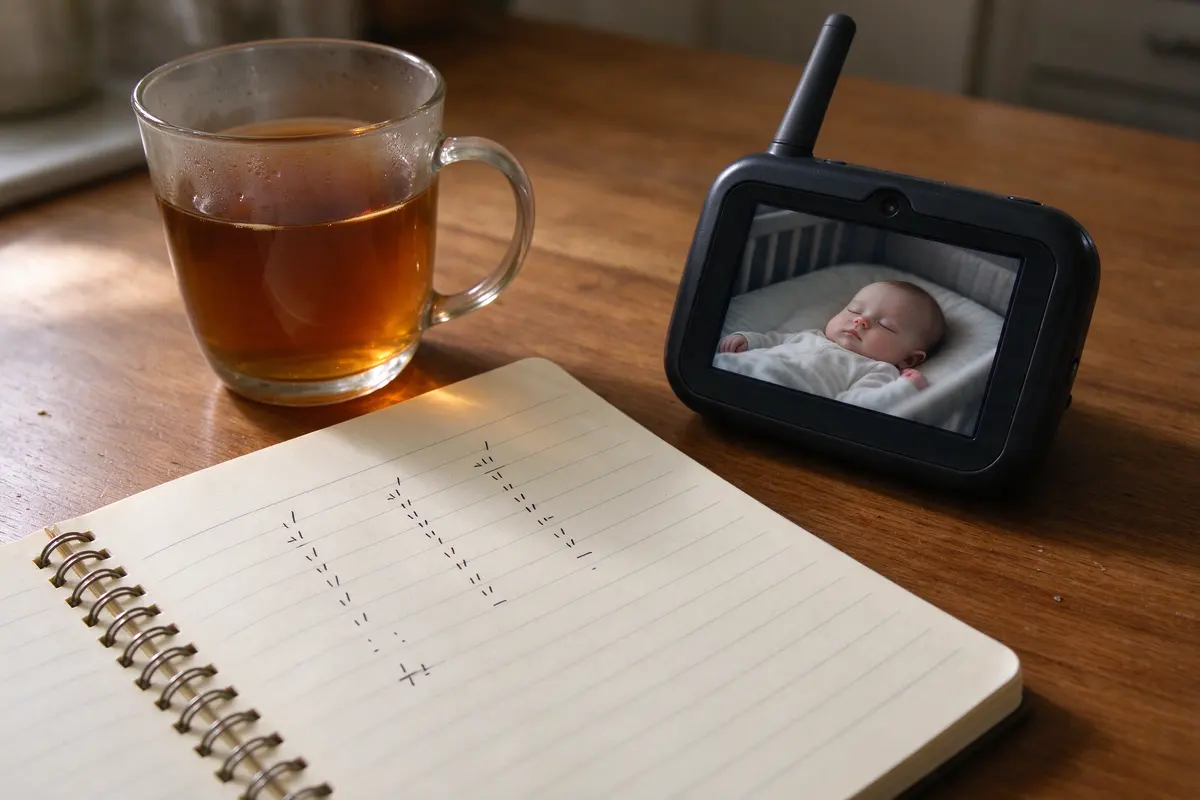
The nap map
Time: 2 minutes, three times today · Sleep and naps in the guide
Write the start and end of each nap today, and bedtime, on a page you'll keep.
Add it up tonight against the figures: 12 to 16 hours in 24 (Paruthi et al., 2016), and 3 to 4 hours of daytime sleep over at least two naps (Nemours KidsHealth).
Do it for three days, then look for the shape of a typical day, not the worst one.
If the shape worries you, it goes on the question list; the 6-month visit is built for questions like it (AAP).
Make it work:A 20-minute nap counts. So does the one in the stroller, as long as a stroller nap ends on a firm, flat surface once you're home.
Watch for
Normal
naps of wildly different lengths from one day to the next.
Call your pediatrician right away
if your baby looks or acts very sick, or you think they need to be seen urgently (AAP).
Normal
waking in the night and settling after a feed; brief night waking is normal at this age (AAP).
Go to the ER now
if your baby isn't alert when awake, or is hard to wake (AAP).
Normal
being in the half that doesn't sleep 10 p.m. to 6 a.m. yet (Henderson et al., 2010).
Call 911
if your baby is struggling for each breath, has stopped breathing, or has bluish lips or face (AAP).
For you
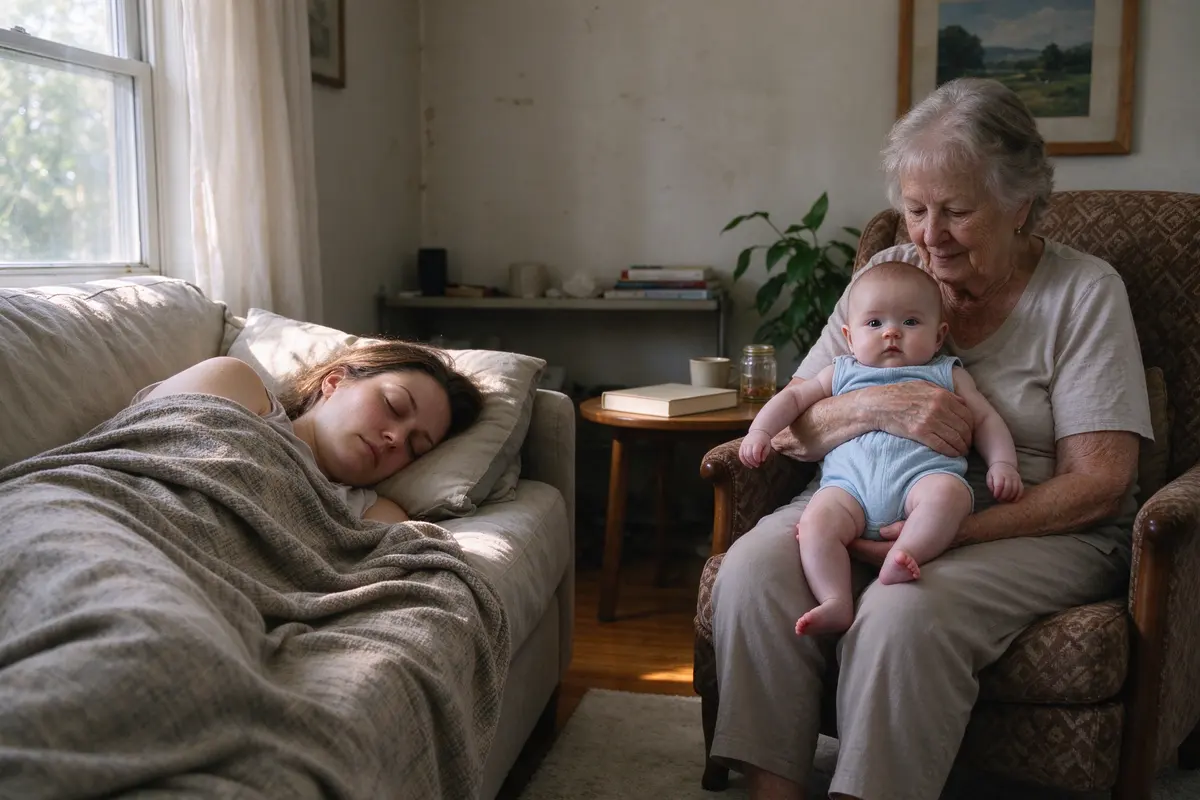
Both patterns are normal, and so is yours. If your baby is in the sleeping-through half, enjoy it without guarding it; it isn't something you did. If they're in the other half, it isn't something you failed to do, and the diaries say it's just as common (Henderson et al., 2010).
What you can change is your own sleep. Bank it: nap when your baby naps, and go to bed right after the last feed (Moon, AAP). Overwhelming tiredness, the kind sleep doesn't touch, is on the CDC's list of urgent maternal warning signs (CDC); know the difference between tired and that.
If you're the partner: the nap map tells you when she can sleep. Take the first wake tonight so the map has a night column too.
Sources
- Paruthi S, Brooks LJ, D'Ambrosio C, et al. "Recommended Amount of Sleep for Pediatric Populations: A Consensus Statement of the American Academy of Sleep Medicine." Journal of Clinical Sleep Medicine, 2016. https://pubmed.ncbi.nlm.nih.gov/27250809/
- Nemours KidsHealth. "Baby Sleep: 4- to 7-Month-Olds." 2022. https://kidshealth.org/en/parents/sleep47m.html
- American Academy of Pediatrics. "Getting Your Baby to Sleep." HealthyChildren.org, 2024. https://www.healthychildren.org/English/ages-stages/baby/sleep/Pages/getting-your-baby-to-sleep.aspx
- Henderson JM, France KG, Owens JL, Blampied NM. "Sleeping through the night: the consolidation of self-regulated sleep across the first year of life." Pediatrics, 2010. https://pubmed.ncbi.nlm.nih.gov/20974775/
- American Academy of Pediatrics. "Brush, Book, Bed: How to Structure Your Child's Nighttime Routine." HealthyChildren.org, 2024. https://www.healthychildren.org/English/healthy-living/oral-health/Pages/Brush-Book-Bed.aspx
- Moon RY. "How to Keep Your Sleeping Baby Safe: AAP Policy Explained." HealthyChildren.org, 2026. https://www.healthychildren.org/English/ages-stages/baby/sleep/Pages/a-parents-guide-to-safe-sleep.aspx
- American Academy of Pediatrics. "Movement Milestones: Babies 4 to 7 Months." HealthyChildren.org, 2021. https://www.healthychildren.org/English/ages-stages/baby/Pages/Movement-4-to-7-Months.aspx
- American Academy of Pediatrics. "Checkup Checklist: 6 Months Old." HealthyChildren.org, 2023. https://www.healthychildren.org/English/ages-stages/Your-Childs-Checkups/Pages/Your-Checkup-Checklist-6-Months-Old.aspx
- American Academy of Pediatrics. "Fever" (symptom checker). HealthyChildren.org, 2026. https://www.healthychildren.org/English/tips-tools/symptom-checker/Pages/symptomviewer.aspx?symptom=Fever
- American Academy of Pediatrics. "Breathing Trouble" (symptom checker). HealthyChildren.org, 2026. https://www.healthychildren.org/English/tips-tools/symptom-checker/Pages/symptomviewer.aspx?symptom=Breathing+Trouble
- Moon RY. "Safe Sleep Tips for Sleep-Deprived New Parents." HealthyChildren.org, 2026. https://www.healthychildren.org/English/ages-stages/baby/sleep/Pages/safe-sleep-tips-for-sleep-deprived-parents.aspx
- Centers for Disease Control and Prevention. "Urgent Maternal Warning Signs and Symptoms." HEAR HER, 2024. https://www.cdc.gov/hearher/maternal-warning-signs/index.html
This guide is general education that summarizes published research and guidance from groups like the American Academy of Pediatrics, the CDC, and the WHO. It isn’t medical advice, and every child develops on their own timeline. Your pediatrician knows your child; if something feels wrong, call them. In an emergency, call 911.
Get each day’s note the morning it applies
Add your baby to a free Chorevia household with their date of birth, and every morning for 300 days the day’s note arrives in the app and by email: what’s developing, one thing to try, what to watch for, and a word for you.
Create your household