Day 164 of 300 · Week 22
Twenty-three weeks: teeth, honestly
Last reviewed · 4 min read · 7 sources · Plain-text version
First teeth usually come between 6 and 10 months, and teething gets blamed for far more than it does. A week of notes on paper shows you what it actually looks like in your baby.
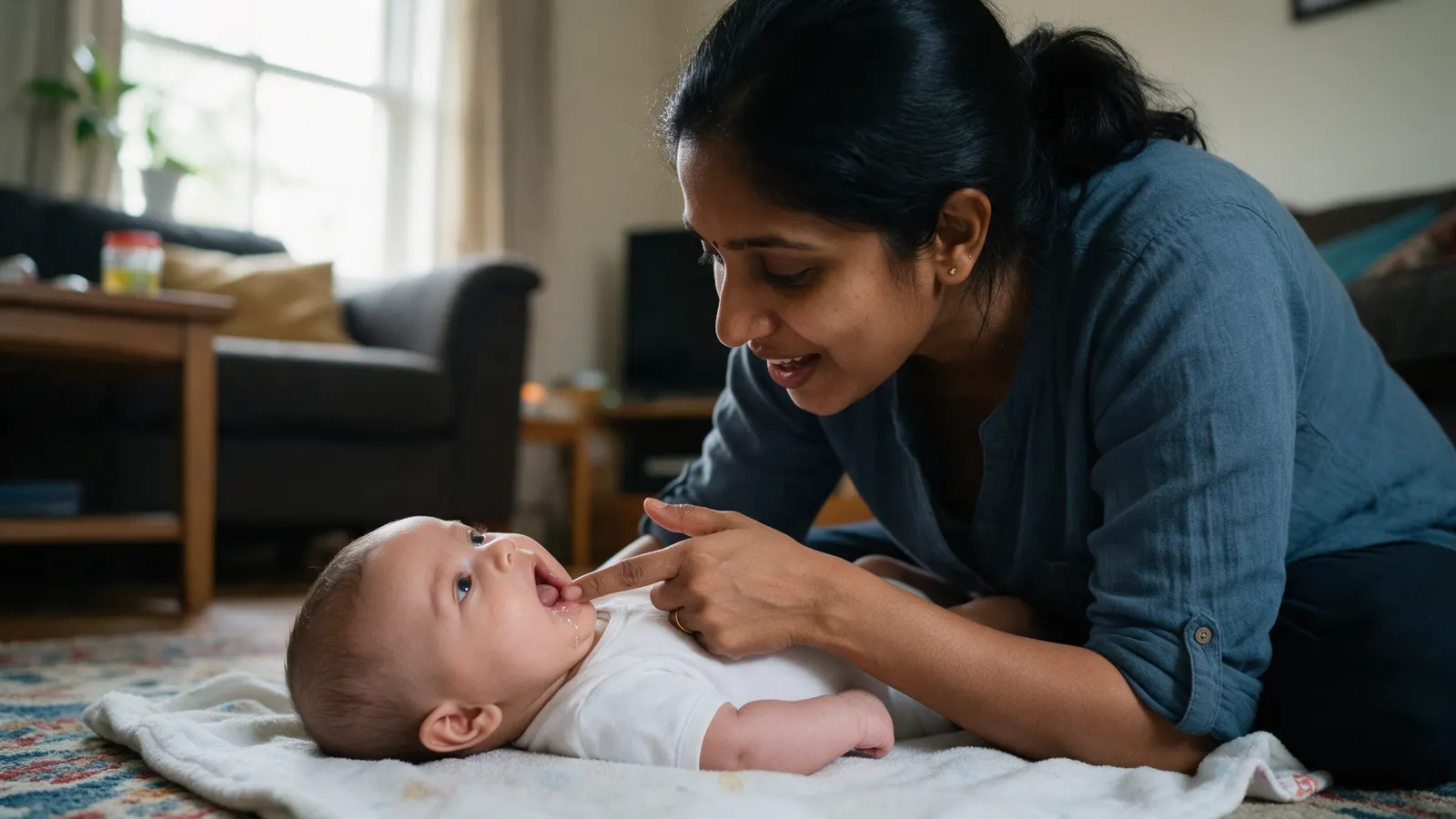
Every parent has heard "it's just teething" about a fever, a runny nose, a bad night. Today is about what teething actually does, measured, and what it doesn't.
Heart
First teeth usually appear between 6 and 10 months, starting with the bottom front two, but discomfort can start weeks or months earlier (AAP), and some babies have no teeth by their first birthday (AAP). The signs are drooling, chewing on everything, swollen or tender gums, mild fussiness, and a rash around the mouth from drool (AAP). The trouble is that babies this age mouth everything anyway (AAP), so the signs are easy to see and hard to read.
Head
The best study is small and careful. Parents of 125 babies logged symptoms daily from 4 months to age 1, covering 475 new teeth. Drooling, biting, gum-rubbing, fussiness, wakefulness, and a mild temperature rise clustered in the 8 days around each tooth; congestion, loose stools, vomiting, and fever over 102°F did not. And no symptom showed up in more than 35% of teething babies (Macknin et al., 2000). A 2016 meta-analysis of 16 studies agreed: a slight temperature rise, but not a fever (Massignan et al., 2016). Put plainly, teething doesn't cause a true fever of 100.4°F (38°C) or higher (AAP). Whatever is causing one is something else.
Body
So the rule for this month is the same as last month's: for any fever of 100.4°F (38°C) or higher at 3 to 6 months, call within 24 hours (AAP), and don't blame it on teething (AAP). Diarrhea or a very unhappy baby isn't "just teething" either; call (AAP). Tomorrow is about what helps sore gums. Today is about seeing clearly.
Try today
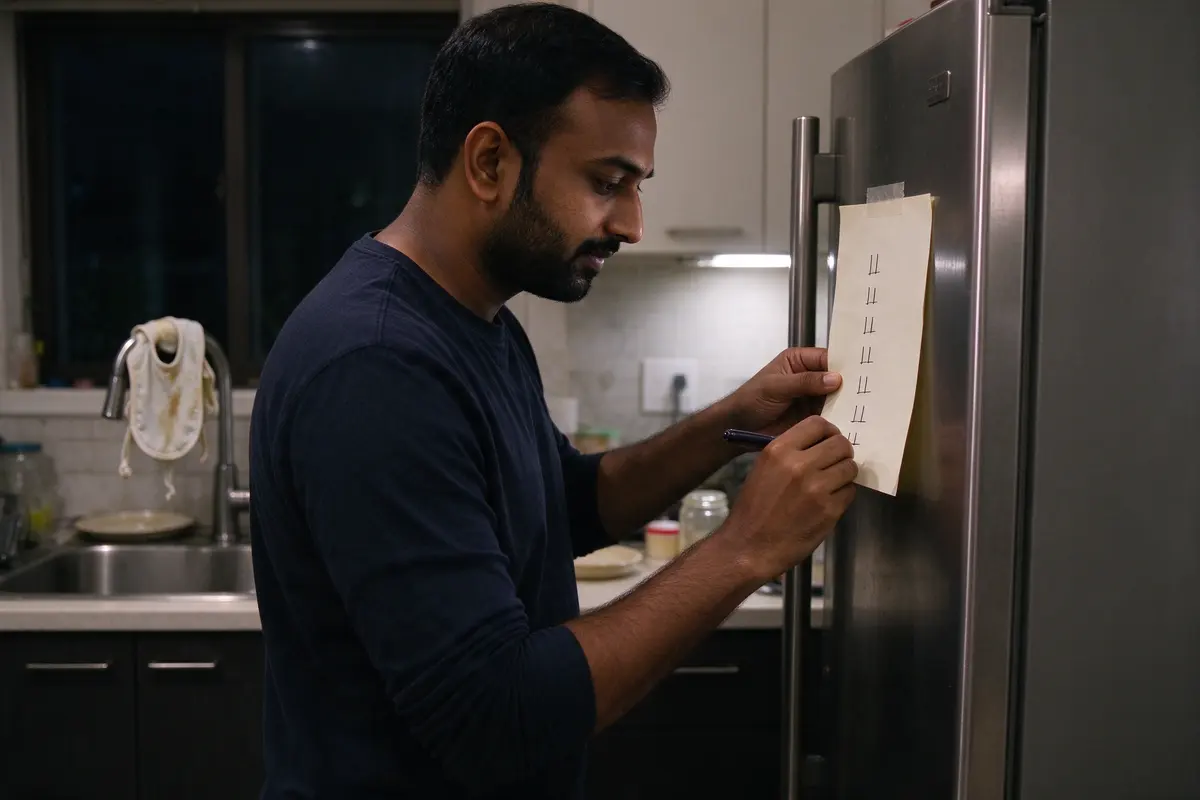
The teething log
Time: 1 minute each evening, for a week · What the research says in the guide
Tape a sheet to the fridge. Tonight, write the date and tick what you saw: drool, biting, gum-rubbing, fussiness, extra waking, and a temperature if you took one, the same symptoms the study parents tracked (Macknin et al., 2000).
Repeat each evening for seven days, whoever did bedtime.
Read it back at the end: a few symptoms bunched over a few days is what a tooth looks like; a fever, loose stools, or vomiting on the sheet is a reason to call, not a tooth (Macknin et al., 2000; Massignan et al., 2016).
Keep the sheet for the 6-month visit, where teeth are on the list of questions (AAP).
Make it work:Take any temperature the way you practiced on day 145, on a calm minute, and write the number, not "warm."
Watch for
Normal
a red, chapped patch around the mouth from drool (AAP).
Call your pediatrician within 24 hours
for any fever of 100.4°F (38°C) or higher at 3 to 6 months (AAP), whatever the gums look like.
Normal
a fist, a sleeve, and the edge of the sofa all gnawed in one afternoon (AAP).
Call your pediatrician right away
if your baby has a fever higher than 104°F (40°C), or looks or acts very sick (AAP).
Normal
a fussy few days that pass.
Go to the ER now
if your baby had a seizure with a fever, or isn't alert when awake (AAP).
For you
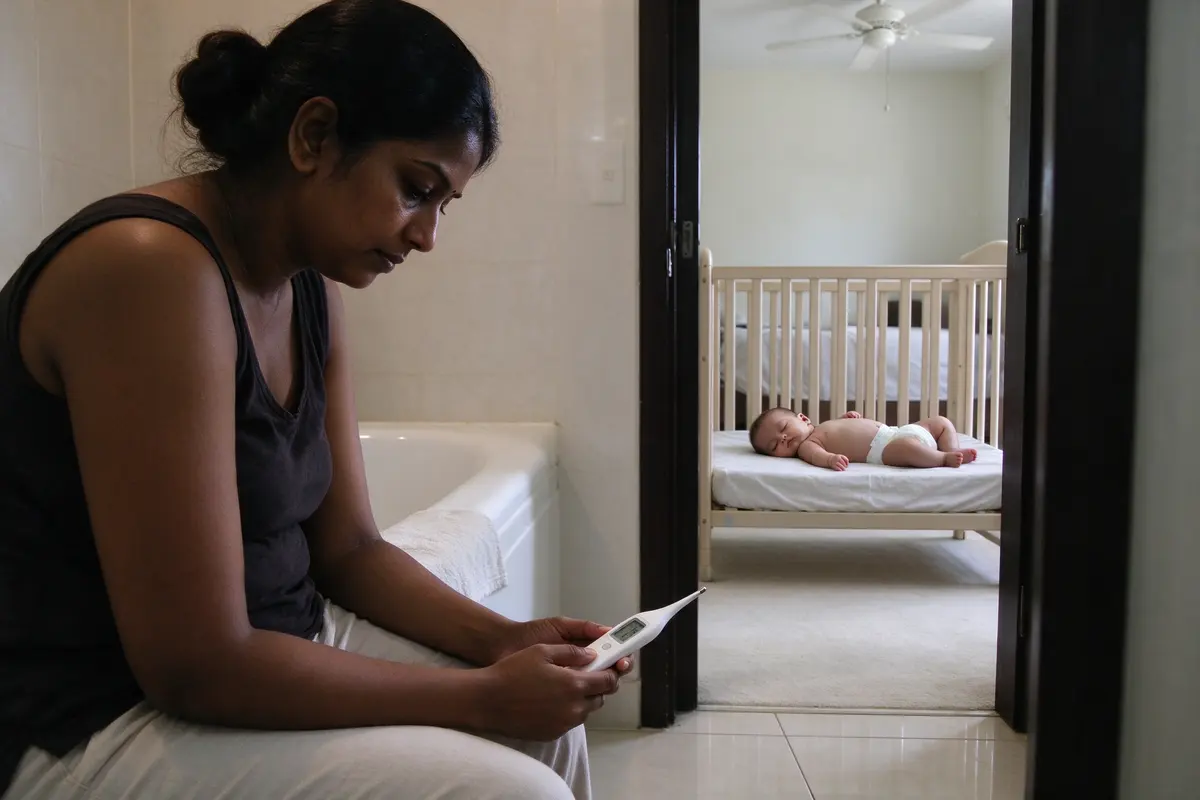
A real fever is never "just teething," and the same honesty applies to you. A fever of 100.4°F or higher is on the CDC's list of urgent maternal warning signs, the ones that mean seek care now, and the CDC's advice is to tell any provider you were pregnant within the last year (CDC). It is easy, twenty-three weeks in, to assume every ache of yours is tiredness and every ache of the baby's is teeth. Neither assumption is safe. If something in you feels wrong, the CDC's line is the one to use: if you feel like something just isn't right, talk to your health care provider (CDC).
If you're the partner: the fridge sheet is a shared job, and so is noticing when she's the one running warm.
Sources
- American Academy of Pediatrics Section on Oral Health. "Teething Pain Relief: How to Soothe Your Baby's Discomfort." HealthyChildren.org, 2025. https://www.healthychildren.org/English/ages-stages/baby/teething-tooth-care/Pages/Teething-Pain.aspx
- DiMaggio D, Cernigliaro J. "Baby's First Tooth: 7 Facts Parents Should Know." HealthyChildren.org, 2022. https://www.healthychildren.org/English/ages-stages/baby/teething-tooth-care/Pages/Babys-First-Tooth-Facts-Parents-Should-Know.aspx
- Macknin ML, Piedmonte M, Jacobs J, Skibinski C. "Symptoms associated with infant teething: a prospective study." Pediatrics, 2000. https://pubmed.ncbi.nlm.nih.gov/10742315/
- Massignan C, Cardoso M, Porporatti AL, et al. "Signs and Symptoms of Primary Tooth Eruption: A Meta-analysis." Pediatrics, 2016. https://pubmed.ncbi.nlm.nih.gov/26908659/
- American Academy of Pediatrics. "Fever" (symptom checker). HealthyChildren.org, 2026. https://www.healthychildren.org/English/tips-tools/symptom-checker/Pages/symptomviewer.aspx?symptom=Fever
- American Academy of Pediatrics. "Checkup Checklist: 6 Months Old." HealthyChildren.org, 2023. https://www.healthychildren.org/English/ages-stages/Your-Childs-Checkups/Pages/Your-Checkup-Checklist-6-Months-Old.aspx
- Centers for Disease Control and Prevention. "Urgent Maternal Warning Signs and Symptoms." HEAR HER, 2024. https://www.cdc.gov/hearher/maternal-warning-signs/index.html
This guide is general education that summarizes published research and guidance from groups like the American Academy of Pediatrics, the CDC, and the WHO. It isn’t medical advice, and every child develops on their own timeline. Your pediatrician knows your child; if something feels wrong, call them. In an emergency, call 911.
Get each day’s note the morning it applies
Add your baby to a free Chorevia household with their date of birth, and every morning for 300 days the day’s note arrives in the app and by email: what’s developing, one thing to try, what to watch for, and a word for you.
Create your household