Day 173 of 300 · Week 24
Cords, blinds, necklaces
Last reviewed · 3 min read · 10 sources · Plain-text version
About nine young children a year die in window-cord strangulations, in under a minute. A room-by-room walk for cords, the crib's spot, and anything around a neck.
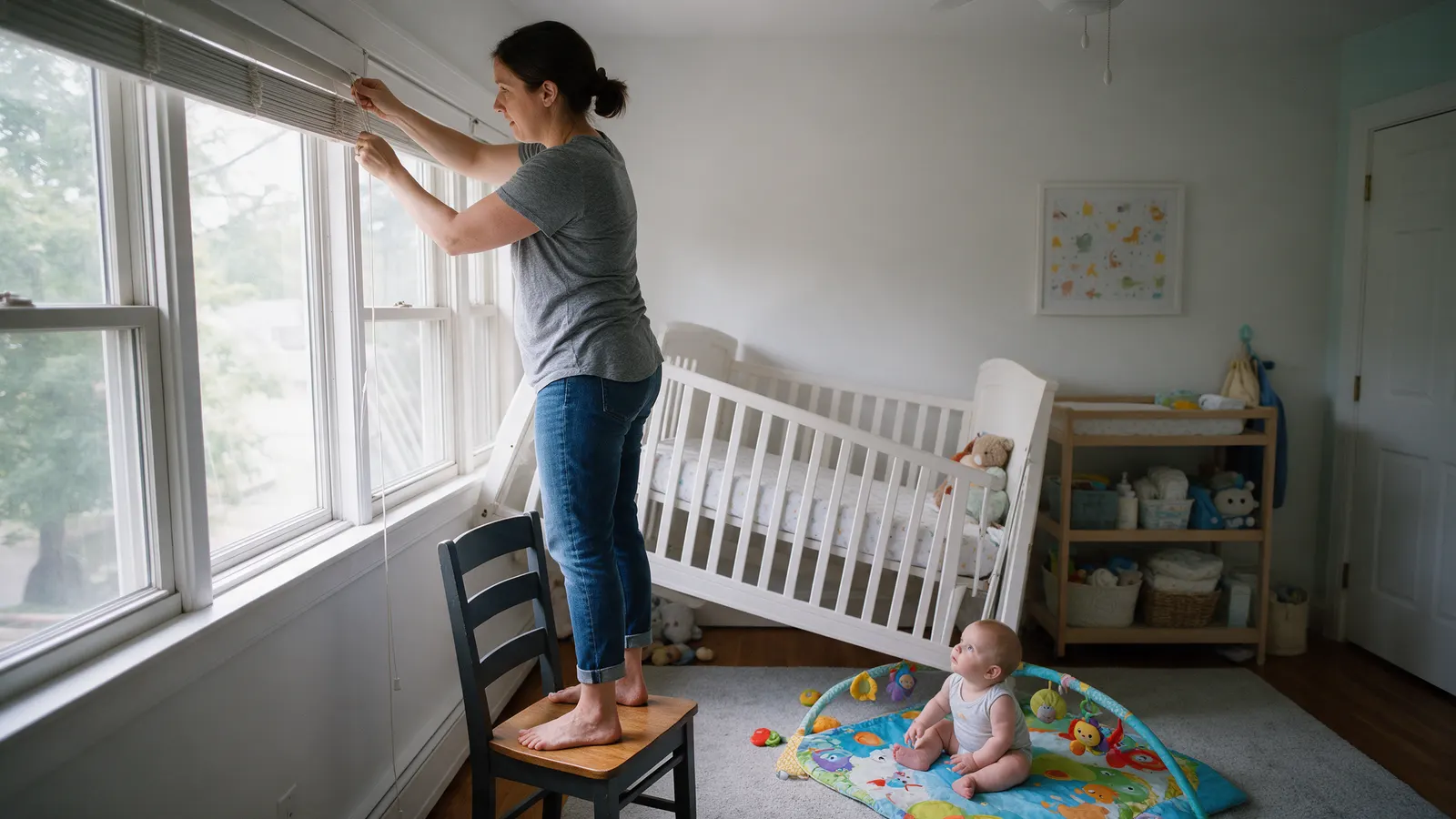
Your baby rolls now, reaches now, and pulls whatever reaches back. Today is a walk through the house looking for the one kind of hazard that works in silence: a loop.
Heart
About nine children 5 and under die each year from window-cord strangulation, and it can happen in under a minute (CPSC, 2021). In a review of blind-cord entanglements in young children that were investigated, two-thirds were fatal (Onders et al., 2018). The numbers are small next to the numbers for falls or choking, and that's the point: the fix is cheap and complete. Choose cordless window coverings, and move cribs and furniture away from windows (CPSC, 2021).
Head
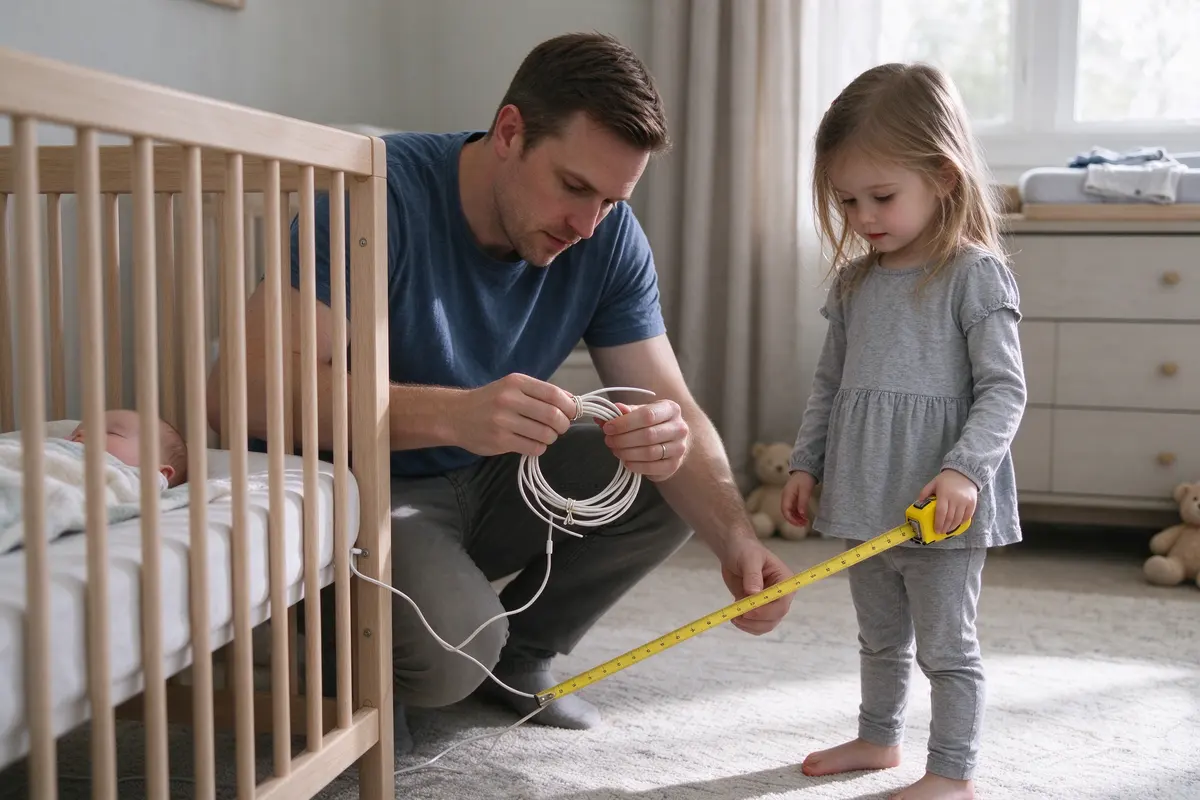
The crib gets its own check. Keep baby monitor, lamp, and night-light cords at least 3 feet from the crib (CPSC, 2019). Three feet is farther than it sounds; a monitor on the dresser beside the crib with its cord trailing down the back is the usual miss. Tape measure it once. And a baby who rolls both ways is a baby who ends up at the crib rail, so the cordless rule and the 3-foot rule aren't for someday; many babies roll both ways by about 7 months, usually tummy to back first (AAP).
Body
Nothing goes around the neck. Teething necklaces and bracelets have caused deaths and serious injuries from strangulation and choking, with no evidence they relieve pain (FDA), and the AAP doesn't recommend any jewelry for babies (AAP). That includes the gift, the heirloom, and the one with the clasp that "breaks away." Pacifiers are in the same family: never on a cord around the neck or clipped to clothing for sleep (AAP). The cords, blinds, and necklaces section of the guide is the whole list.
Try today
The cord walk
Time: 20 minutes, once · Cords, blinds, and necklaces in the guide
Room by room, find every window covering with a cord. Replace it with a cordless one, or for now tie every cord up high and out of reach (CPSC, 2021).
Move the crib, and any furniture a baby could climb, away from the windows (CPSC, 2021).
Measure 3 feet from the crib and move every monitor, lamp, and night-light cord outside that line (CPSC, 2019).
Take off any necklace or bracelet on the baby, and put pacifier clips away at sleep time (AAP).
Make it work:Do the walk at the baby's height: lie on the floor by the crib and look up. Cords you can't see standing are the ones a rolling baby finds.
Watch for
Normal
a baby who grabs your necklace, your glasses, and your hair; reaching for what they want is a 6-month milestone (CDC).
Call 911
if your baby is not moving or is very weak, or can't be woken (AAP).
Normal
rolling to the edge of the mat and getting stuck against the sofa.
Call your pediatrician
if your baby has lost skills they once had (CDC).
Normal
chewing on a teether, a washcloth, or their own fist for most of the day.
Go to the ER now
if your baby swallowed, or might have swallowed, a button battery or magnet (AAP).
For you
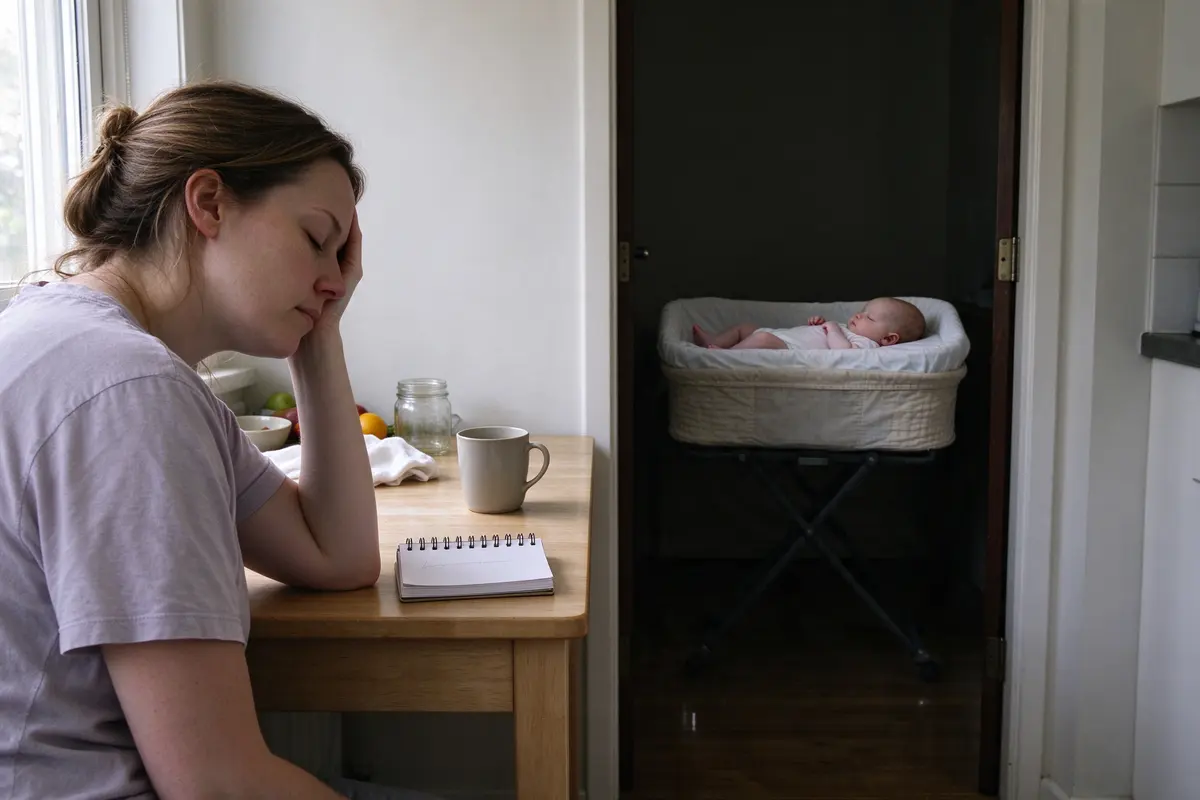
The one change you make today sticks. A cordless blind doesn't need you to remember anything tomorrow; a crib three feet from the window stays three feet from the window at 3 a.m. when you're too tired to think (CPSC, 2021). Most of what keeps a baby safe is habits, and habits need a rested brain. This is the other kind: a fix you make once with the brain you have at 10 a.m., and then never again.
So pick the one you can do today. Tie the cords up if the new blinds are a week away. Write the rest on a list and hand it to someone.
If you're the partner: the list is yours. Blinds, the crib, the tape measure. Done by the weekend.
Sources
- US Consumer Product Safety Commission. "CPSC to Consumers: The Safest Window Coverings When Young Children Are Present Are Cordless." 2021. https://www.cpsc.gov/Newsroom/News-Releases/2022/CPSC-to-Consumers-The-Safest-Window-Coverings-When-Young-Children-Are-Present-Are-Cordless
- Onders B, Kim EH, Chounthirath T, Hodges NL, Smith GA. "Pediatric Injuries Related to Window Blinds, Shades, and Cords." Pediatrics, 2018. https://pubmed.ncbi.nlm.nih.gov/29229682/
- US Consumer Product Safety Commission. "CPSC Issues Call to Action: Check Your Homes for Recalled Products; Babies' Lives Depend on It!" OnSafety, 2019. https://onsafety.cpsc.gov/blog/2019/09/11/cpsc-issues-call-to-action-check-your-homes-for-recalled-products-babies-lives-depend-on-it
- American Academy of Pediatrics. "Movement Milestones: Babies 4 to 7 Months." HealthyChildren.org, 2021. https://www.healthychildren.org/English/ages-stages/baby/Pages/Movement-4-to-7-Months.aspx
- US Food and Drug Administration. "Safely Soothing Teething Pain in Infants and Children." Consumer update, 2024. https://www.fda.gov/consumers/consumer-updates/safely-soothing-teething-pain-infants-and-children
- American Academy of Pediatrics. "Teething Necklaces and Beads: A Caution for Parents." HealthyChildren.org, 2018. https://www.healthychildren.org/English/ages-stages/baby/teething-tooth-care/Pages/Amber-Teething-Necklaces.aspx
- Moon RY. "How to Keep Your Sleeping Baby Safe: AAP Policy Explained." HealthyChildren.org, 2026. https://www.healthychildren.org/English/ages-stages/baby/sleep/Pages/a-parents-guide-to-safe-sleep.aspx
- Centers for Disease Control and Prevention. "Milestones by 6 Months." Learn the Signs. Act Early., 2026. https://www.cdc.gov/act-early/milestones/6-months.html
- American Academy of Pediatrics. "Fever" (symptom checker). HealthyChildren.org, 2026. https://www.healthychildren.org/English/tips-tools/symptom-checker/Pages/symptomviewer.aspx?symptom=Fever
- American Academy of Pediatrics. "Swallowed Foreign Object" (symptom checker). HealthyChildren.org, 2026. https://www.healthychildren.org/English/tips-tools/symptom-checker/Pages/symptomviewer.aspx?symptom=Swallowed+Foreign+Object
This guide is general education that summarizes published research and guidance from groups like the American Academy of Pediatrics, the CDC, and the WHO. It isn’t medical advice, and every child develops on their own timeline. Your pediatrician knows your child; if something feels wrong, call them. In an emergency, call 911.
Get each day’s note the morning it applies
Add your baby to a free Chorevia household with their date of birth, and every morning for 300 days the day’s note arrives in the app and by email: what’s developing, one thing to try, what to watch for, and a word for you.
Create your household