Day 160 of 300 · Week 22
Not before you're both ready
Last reviewed · 3 min read · 13 sources · Plain-text version
Readiness for solids is four signs, not a date. What the AAP, WHO, and a Cochrane review say about six months, who should wait, and a way to watch for the signs at dinner tonight.

The calendar says almost six months. Today is about the four things that matter more than the calendar.
Heart
Readiness has signs, and the date isn't one of them. The signs include sitting up alone or with support, good head and neck control, opening their mouth when food comes, and swallowing food instead of pushing it out (CDC). The timing guidance is consistent: the AAP recommends only breast milk for about the first 6 months (AAP), the WHO starts other foods at 6 months (WHO, 2023), and starting before 4 months isn't recommended (CDC). Both halves count: you and your baby both have to be ready.
Head
"About 6 months" rests on solid ground. A Cochrane review of 23 studies found that babies breastfed exclusively for 6 months, rather than 3 to 4, grew just as well and had fewer stomach infections; where newborn iron stores may be low, iron status could suffer without drops (Kramer & Kakuma, 2012). And there's no reason to hold back once your baby is ready: the AAP finds no evidence that delaying allergenic foods past 4 to 6 months prevents allergy (Greer et al., 2019). There's no prize for starting early, and no penalty for starting on time.
Body
Some babies should wait a little longer. If your baby was premature or struggles to sit or swallow, wait (AAP); if they were born early, their corrected age is the age that counts (AAP). The 6-month checkup includes questions about solids (AAP), so what you notice at the table this week is what you'll bring to it.
Try today
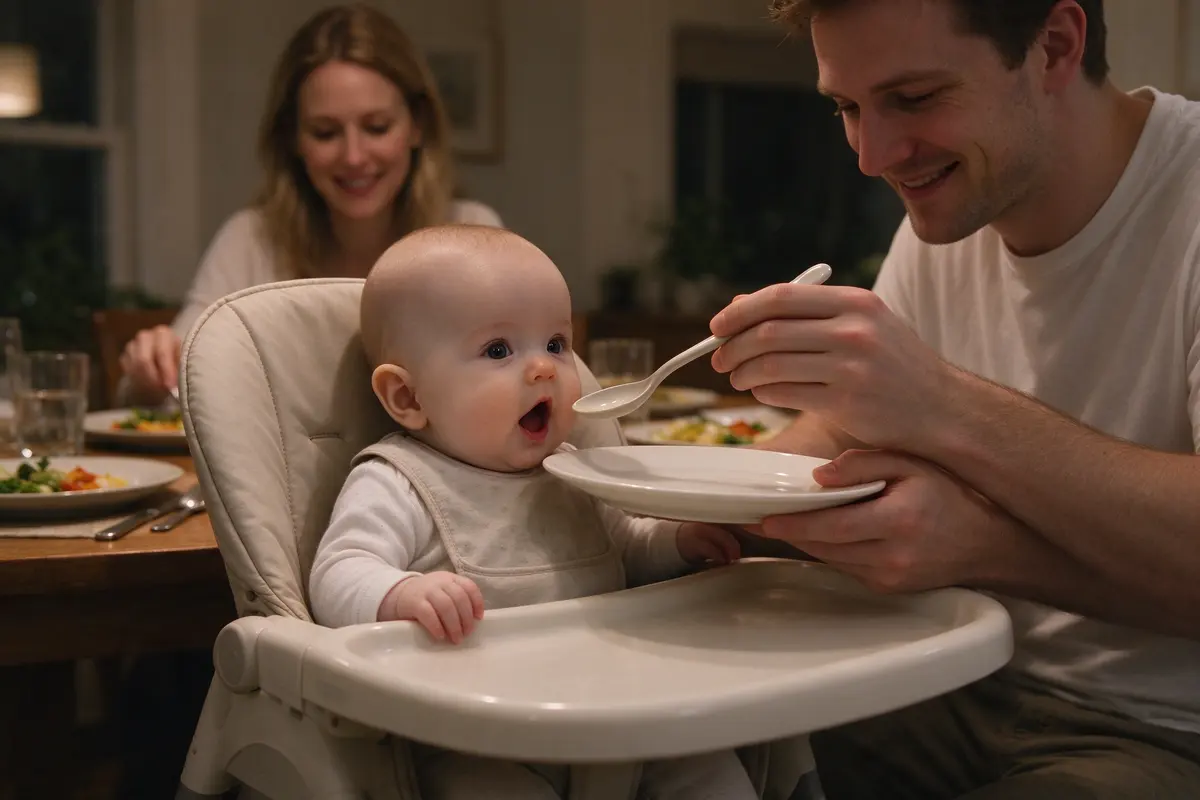
The readiness watch
Time: One family meal, no food for the baby · Get ready for solids without rushing in the guide
Buckle your baby into a high chair, harness fastened, or hold them on your lap at the table while the family eats (AAP).
Watch the first two signs: do they sit with support, and hold their head steady through the meal (CDC)?
Bring an empty spoon toward their lips. Do they open for it, or push it out with the tongue (CDC)?
Notice whether they watch you eat and reach for your food, both readiness signs (AAP).
Write down what you saw. Nothing is eaten tonight.
Watch for
Normal
a tongue that pushes the spoon straight back out; that baby isn't ready yet, and there's no hurry (CDC).
Ask your pediatrician before starting
if your baby was premature or struggles to sit or swallow (AAP).
Normal
a slump to one side after a few minutes upright.
Normal
a gag when the spoon handle goes in too far, then carrying on.
Call 911
if your baby choked on a small object that could still be stuck, or is struggling for each breath (AAP).
Normal
a hunch with nothing you can point to.
Call anyway
if your baby just doesn't seem right to you. Trust your instincts; twenty-two weeks have trained them (Lurie Children's).
For you

Your own meal first. The AAP encourages family meals from the first feeding (AAP), and a family meal needs you at the table with a plate, not standing at the counter eating the toddler's crusts. Tonight, before anyone watches the baby for anything, sit down and eat a whole meal while it's warm. The readiness you're modeling is yours.
If you're the partner: tonight's meal is your watch. She eats; you hold the baby and count the signs.
Sources
- Centers for Disease Control and Prevention. "When, What, and How to Introduce Solid Foods." 2026. https://www.cdc.gov/infant-toddler-nutrition/foods-and-drinks/when-what-and-how-to-introduce-solid-foods.html
- American Academy of Pediatrics. "When Can Babies Start Solid Foods? Readiness & Feeding Tips." HealthyChildren.org, updated 2026. https://www.healthychildren.org/English/ages-stages/baby/feeding-nutrition/Pages/Starting-Solid-Foods.aspx
- World Health Organization. "WHO Guideline for complementary feeding of infants and young children 6-23 months of age." 2023. https://www.who.int/publications/i/item/9789240081864
- Kramer MS, Kakuma R. "Optimal duration of exclusive breastfeeding." Cochrane Database of Systematic Reviews, 2012. https://pubmed.ncbi.nlm.nih.gov/22895934/
- Greer FR, Sicherer SH, Burks AW; AAP Committee on Nutrition, Section on Allergy and Immunology. "The Effects of Early Nutritional Interventions on the Development of Atopic Disease in Infants and Children." Pediatrics, 2019. https://pubmed.ncbi.nlm.nih.gov/30886111/
- Agbim IA, Hurtado CW. "Baby-Led Weaning: Is It Safe?" HealthyChildren.org, updated 2024. https://www.healthychildren.org/English/ages-stages/baby/feeding-nutrition/Pages/baby-led-weaning-is-it-safe.aspx
- American Academy of Pediatrics. "Corrected Age For Preemies." HealthyChildren.org, updated 2018. https://www.healthychildren.org/English/ages-stages/baby/preemie/Pages/Corrected-Age-For-Preemies.aspx
- American Academy of Pediatrics. "Checkup Checklist: 6 Months Old." HealthyChildren.org, updated 2023. https://www.healthychildren.org/English/ages-stages/Your-Childs-Checkups/Pages/Your-Checkup-Checklist-6-Months-Old.aspx
- American Academy of Pediatrics Council on Injury, Violence and Poison Prevention. "Infant Drowning Prevention & Water Safety: How to Protect Your Baby." HealthyChildren.org, updated 2026. https://www.healthychildren.org/English/safety-prevention/at-play/Pages/Infant-Water-Safety.aspx
- Centers for Disease Control and Prevention. "Milestones by 6 Months." Learn the Signs. Act Early. program, updated 2026. https://www.cdc.gov/act-early/milestones/6-months.html
- Centers for Disease Control and Prevention. "Concerned About Your Child's Development?" 2026. https://www.cdc.gov/act-early/families/concerned.html
- American Academy of Pediatrics. "Breathing Trouble" (symptom checker). HealthyChildren.org, accessed 2026. https://www.healthychildren.org/English/tips-tools/symptom-checker/Pages/symptomviewer.aspx?symptom=Breathing+Trouble
- Lurie Children's Hospital of Chicago. "When to Call the Pediatrician for Your Newborn." 2024. https://www.luriechildrens.org/en/blog/when-to-call-the-pediatrician-for-your-newborn/
This guide is general education that summarizes published research and guidance from groups like the American Academy of Pediatrics, the CDC, and the WHO. It isn’t medical advice, and every child develops on their own timeline. Your pediatrician knows your child; if something feels wrong, call them. In an emergency, call 911.
Get each day’s note the morning it applies
Add your baby to a free Chorevia household with their date of birth, and every morning for 300 days the day’s note arrives in the app and by email: what’s developing, one thing to try, what to watch for, and a word for you.
Create your household