Day 163 of 300 · Week 22
Gear, kept simple
Last reviewed · 3 min read · 12 sources · Plain-text version
A high chair with a harness you buckle every time, a soft spoon, a bib, and later a small cup. That's the whole kit. Today your baby takes a seat at the table, with nothing on the tray.
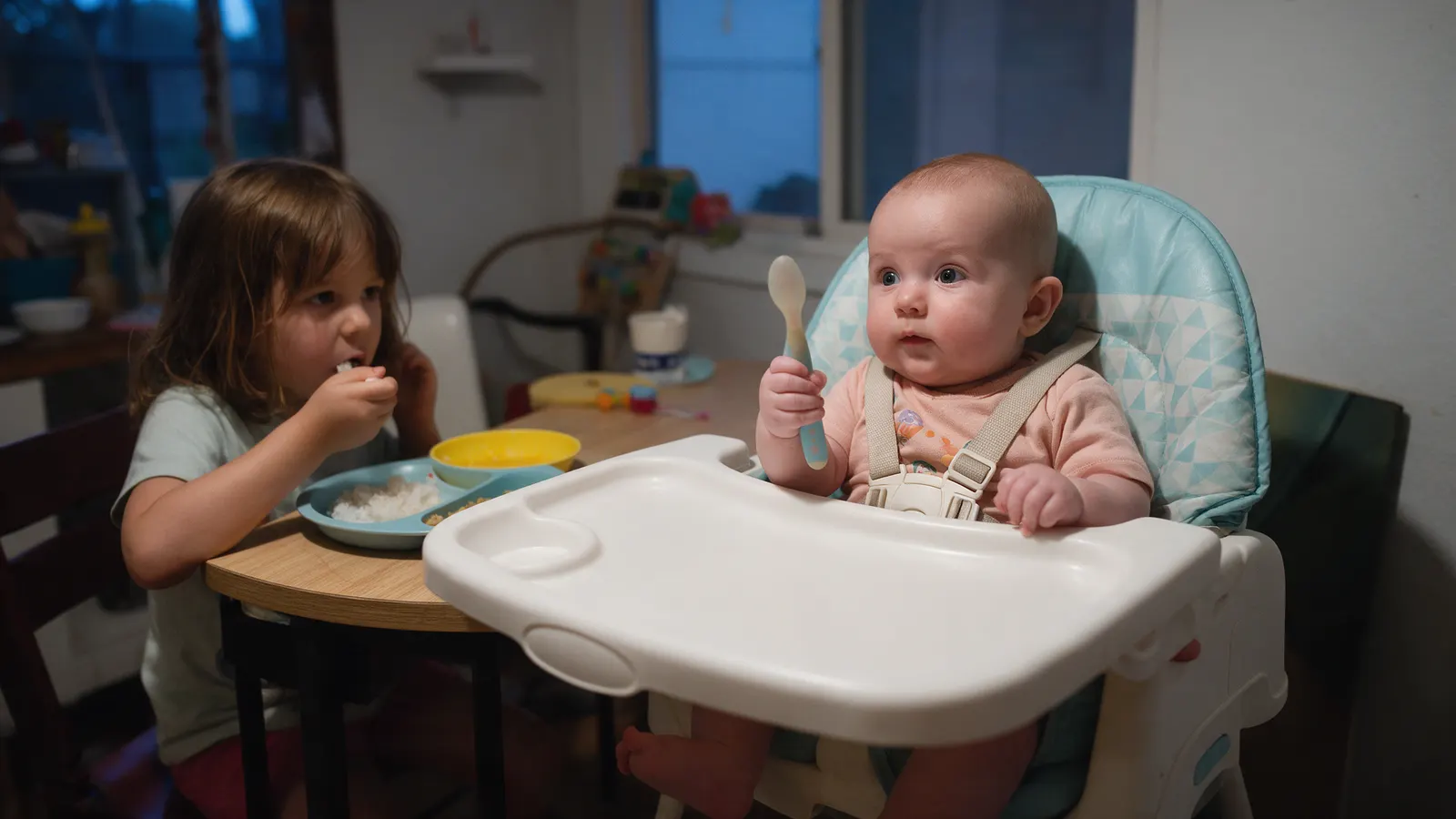
You don't need much for first foods, and most of what you need you can borrow. Today is about the short list, and the chair.
Heart
Gear is simple: a high chair with a harness you buckle every time (AAP), a soft spoon, a bib, and later a small cup for sips of water (AAP). The AAP encourages family meals from the first feeding (AAP), which is the real reason to set the chair up now: your baby can join dinner weeks before they eat it.
Head
The harness isn't fussiness. By 6 months most babies lean on their hands to hold themselves up when sitting (CDC), and many stay upright once set in a sit by 6 to 8 months (AAP); in between, a baby in a chair slides, slumps, and twists after a sibling. If you use a bouncy seat at the table instead, it goes on the floor, not on a table or counter (NHS). Keep hot drinks and plates out of reach (AAP); a tray is exactly arm's length from a reaching hand. And the WHO's limit applies here as much as to a stroller: not more than 1 hour strapped in at a time (WHO). One meal, then out.
Body
If you don't have a chair yet, your lap works. The guide's version of this activity starts with "buckle your baby into a high chair, or hold them on your lap, at the table," and is honest that whether watching speeds readiness hasn't been studied; watching you eat and reaching for food are readiness signs in themselves (AAP). The point of the seat is the company.
Try today

A seat at the table
Time: One family meal · A seat at the table in the guide
Buckle your baby into a high chair, harness clicked, or hold them on your lap, at the table (AAP).
Talk about the food as you eat it: "Crunchy carrots. Warm soup."
Give them a spoon or an empty cup to hold while you eat (AAP).
Unbuckle when the meal ends, and before the hour is up (WHO).
Make it work:Hot drinks and plates stay out of reach (AAP), and nothing goes on the tray until your baby is ready to eat.
Watch for
Normal
slumping to one side in the chair, or leaning forward on both hands; tripod sitting is where sitting starts (AAP).
Call your pediatrician right away
if your baby has a fever higher than 104°F (40°C), or looks or acts very sick (AAP).
Normal
a grab at the nearest plate.
Call 911
if your baby is choking: a weak or no cough, no sound, can't cry, or pale or blue skin; start back blows and chest thrusts (Red Cross).
Normal
a protest when the spoon is taken away.
Go to the ER now
if your baby screams and can't be consoled, or cries when you touch or move them (AAP).
For you
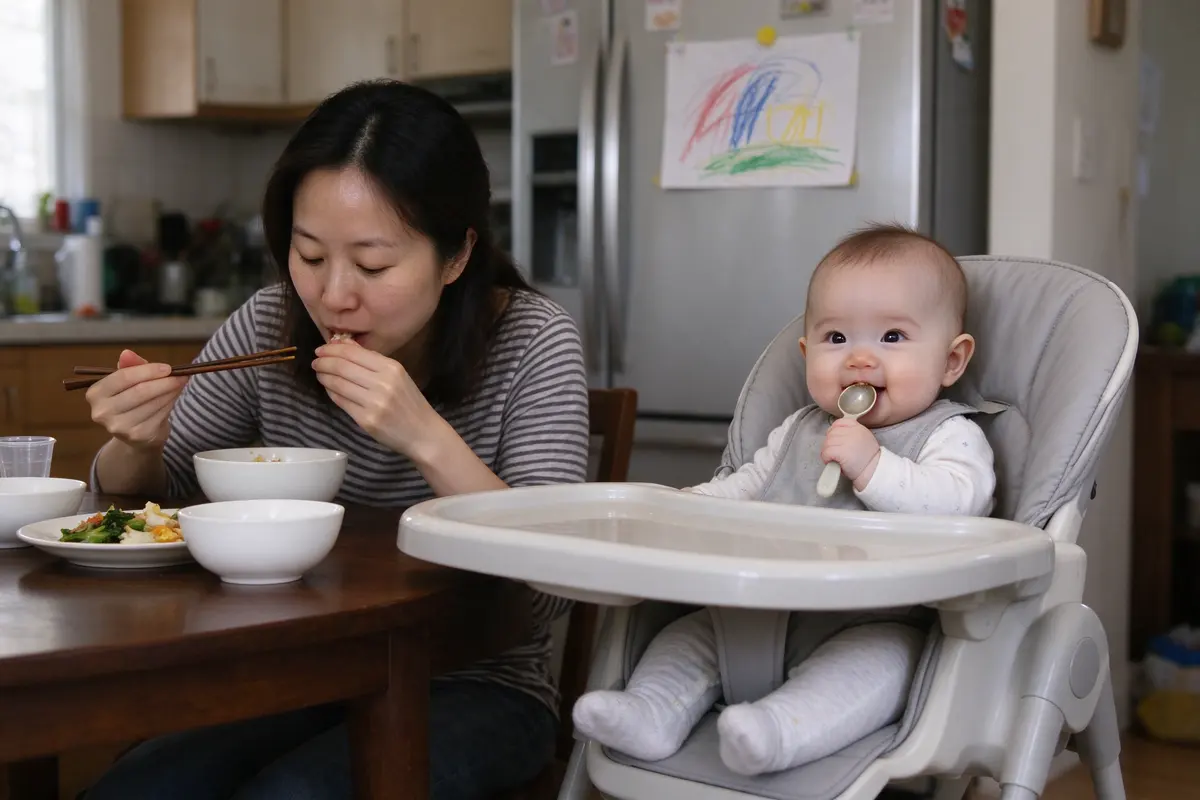
One meal sitting down. The chair changes who eats standing up: with the baby buckled in beside you, both of your hands are free for the first time at a table in twenty-three weeks. Use them on your own plate. Eating one real meal at a table a day is a small thing with a long reach, and plenty of water and fresh fruit and vegetables are what the OWH suggests you're aiming for (OWH). Overwhelming tiredness is on the CDC's list of urgent maternal warning signs (CDC); skipped meals make every other kind of tired worse.
If you're the partner: you buckle, every time, and you check the click out loud. "Buckled" is a word worth saying at every meal for a year.
Sources
- Agbim IA, Hurtado CW. "Baby-Led Weaning: Is It Safe?" HealthyChildren.org, 2024. https://www.healthychildren.org/English/ages-stages/baby/feeding-nutrition/Pages/baby-led-weaning-is-it-safe.aspx
- American Academy of Pediatrics. "When Can Babies Start Solid Foods? Readiness & Feeding Tips." HealthyChildren.org, 2026. https://www.healthychildren.org/English/ages-stages/baby/feeding-nutrition/Pages/Starting-Solid-Foods.aspx
- Centers for Disease Control and Prevention. "Milestones by 6 Months." Learn the Signs. Act Early., 2026. https://www.cdc.gov/act-early/milestones/6-months.html
- American Academy of Pediatrics. "Movement Milestones: Babies 4 to 7 Months." HealthyChildren.org, 2021. https://www.healthychildren.org/English/ages-stages/baby/Pages/Movement-4-to-7-Months.aspx
- National Health Service (UK). "Baby and toddler safety." 2026. https://www.nhs.uk/baby/first-aid-and-safety/safety/baby-and-toddler-safety/
- American Academy of Pediatrics Council on Injury, Violence and Poison Prevention. "Infant Drowning Prevention & Water Safety: How to Protect Your Baby." HealthyChildren.org, 2026. https://www.healthychildren.org/English/safety-prevention/at-play/Pages/Infant-Water-Safety.aspx
- World Health Organization. "To grow up healthy, children need to sit less and play more." 2019. https://www.who.int/news/item/24-04-2019-to-grow-up-healthy-children-need-to-sit-less-and-play-more
- American Academy of Pediatrics. "Fever" (symptom checker). HealthyChildren.org, 2026. https://www.healthychildren.org/English/tips-tools/symptom-checker/Pages/symptomviewer.aspx?symptom=Fever
- American Red Cross. "Infant Choking: How To Help." 2026. https://www.redcross.org/take-a-class/resources/learn-first-aid/infant-choking
- American Academy of Pediatrics. "Crying Child - 3 Months and Older" (symptom checker). HealthyChildren.org, 2026. https://www.healthychildren.org/English/tips-tools/symptom-checker/Pages/symptomviewer.aspx?symptom=Crying+Child+-+3+Months+and+Older
- Office on Women's Health. "Recovering from birth." US Department of Health and Human Services, 2021. https://womenshealth.gov/pregnancy/childbirth-and-beyond/recovering-birth
- Centers for Disease Control and Prevention. "Urgent Maternal Warning Signs and Symptoms." HEAR HER, 2024. https://www.cdc.gov/hearher/maternal-warning-signs/index.html
This guide is general education that summarizes published research and guidance from groups like the American Academy of Pediatrics, the CDC, and the WHO. It isn’t medical advice, and every child develops on their own timeline. Your pediatrician knows your child; if something feels wrong, call them. In an emergency, call 911.
Get each day’s note the morning it applies
Add your baby to a free Chorevia household with their date of birth, and every morning for 300 days the day’s note arrives in the app and by email: what’s developing, one thing to try, what to watch for, and a word for you.
Create your household