Day 170 of 300 · Week 23
Twenty-four weeks: shy, for now
Last reviewed · 4 min read · 11 sources · Plain-text version
Temperament is getting clearer, and some babies are already wary of new faces. About 1 in 4 are quite fearful at 6 months, and half of those grow out of it. Let visitors warm up first.
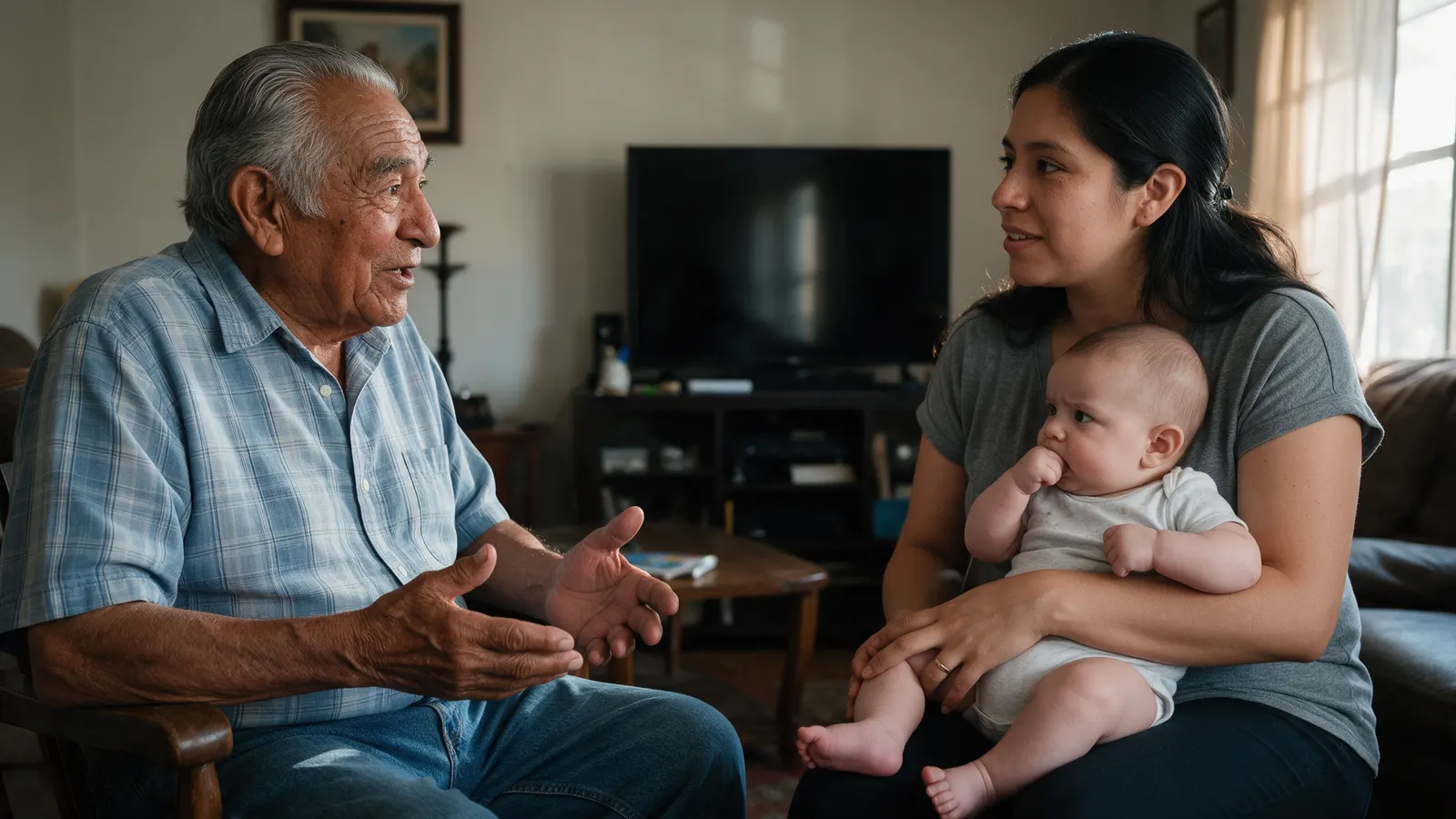
Some babies grin at the mail carrier. Some study a grandparent for a full minute first. Today is about the second kind, and why that's a temperament, not a problem.
Heart
Between 4 and 7 months, many babies turn from fairly passive to eager and assertive, and their temperament becomes clearer (AAP). Some are easygoing; others are intense or slow to warm up. A quiet, sensitive baby needs extra time and people who approach slowly, and may need your attention more than they show (AAP). Stranger anxiety usually arrives at 7 to 12 months (AAP), but some babies are wary earlier, and this week you may be meeting one.
Head
A study of 1,285 twins tracked fear of strangers from 6 to 36 months. On average, it rose between 6 and 12 months. About 1 in 4 babies were already quite fearful at 6 months, and half of those became less fearful by age 3 (Brooker et al., 2013). So a wary baby now is common, and often temporary. It is also not a verdict on the visitor, or on you: a rise in wariness over these months was the average course in that study, not a sign something went wrong (Brooker et al., 2013), so the people you love should keep showing up, at your baby's pace.
Body
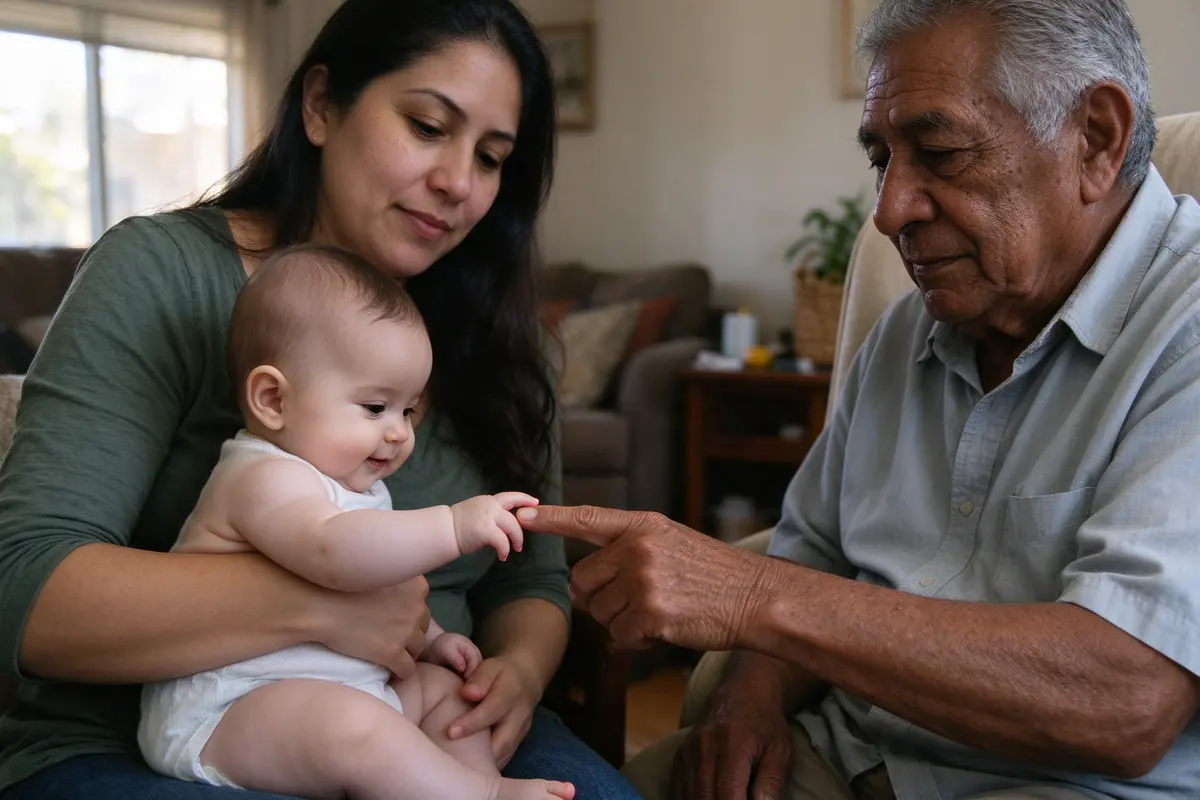
The technique is patience with a script. Hold your baby while visitors talk to you first, then let your baby decide when to look, smile, or reach (AAP). The guide's version: "This is Grandpa. We're going to watch him for a minute." Grandpa talks to you, not the baby, until the baby leans in. Cuddling, talking, and distraction can calm an intense baby if the visit tips over (AAP); the slow-to-warm one just needs the minute.
Try today
The warm-up minute
Time: 1 minute per visitor · Let new people warm up in the guide
Hold your baby facing the room and say the line: "This is Grandpa. We're going to watch him for a minute."
The visitor talks to you, not the baby, for a full minute, sitting, without reaching (AAP).
Watch for the lean, the smile, or the reach. When it comes, let the visitor offer a finger, and only then a hold.
If your baby turns into your shoulder instead, go back to step 2. No "go to Grandpa," and no passing them over to see what happens.
Make it work:Say the visitor's name every time, in the people book and at the door; naming the people your baby meets is an easy habit, though its long-term effects haven't been tested (Scott & Monesson, 2009).
Watch for
Normal
a long, serious stare at a new face, then a turn into your neck.
Normal
crying when handed to a visitor and stopping the moment they're back with you.
Go to the ER now
if your baby screams and can't be consoled, or cries when you touch or move them (AAP).
Normal
a baby who is wary with everyone this week and fine next week; shyness at 6 months often fades (Brooker et al., 2013).
Call your pediatrician right away
if your baby has a fever higher than 104°F (40°C), or looks or acts very sick (AAP).
Normal
knowing this baby better than anyone alive.
Call anyway
if your baby just doesn't seem right to you. Trust your instincts; twenty-four weeks have made them sharp (Lurie Children's).
For you
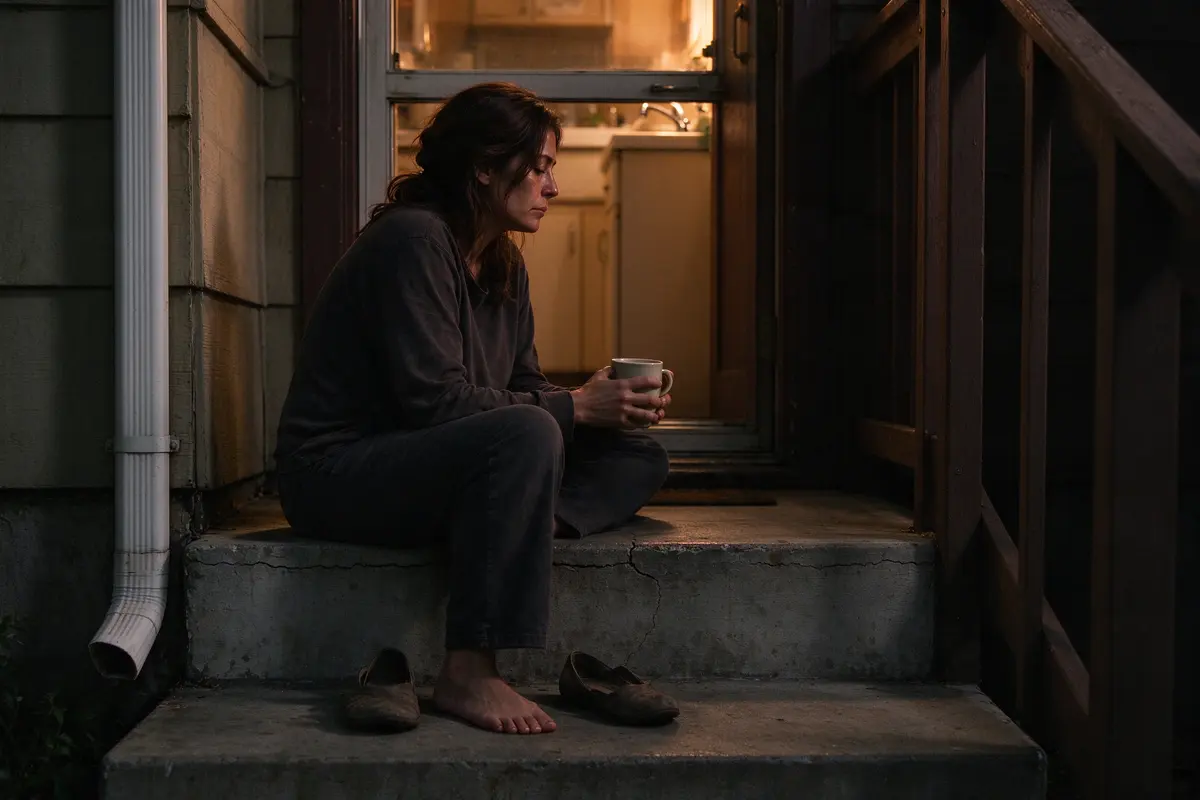
Your own temperament with visitors. Some mothers want a full house at twenty-four weeks; some want the door shut and one person at a time, and the second is a preference, not a symptom. The line between wanting fewer visitors and wanting none of anything is the one to watch: low mood, anxiety, or emptiness that is severe or lasts more than 2 weeks may be postpartum depression, and it responds to treatment (NIMH). If sadness has lasted more than two weeks, go to the doctor rather than waiting for a visit (OWH).
If you're the partner: host. Take the coats, run the warm-up minute, and let her sit with the baby while the room comes to them.
Sources
- American Academy of Pediatrics. "Emotional and Social Development: 4 to 7 Months." HealthyChildren.org, 2009. https://www.healthychildren.org/English/ages-stages/baby/Pages/Emotional-and-Social-Development-4-7-Months.aspx
- American Academy of Pediatrics. "Making Baby Drop Off at Child Care Easier." HealthyChildren.org, 2022. https://www.healthychildren.org/English/family-life/work-and-child-care/Pages/making-baby-drop-off-at-child-care-easier.aspx
- Brooker RJ, Buss KA, Lemery-Chalfant K, et al. "The development of stranger fear in infancy and toddlerhood: normative development, individual differences, antecedents, and outcomes." Developmental Science, 2013. https://pubmed.ncbi.nlm.nih.gov/24118713/
- Scott LS, Monesson A. "The origin of biases in face perception." Psychological Science, 2009. https://pubmed.ncbi.nlm.nih.gov/19422630/
- Centers for Disease Control and Prevention. "Milestones by 6 Months." Learn the Signs. Act Early., 2026. https://www.cdc.gov/act-early/milestones/6-months.html
- Centers for Disease Control and Prevention. "Concerned About Your Child's Development?" 2026. https://www.cdc.gov/act-early/families/concerned.html
- American Academy of Pediatrics. "Crying Child - 3 Months and Older" (symptom checker). HealthyChildren.org, 2026. https://www.healthychildren.org/English/tips-tools/symptom-checker/Pages/symptomviewer.aspx?symptom=Crying+Child+-+3+Months+and+Older
- American Academy of Pediatrics. "Fever" (symptom checker). HealthyChildren.org, 2026. https://www.healthychildren.org/English/tips-tools/symptom-checker/Pages/symptomviewer.aspx?symptom=Fever
- Latimer T. "When to Call the Pediatrician for Your Newborn." Lurie Children's Hospital of Chicago, 2022. https://www.luriechildrens.org/en/blog/when-to-call-the-pediatrician-for-your-newborn/
- National Institute of Mental Health. "Perinatal Depression." 2023. https://www.nimh.nih.gov/health/publications/perinatal-depression
- Office on Women's Health. "Recovering from birth." US Department of Health and Human Services, 2021. https://womenshealth.gov/pregnancy/childbirth-and-beyond/recovering-birth
This guide is general education that summarizes published research and guidance from groups like the American Academy of Pediatrics, the CDC, and the WHO. It isn’t medical advice, and every child develops on their own timeline. Your pediatrician knows your child; if something feels wrong, call them. In an emergency, call 911.
Get each day’s note the morning it applies
Add your baby to a free Chorevia household with their date of birth, and every morning for 300 days the day’s note arrives in the app and by email: what’s developing, one thing to try, what to watch for, and a word for you.
Create your household