Day 153 of 300 · Week 21
Tripod sitting
Last reviewed · 3 min read · 10 sources · Plain-text version
Leaning forward on both hands is how sitting starts. When babies stay upright on their own, why propping is practice rather than a shortcut, and your own back when you join them on the floor.
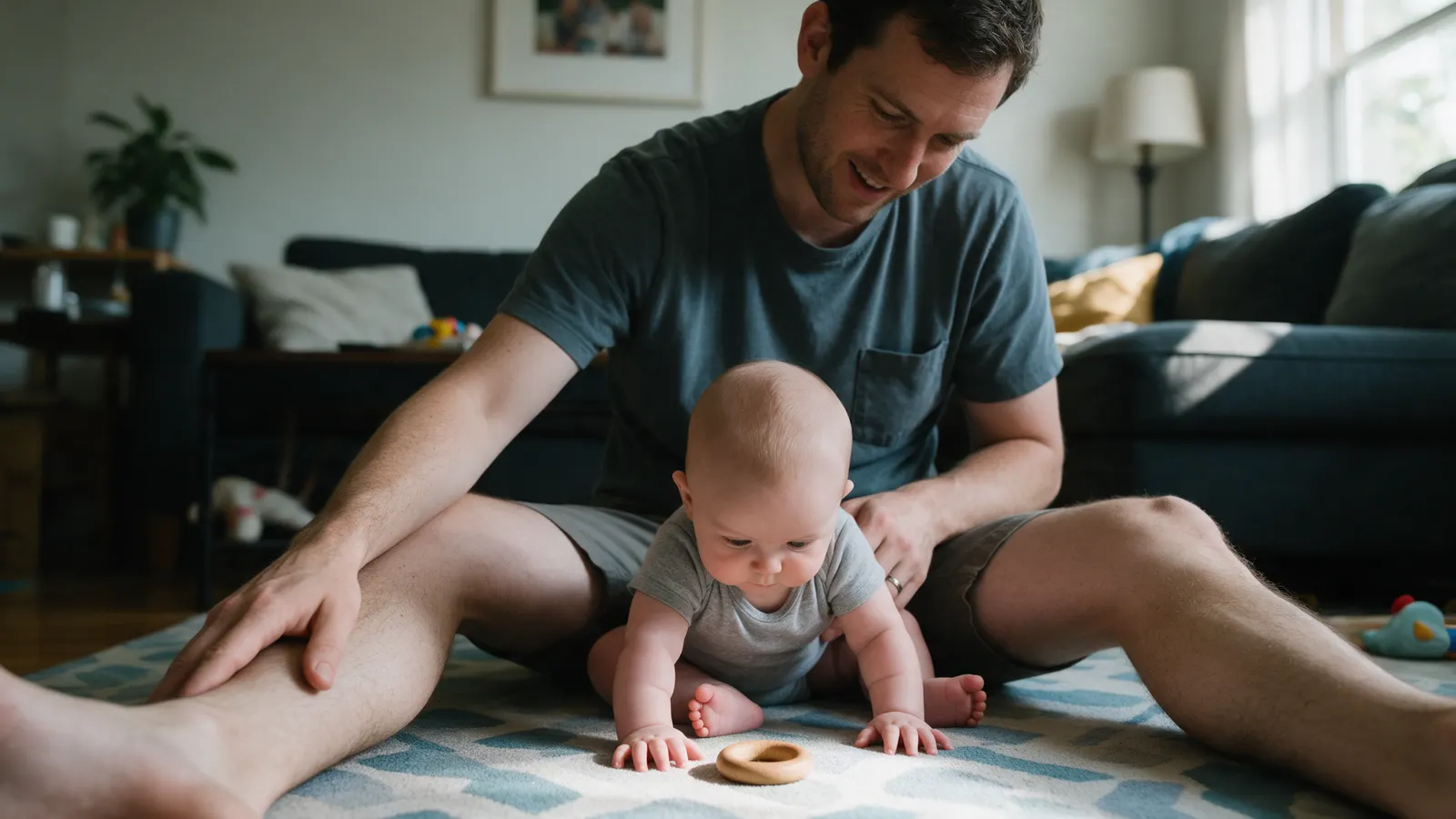
Sitting doesn't arrive all at once. It starts as a lean, with both hands on the floor, and today is about that lean.
Heart
Sitting starts with "tripod" sitting: leaning forward on both hands, which is the third leg. By 6 to 8 months, many babies stay upright once you set them in a sit (AAP), and leaning on their hands to hold themselves up is on CDC's 6-month list (CDC). Getting into a sit on their own comes later (AAP). The range is wide: in a WHO study, almost all healthy babies first sat alone somewhere between 3.8 and 9.2 months (WHO Multicentre Growth Reference Study Group, 2006).
Head
Upright is a new view of the world, and it's worth being honest about what propping does. The AAP and CDC suggest holding babies or propping them with pillows so they can practice balancing (AAP; CDC); practice hasn't been shown to speed up sitting. So the point isn't to get there sooner. It's that a baby sitting up, hands free for a moment, sees the room differently, and meanwhile the hands are busy raking, grabbing feet, and bringing everything to the mouth (AAP).
Body
A tripod sitter topples, so the rule is stay within an arm's reach, every time. Keep the practice on the floor, never on a bed or sofa (NHS). Equipment doesn't substitute: stop using a bouncer once your baby can sit up alone (CPSC), and the WHO advises not keeping babies strapped into a stroller, high chair, or carrier for more than 1 hour at a time (WHO). Your legs and a couple of cushions are the only gear.
Try today
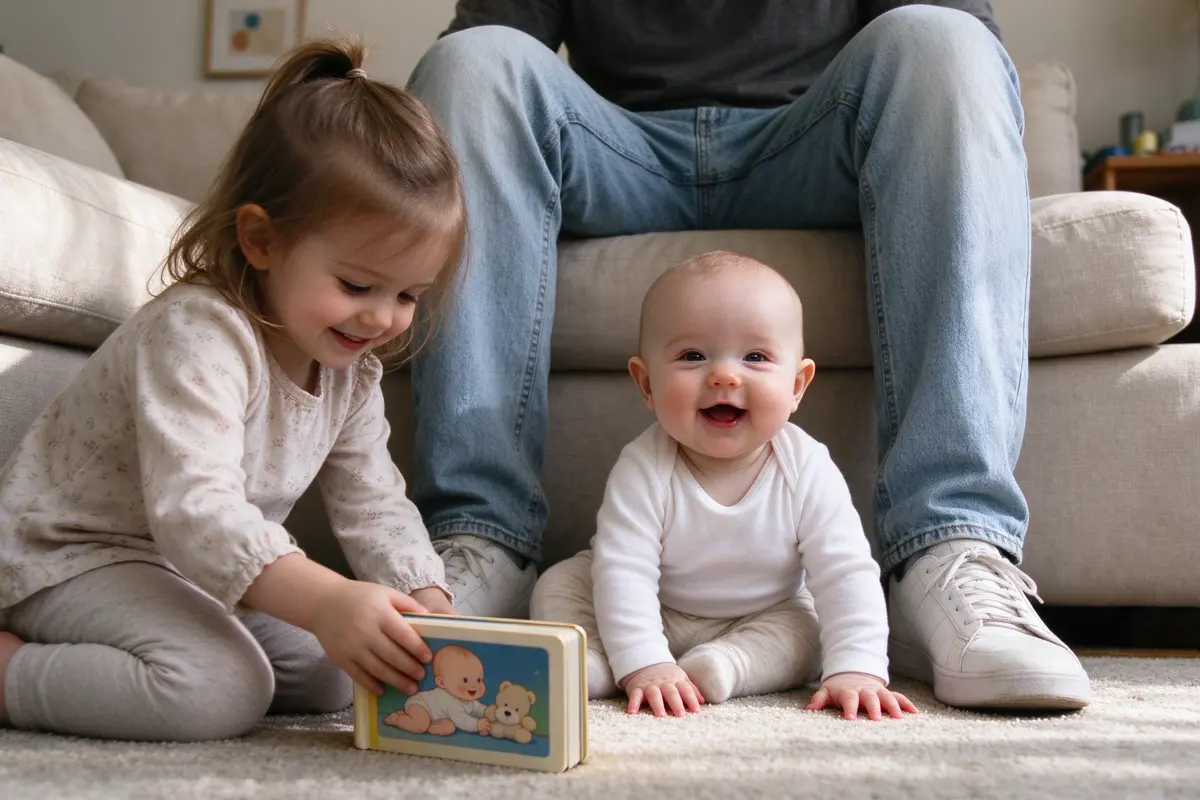
Supported sitting
Time: A few minutes at a time · Supported sitting in the guide
Sit on the floor with your legs in a V and your baby sitting between them, or ring them with pillows.
Put an interesting toy in front of them so they lean on their hands to look.
Stay right there to catch the topple.
Lay them down the moment they tire or slump.
Make it work:A short, happy sit beats a long, wobbly one. Stop when your baby turns away, fusses, or arches.
Watch for
Normal
a sit that lasts a few seconds before they fold forward onto the toy.
Bring it up with your pediatrician
if your baby's head still flops back when pulled up to sitting between 4 and 7 months, or if they seem very stiff or very floppy (AAP).
Normal
no interest in sitting yet, and a preference for the tummy.
Normal
a head that bobs then steadies.
Go to the ER now
if your baby has a bulging or swollen soft spot, or a stiff neck (AAP).
For you
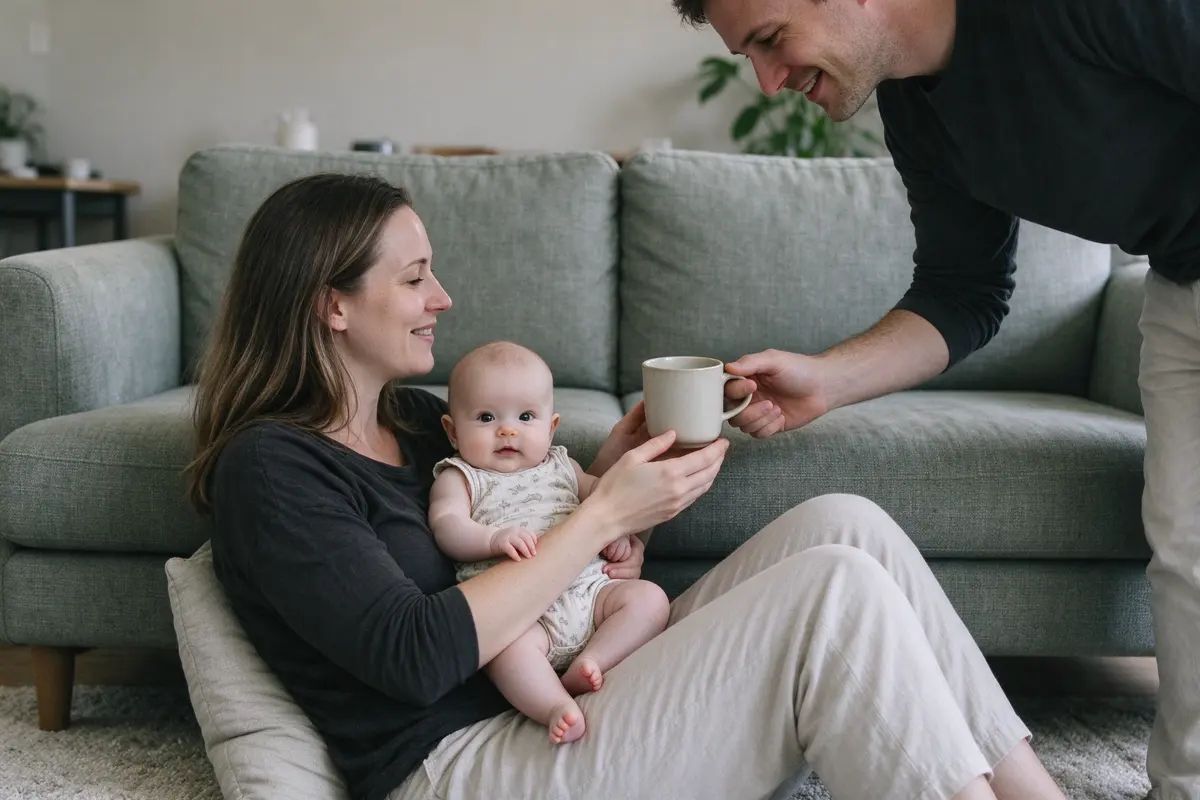
Your own posture, since you'll be down there a lot. The WHO wants interactive floor play several times a day (WHO), which means your back is on the floor several times a day too. Sit against the sofa or a wall with a cushion behind you, switch which side you lean to, and get up by rolling to your hands and knees instead of jerking straight up. Your baby is learning to hold themselves up; it's fair to give yourself something to lean on while they do.
If you're the partner: the floor shift is a real shift. Take the afternoon sit so her back gets a break.
Sources
- American Academy of Pediatrics. "Movement Milestones: Babies 4 to 7 Months." HealthyChildren.org, updated 2021. https://www.healthychildren.org/English/ages-stages/baby/Pages/Movement-4-to-7-Months.aspx
- Centers for Disease Control and Prevention. "Milestones by 6 Months." Learn the Signs. Act Early. program, updated 2026. https://www.cdc.gov/act-early/milestones/6-months.html
- WHO Multicentre Growth Reference Study Group. "WHO Motor Development Study: windows of achievement for six gross motor development milestones." Acta Paediatrica Supplement, 2006. https://pubmed.ncbi.nlm.nih.gov/16817682/
- National Health Service (UK). "Baby and toddler safety." Accessed 2026. https://www.nhs.uk/baby/first-aid-and-safety/safety/baby-and-toddler-safety/
- US Consumer Product Safety Commission. "New Federal Standard to Improve Safety of Infant Bouncer Seats Takes Effect." 2018. https://www.cpsc.gov/Newsroom/News-Releases/2018/New-Federal-Standard-to-Improve-Safety-of-Infant-Bouncer-Seats-Takes-Effect
- World Health Organization. "To grow up healthy, children need to sit less and play more." 2019. https://www.who.int/news/item/24-04-2019-to-grow-up-healthy-children-need-to-sit-less-and-play-more
- American Academy of Pediatrics. "Developmental Milestones: 7 Months." HealthyChildren.org, updated 2009. https://www.healthychildren.org/English/ages-stages/baby/Pages/Developmental-Milestones-7-Months.aspx
- Centers for Disease Control and Prevention. "Milestones by 4 Months." Learn the Signs. Act Early. program, updated 2026. https://www.cdc.gov/act-early/milestones/4-months.html
- Centers for Disease Control and Prevention. "Concerned About Your Child's Development?" 2026. https://www.cdc.gov/act-early/families/concerned.html
- American Academy of Pediatrics. "Fever" (symptom checker). HealthyChildren.org, accessed 2026. https://www.healthychildren.org/English/tips-tools/symptom-checker/Pages/symptomviewer.aspx?symptom=Fever
This guide is general education that summarizes published research and guidance from groups like the American Academy of Pediatrics, the CDC, and the WHO. It isn’t medical advice, and every child develops on their own timeline. Your pediatrician knows your child; if something feels wrong, call them. In an emergency, call 911.
Get each day’s note the morning it applies
Add your baby to a free Chorevia household with their date of birth, and every morning for 300 days the day’s note arrives in the app and by email: what’s developing, one thing to try, what to watch for, and a word for you.
Create your household