Day 181 of 300 · Week 25
Month seven: first bites
Last reviewed · 4 min read · 14 sources · Plain-text version
Solids start when the readiness signs are there, not when the calendar says so. The signs, why milk is still the main meal, and the six-month list once more as 'most babies, around now'.
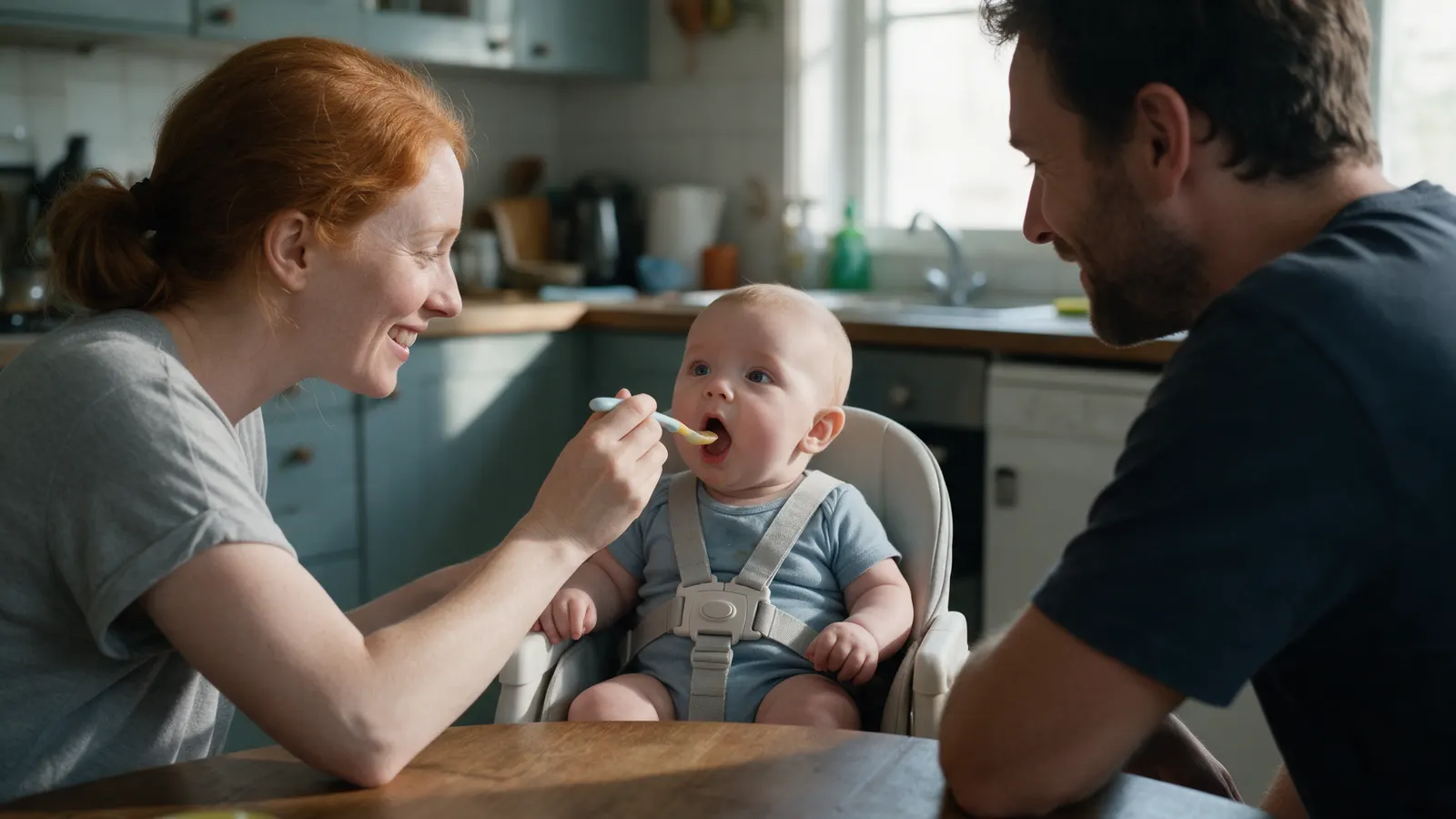
Six months are done; the notes for them are at the sixth month. Month seven is the month the spoon comes out for most babies, and the one rule that matters today is that your baby sets the date, not the calendar.
Heart
Readiness is a list of things your baby does, not an age. The signs: sitting with support and good head control, opening their mouth when food comes, and swallowing rather than pushing it back out with the tongue (AAP; CDC). Most babies are ready around 6 months, and CDC advises against starting before 4 (CDC). If your baby keeps pushing food out, wait a week or two and try again (AAP).
Head
Even once the spoon is in play, breast milk or formula is still the most important source of nutrition (CDC). Most babies have doubled their birth weight by 6 months (AAP), on milk alone; the spoon isn't there to fix growth. Iron is the one thing the first foods are really for. The AAP's 2026 guidance calls for an iron supplement for exclusively breastfed babies by 6 months (AAP, 2026), and iron-rich foods matter once solids start (CDC).
Body
The six-month list, once more, as "most babies, around now" rather than a test. CDC's checklists hold skills that at least 75% of babies show by each age (Zubler et al., 2022). By 6 months, most babies know familiar people, laugh, take turns making sounds with you, blow raspberries, put things in their mouth to explore them, reach to grab a toy they want, roll from tummy to back, push up on straight arms, lean on their hands to sit, and close their lips to show they don't want more food (CDC). Born early? Use corrected age for milestones until age 2 (AAP).
Try today
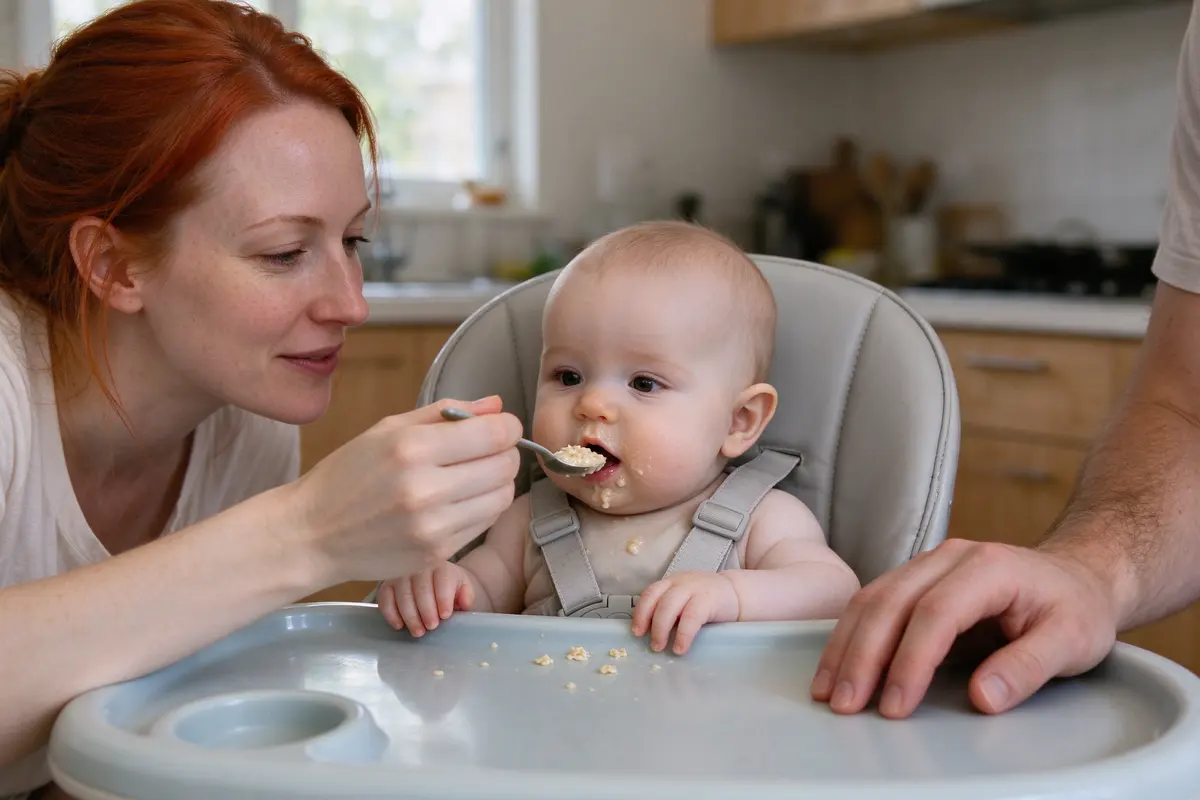
First tastes from a spoon
Time: A few minutes, once a day to start · First tastes from a spoon in the guide
Buckle your baby upright in the high chair at a time when they're alert and only a little hungry (AAP).
Offer half a spoonful or less of a smooth, iron-rich puree, like meat or iron-fortified oat cereal (AAP).
Hold the spoon near their lips and wait for the mouth to open, or not.
Stop when they turn away or close their lips.
Make it work:Grimaces are normal; offer the food again over the next week. In one trial, babies ate more green beans after 8 days even though many kept grimacing (Forestell & Mennella, 2007).
Watch for
Normal
the spoon's contents pushed straight back out by the tongue; that's a baby who isn't quite ready, and the move is to wait a week or two (AAP).
Call your pediatrician
if your baby can't sit with help, or seems very stiff or very floppy (AAP).
Normal
a grimace and a shudder at the first taste (Forestell & Mennella, 2007).
Normal
a bigger milk feed than usual after the taste; milk is still the main meal (CDC).
Call 911
for swelling of the lips, face, or tongue, widespread hives, vomiting, wheezing, repeated coughing, pale or blue skin, or sudden floppiness after a food (NIAID).
For you
A new month, the same list for you, briefly. The CDC's urgent maternal warning signs still apply: a headache that won't go away or gets worse, changes in vision, a fever of 100.4°F or higher, trouble breathing, chest pain or a fast-beating heart, severe belly pain that doesn't go away, heavy bleeding, extreme swelling of the hands or face, overwhelming tiredness, or thoughts about harming yourself or your baby. Any of them means care now, and tell whoever sees you that you were pregnant within the last year (CDC).
If you're the partner: you know her list and the baby's. Put the baby's 911 line from today's Watch for next to hers in your phone.
Sources
- American Academy of Pediatrics. "When Can Babies Start Solid Foods? Readiness & Feeding Tips." HealthyChildren.org, updated 2026. https://www.healthychildren.org/English/ages-stages/baby/feeding-nutrition/Pages/Starting-Solid-Foods.aspx
- Centers for Disease Control and Prevention. "When, What, and How to Introduce Solid Foods." 2026. https://www.cdc.gov/infant-toddler-nutrition/foods-and-drinks/when-what-and-how-to-introduce-solid-foods.html
- Agbim IA, Hurtado CW. "Baby-Led Weaning: Is It Safe?" HealthyChildren.org, updated 2024. https://www.healthychildren.org/English/ages-stages/baby/feeding-nutrition/Pages/baby-led-weaning-is-it-safe.aspx
- Centers for Disease Control and Prevention. "Milestones by 6 Months." Learn the Signs. Act Early. program, updated 2026. https://www.cdc.gov/act-early/milestones/6-months.html
- American Academy of Pediatrics. "Checkup Checklist: 6 Months Old." HealthyChildren.org, updated 2023. https://www.healthychildren.org/English/ages-stages/Your-Childs-Checkups/Pages/Your-Checkup-Checklist-6-Months-Old.aspx
- American Academy of Pediatrics. "Iron Deficiency & Iron Deficiency Anemia: AAP Updates Screening, Prevention & Treatment Guidance." HealthyChildren.org, 2026. https://www.healthychildren.org/English/news/Pages/iron-deficiency-anemia-prevention-screening-treatment-AAP-updates-guidance.aspx
- Centers for Disease Control and Prevention. "Iron." Infant and Toddler Nutrition, 2026. https://www.cdc.gov/infant-toddler-nutrition/vitamins-minerals/iron.html
- Zubler JM, Wiggins LD, Macias MM, et al. "Evidence-Informed Milestones for Developmental Surveillance Tools." Pediatrics, 2022. https://pubmed.ncbi.nlm.nih.gov/35132439/
- American Academy of Pediatrics. "Corrected Age For Preemies." HealthyChildren.org, accessed 2026. https://www.healthychildren.org/English/ages-stages/baby/preemie/Pages/Corrected-Age-For-Preemies.aspx
- Forestell CA, Mennella JA. "Early determinants of fruit and vegetable acceptance." Pediatrics, 2007. https://pubmed.ncbi.nlm.nih.gov/18055673/
- American Academy of Pediatrics. "Developmental Milestones: 7 Months." HealthyChildren.org, updated 2009. https://www.healthychildren.org/English/ages-stages/baby/Pages/Developmental-Milestones-7-Months.aspx
- National Institute of Allergy and Infectious Diseases. "Instructions for Home Feeding of Peanut Protein for Infants at Low Risk of an Allergic Reaction to Peanut" (Appendix D). 2017. https://www.niaid.nih.gov/sites/default/files/addendum_guidelines_peanut_appx_d.pdf
- Cox A, Pistiner M. "When to Introduce Egg, Peanut Butter & Other Common Food Allergens to a Baby." HealthyChildren.org, updated 2025. https://www.healthychildren.org/English/healthy-living/nutrition/Pages/when-to-introduce-egg-peanut-butter-and-other-common-food-allergens-to-your-baby-food-allergy-prevention-tips.aspx
- Centers for Disease Control and Prevention. "Urgent Maternal Warning Signs and Symptoms." HEAR HER, 2024. https://www.cdc.gov/hearher/maternal-warning-signs/index.html
This guide is general education that summarizes published research and guidance from groups like the American Academy of Pediatrics, the CDC, and the WHO. It isn’t medical advice, and every child develops on their own timeline. Your pediatrician knows your child; if something feels wrong, call them. In an emergency, call 911.
Get each day’s note the morning it applies
Add your baby to a free Chorevia household with their date of birth, and every morning for 300 days the day’s note arrives in the app and by email: what’s developing, one thing to try, what to watch for, and a word for you.
Create your household