Day 185 of 300 · Week 25
Peanut, this week or next
Last reviewed · 4 min read · 10 sources · Plain-text version
Three groups, one recipe, two hours of watching. The NIAID home-feeding steps for peanut, egg on another day, and the exact signs that mean a call or 911.
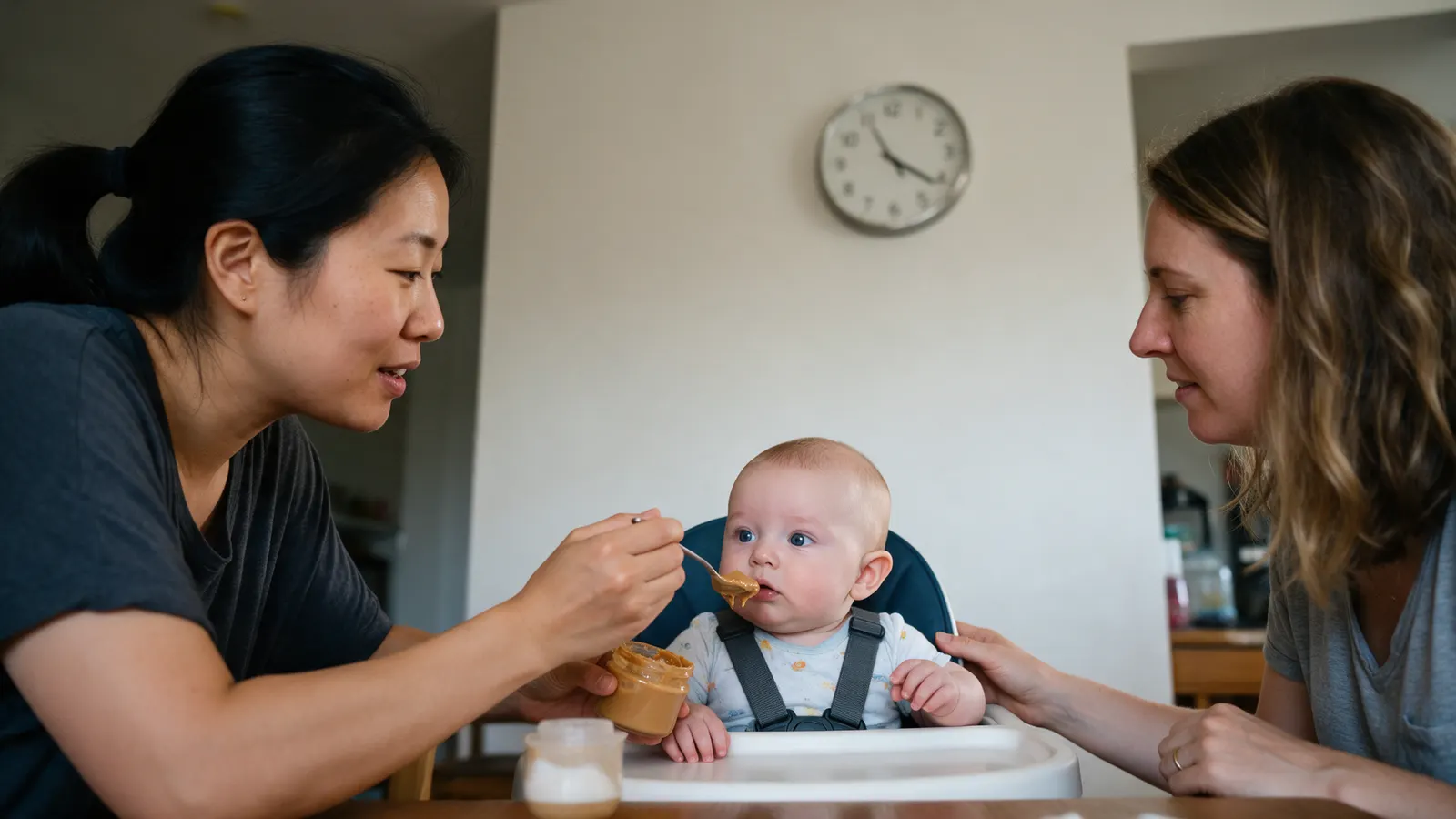
If a few first foods have gone down without fuss, peanut is this week or next. Here is the whole plan, slowly.
Heart
The 2017 US guidelines sort babies into three groups (NIAID). Severe eczema, egg allergy, or both: peanut as early as 4 to 6 months, after checking with your pediatrician, who may test or refer first; if that's your baby, you've had this conversation already. Mild to moderate eczema: peanut around 6 months. No eczema or food allergy: peanut freely at home, along with other solids (NIAID). A 2021 consensus from US and Canadian allergy societies says the same for both peanut and egg: around 6 months, not before 4, with no screening test required (Fleischer et al., 2021). If your pediatrician hasn't brought it up, ask.
Head
The reason the advice is firm is one trial. In LEAP, 640 babies 4 to 11 months old with severe eczema, egg allergy, or both were randomly assigned to eat peanut regularly or avoid it until age 5. Among the 530 whose skin tests were negative at the start, 13.7% of avoiders had peanut allergy at age 5, versus 1.9% of eaters (Du Toit et al., 2015). A meta-analysis rated the evidence for early egg and early peanut as moderate certainty (Ierodiakonou et al., 2016).
Body
Start after a few first foods (NIAID). The recipe: thin 2 teaspoons of smooth peanut butter with 2 to 3 teaspoons of hot water and let it cool, or stir it into a puree your baby already eats (NIAID). NIAID's home-feeding steps, written for higher-risk babies whose tests were reassuring, are a good habit for any baby: feed at home on a day your baby is well, offer a small taste, wait 10 minutes, give the rest, and watch for 2 hours (NIAID). Egg comes on another day: about a third of a well-cooked egg, mashed (AAP). Never whole nuts or thick globs of nut butter (AAP).
Try today
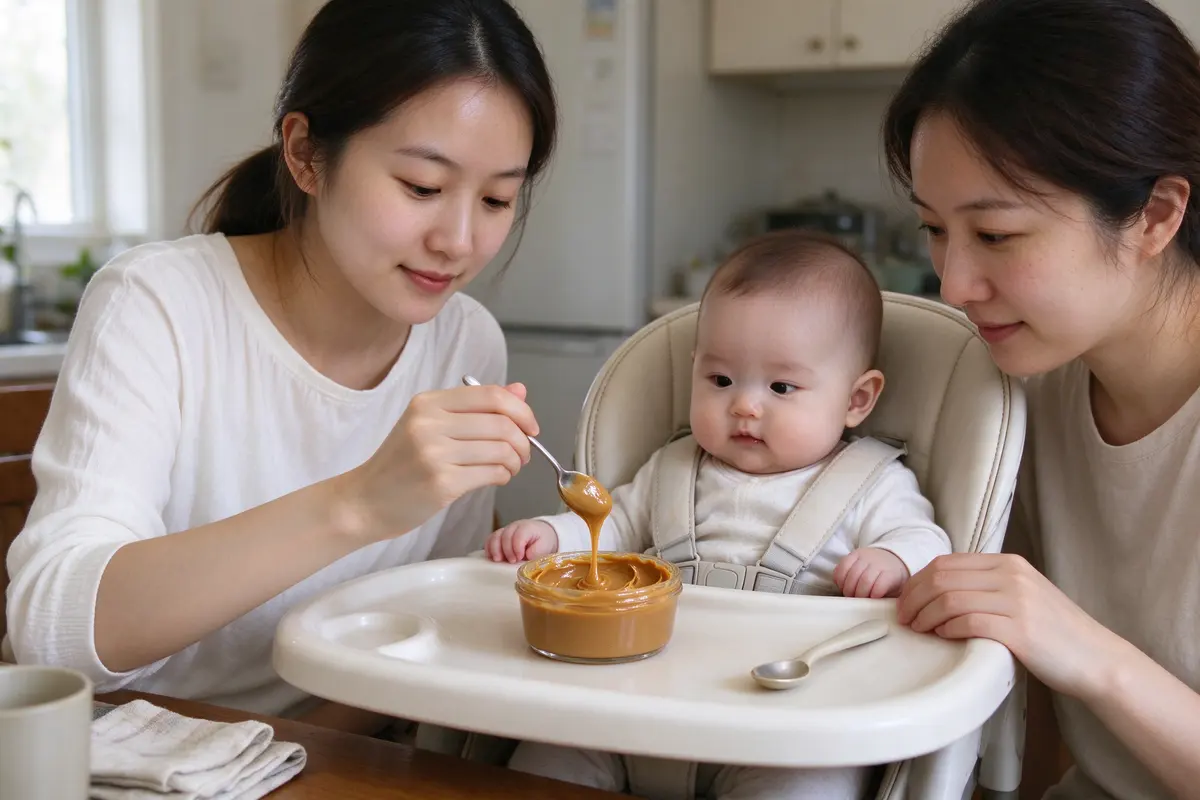
Peanut and egg, early and often
Time: A few minutes, 3 or more times a week once started · Peanut and egg, early and often in the guide
If your baby has severe eczema or an egg allergy, talk to your pediatrician before starting (NIAID).
Thin 2 teaspoons of smooth peanut butter with 2 to 3 teaspoons of hot water and let it cool (NIAID).
With your baby upright and buckled, offer a small taste, wait 10 minutes, then offer the rest at their usual pace, and watch for 2 hours (NIAID).
On another day, offer about a third of a well-cooked egg, mashed (AAP).
Make it work:Keep both in the weekly rotation once they're in. Never offer whole nuts or thick globs of nut butter (AAP).
Watch for
Normal
a face, a shudder, and a second open mouth; a grimace isn't a verdict (Forestell & Mennella, 2007).
Normal
turning away after a taste or two; stop, and try another time (AAP).
Call 911
for lip, face, or tongue swelling, vomiting, widespread hives, trouble breathing, wheezing, repeated coughing, pale or blue skin, or sudden tiredness or floppiness (NIAID).
Normal
a long nap after the 2-hour watch.
Call 911
if your baby can't be woken up, isn't moving, or is very weak (AAP).
For you

The first taste is scary for a reason, and the plan is what makes it smaller. You have the list, a well day, home, and a clock (NIAID), and the thing you're afraid of is the thing the trial showed the spoon prevents: 13.7% versus 1.9% in the highest-risk babies (Du Toit et al., 2015). Most babies need no test first (Fleischer et al., 2021).
If you're the partner: be home for this one. One of you watches the clock, one watches the baby, and neither of you watches a phone.
Sources
- National Institute of Allergy and Infectious Diseases. "Addendum Guidelines for the Prevention of Peanut Allergy in the United States: Summary for Parents and Caregivers." 2017. https://www.niaid.nih.gov/sites/default/files/peanut-allergy-prevention-guidelines-parent-summary.pdf
- Fleischer DM, Chan ES, Venter C, et al. "A Consensus Approach to the Primary Prevention of Food Allergy Through Nutrition." Journal of Allergy and Clinical Immunology: In Practice, 2021. https://pubmed.ncbi.nlm.nih.gov/33250376/
- Du Toit G, Roberts G, Sayre PH, et al. "Randomized trial of peanut consumption in infants at risk for peanut allergy." New England Journal of Medicine, 2015. https://pubmed.ncbi.nlm.nih.gov/25705822/
- Ierodiakonou D, Garcia-Larsen V, Logan A, et al. "Timing of Allergenic Food Introduction to the Infant Diet and Risk of Allergic or Autoimmune Disease: A Systematic Review and Meta-analysis." JAMA, 2016. https://pubmed.ncbi.nlm.nih.gov/27654604/
- National Institute of Allergy and Infectious Diseases. "Instructions for Home Feeding of Peanut Protein for Infants at Low Risk of an Allergic Reaction to Peanut" (Appendix D). 2017. https://www.niaid.nih.gov/sites/default/files/addendum_guidelines_peanut_appx_d.pdf
- Cox A, Pistiner M. "When to Introduce Egg, Peanut Butter & Other Common Food Allergens to a Baby." HealthyChildren.org, updated 2025. https://www.healthychildren.org/English/healthy-living/nutrition/Pages/when-to-introduce-egg-peanut-butter-and-other-common-food-allergens-to-your-baby-food-allergy-prevention-tips.aspx
- Bradin S. "Choking Prevention for Babies & Children: What Every Parent Needs to Know." HealthyChildren.org, updated 2026. https://www.healthychildren.org/English/health-issues/injuries-emergencies/Pages/Choking-Prevention.aspx
- Forestell CA, Mennella JA. "Early determinants of fruit and vegetable acceptance." Pediatrics, 2007. https://pubmed.ncbi.nlm.nih.gov/18055673/
- American Academy of Pediatrics. "When Can Babies Start Solid Foods? Readiness & Feeding Tips." HealthyChildren.org, updated 2026. https://www.healthychildren.org/English/ages-stages/baby/feeding-nutrition/Pages/Starting-Solid-Foods.aspx
- American Academy of Pediatrics. "Fever" (symptom checker). HealthyChildren.org, accessed 2026. https://www.healthychildren.org/English/tips-tools/symptom-checker/Pages/symptomviewer.aspx?symptom=Fever
This guide is general education that summarizes published research and guidance from groups like the American Academy of Pediatrics, the CDC, and the WHO. It isn’t medical advice, and every child develops on their own timeline. Your pediatrician knows your child; if something feels wrong, call them. In an emergency, call 911.
Get each day’s note the morning it applies
Add your baby to a free Chorevia household with their date of birth, and every morning for 300 days the day’s note arrives in the app and by email: what’s developing, one thing to try, what to watch for, and a word for you.
Create your household