Day 208 of 300 · Week 28
Sun after six months
Last reviewed · 4 min read · 6 sources · Plain-text version
From 6 months, sunscreen is fine on uncovered skin: broad-spectrum SPF 15 or higher, mineral if you can, reapplied every 90 minutes to 2 hours, with shade still first. And the car seat, as they grow.

For six months the rule was shade, long sleeves, a hat. The hat and the shade stay. Today the tube of sunscreen comes out of the drawer, and the car seat gets a second look on the way to the park.
Heart
From 6 months, sunscreen is fine on uncovered skin like the face and hands. The AAP's advice: choose broad-spectrum SPF 15 or higher, ideally a mineral formula with zinc oxide or titanium dioxide, and reapply every 90 minutes to 2 hours. Shade still comes first (AAP). Sunscreen is for the parts you can't cover, not a reason to uncover more. A walk under trees with a hat on is still a better plan than an open field with SPF 50.
Head
The seat you buckle on the way there is the other summer safety item. Keep your baby rear-facing as long as possible, until they reach the highest weight or height their seat allows. Rear-facing-only infant seats typically fit babies up to 22 to 35 pounds and 26 to 35 inches, depending on the model, and when your baby outgrows theirs, the next seat is a convertible or all-in-one, installed rear-facing (AAP). A baby who has doubled their birth weight by 6 months, as most have (AAP), is closer to the label's limits than they were in the spring.
Body
The fit check is the same at every age: harness snug, chest clip at armpit level, bulky coats off under the straps (AAP). In summer the coat problem turns into a sunshade problem: nothing goes between your baby and the harness. And whatever you spread on the blanket at the park, the WHO's floor-time rule follows you out the door: not more than an hour at a time strapped into a stroller or carrier (WHO). The shade under a tree is a fine place to roll.
Try today
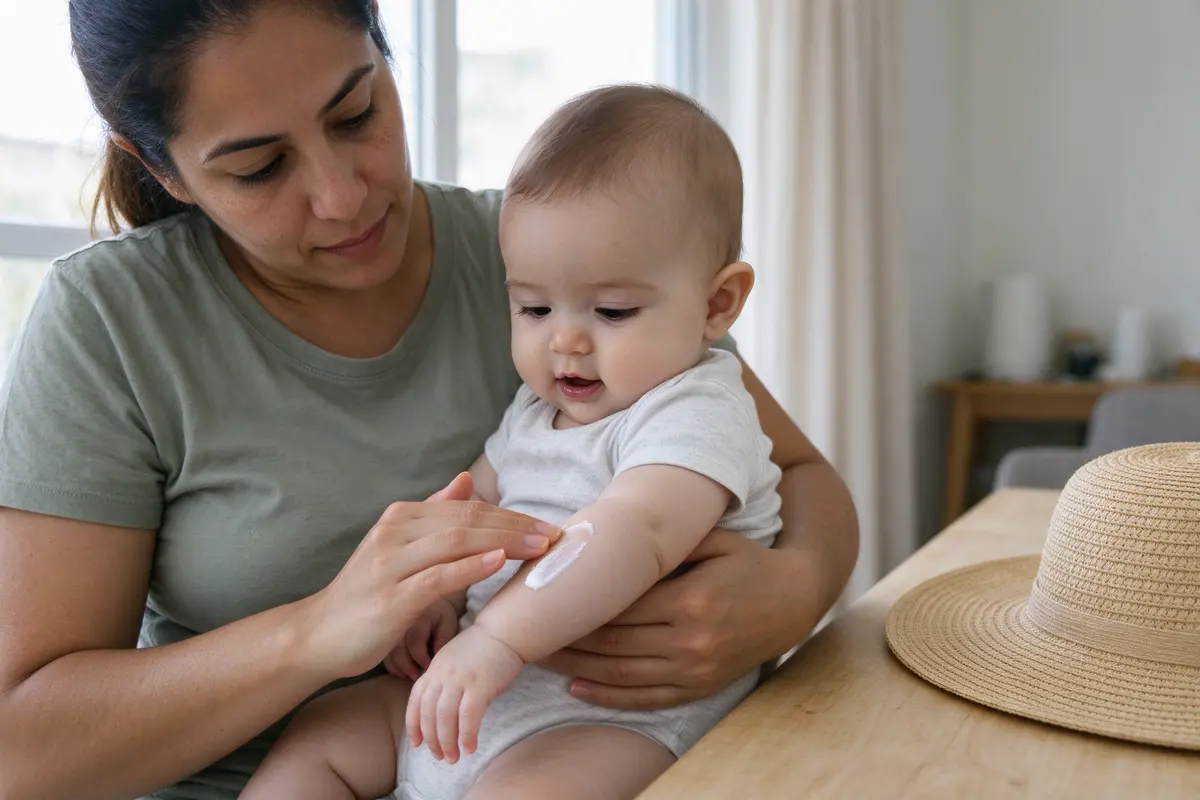
The first sunscreen
Time: 5 minutes at home, before the first outing · Sun protection in the guide
Read the tube: broad-spectrum, SPF 15 or higher, and look for zinc oxide or titanium dioxide on the ingredients list (AAP).
At home, rub a small dot onto the inside of your baby's forearm and leave it. Check the spot later in the day before you use the tube on their face.
Put the hat on first, then sunscreen on only what the hat and clothes don't cover: face, ears, backs of the hands (AAP).
Set a timer for 90 minutes. That's when it goes on again, shade or not (AAP).
Pick the shady spot before you pick the sunny one.
Make it work:Keep the tube in the stroller, not the bathroom. The second application is the one families forget.
Watch for
Normal
a baby who pulls the hat off six times and chews the brim.
Call your pediatrician right away
if your baby seems dehydrated after a hot day: no urine in more than 8 hours, dark urine, a very dry mouth, or no tears (AAP).
Normal
pink, warm cheeks after a stroller walk that cool in the shade in a few minutes.
Call 911
if your baby can't be woken, isn't moving, or is very weak (AAP).
Normal
a baby whose legs now reach past the end of the infant seat; that's fine until they pass the seat's height or weight limit (AAP).
Go to the ER now
if your baby has any trouble breathing, including ribs pulling in with each breath or loud wheezing (AAP).
For you
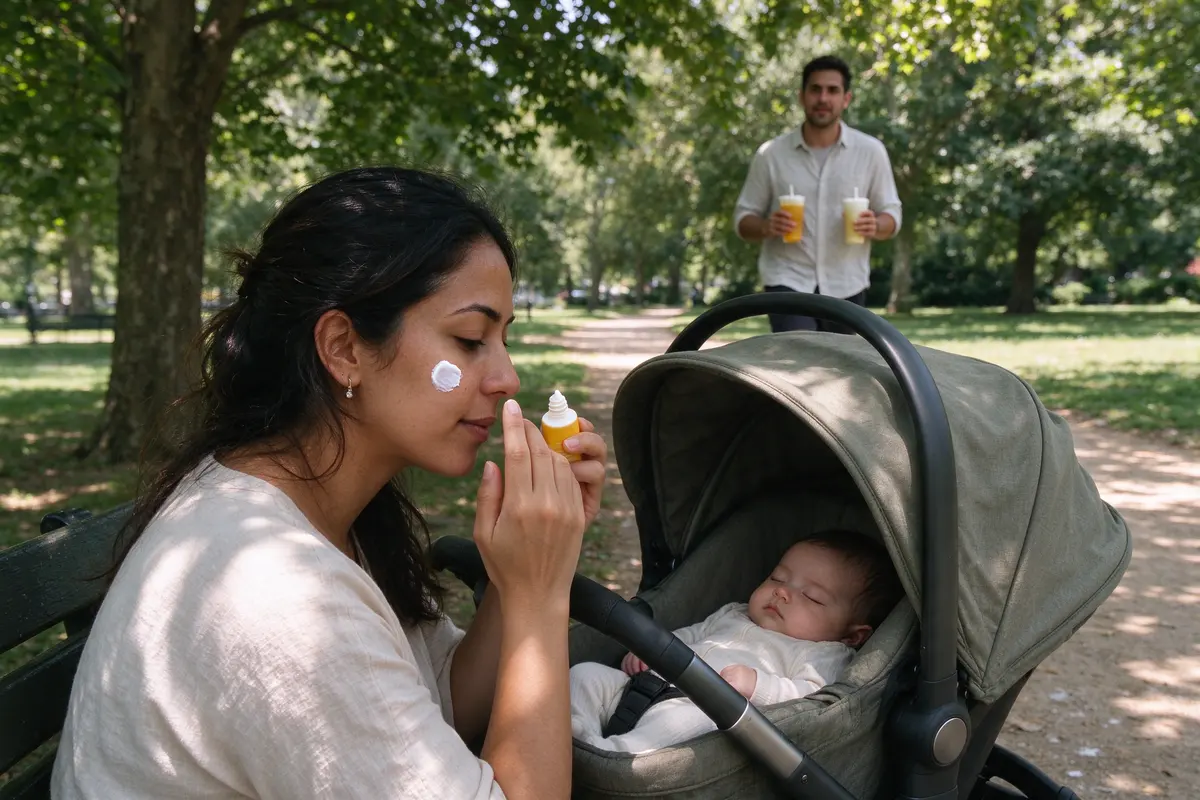
Your own sunscreen. Seven months of thinking about someone else's skin, and the AAP's rule for your baby, shade first and sunscreen on whatever's uncovered, reapplied every 90 minutes to 2 hours (AAP), is a perfectly good rule for a tired adult who hasn't been outside much. When the timer goes off for the baby, do your own face.
If you're the partner: the car seat label is yours to read today. Find the top weight and height, write them on a sticky note on the dashboard, and the next seat stops being a surprise (AAP).
Sources
- American Academy of Pediatrics. "Baby Sunburn Prevention Tips." HealthyChildren.org, updated 2026. https://www.healthychildren.org/English/ages-stages/baby/bathing-skin-care/Pages/Baby-Sunburn-Prevention.aspx
- American Academy of Pediatrics. "Car Seats: Information for Families." HealthyChildren.org, updated 2026. https://www.healthychildren.org/English/safety-prevention/on-the-go/Pages/Car-Safety-Seats-Information-for-Families.aspx
- American Academy of Pediatrics. "Checkup Checklist: 6 Months Old." HealthyChildren.org, updated 2023. https://www.healthychildren.org/English/ages-stages/Your-Childs-Checkups/Pages/Your-Checkup-Checklist-6-Months-Old.aspx
- World Health Organization. "To grow up healthy, children need to sit less and play more." 2019. https://www.who.int/news/item/24-04-2019-to-grow-up-healthy-children-need-to-sit-less-and-play-more
- American Academy of Pediatrics. "Fever" (symptom checker). HealthyChildren.org, accessed 2026. https://www.healthychildren.org/English/tips-tools/symptom-checker/Pages/symptomviewer.aspx?symptom=Fever
- American Academy of Pediatrics. "Breathing Trouble" (symptom checker). HealthyChildren.org, accessed 2026. https://www.healthychildren.org/English/tips-tools/symptom-checker/Pages/symptomviewer.aspx?symptom=Breathing+Trouble
This guide is general education that summarizes published research and guidance from groups like the American Academy of Pediatrics, the CDC, and the WHO. It isn’t medical advice, and every child develops on their own timeline. Your pediatrician knows your child; if something feels wrong, call them. In an emergency, call 911.
Get each day’s note the morning it applies
Add your baby to a free Chorevia household with their date of birth, and every morning for 300 days the day’s note arrives in the app and by email: what’s developing, one thing to try, what to watch for, and a word for you.
Create your household