Day 182 of 300 · Week 25
Half a spoonful
Last reviewed · 3 min read · 9 sources · Plain-text version
Start smaller than feels right: half a spoonful or less, a little milk first, and a week off if it comes straight back out. The sweet-potato script, and why the mess is the point.

Yesterday was the readiness list. Today is how much, and the answer is less than you think.
Heart
The AAP's rule is to begin with half a spoonful or less and work up to a teaspoon or two. A little breast milk or formula first keeps a very hungry baby from getting frustrated with a spoon that delivers almost nothing (AAP). The script from the guide is the whole technique: "Here comes some sweet potato. Mmm." Hold the spoon near your baby's lips and wait for them to open up, or not. If they cry or turn away, stop and try again another time (AAP).
Head
Eating is a skill, and every part of it is learned: sitting up, taking food from a spoon, resting between bites, stopping when full (AAP). The tongue that pushed the first spoonful straight back out is not refusing; it's the reflex the readiness list is checking for. If it keeps happening, the AAP's advice is to wait a week or two and try again (AAP). Closing their lips to show they don't want more food is on the 6-month list (CDC).
Body
Where this happens matters as much as how much. Every feeding activity in the guide assumes a baby sitting upright and buckled into a high chair with the harness on (AAP), never eating in a car seat or stroller or while lying down (CDC). Keep meals calm and unhurried, with your eyes on your baby the whole time (CDC). A gag or a sputter in these first weeks is the reflex doing its job, and the move is to give your baby a moment, not to sweep the food out with a finger (Children's Wisconsin).
Try today
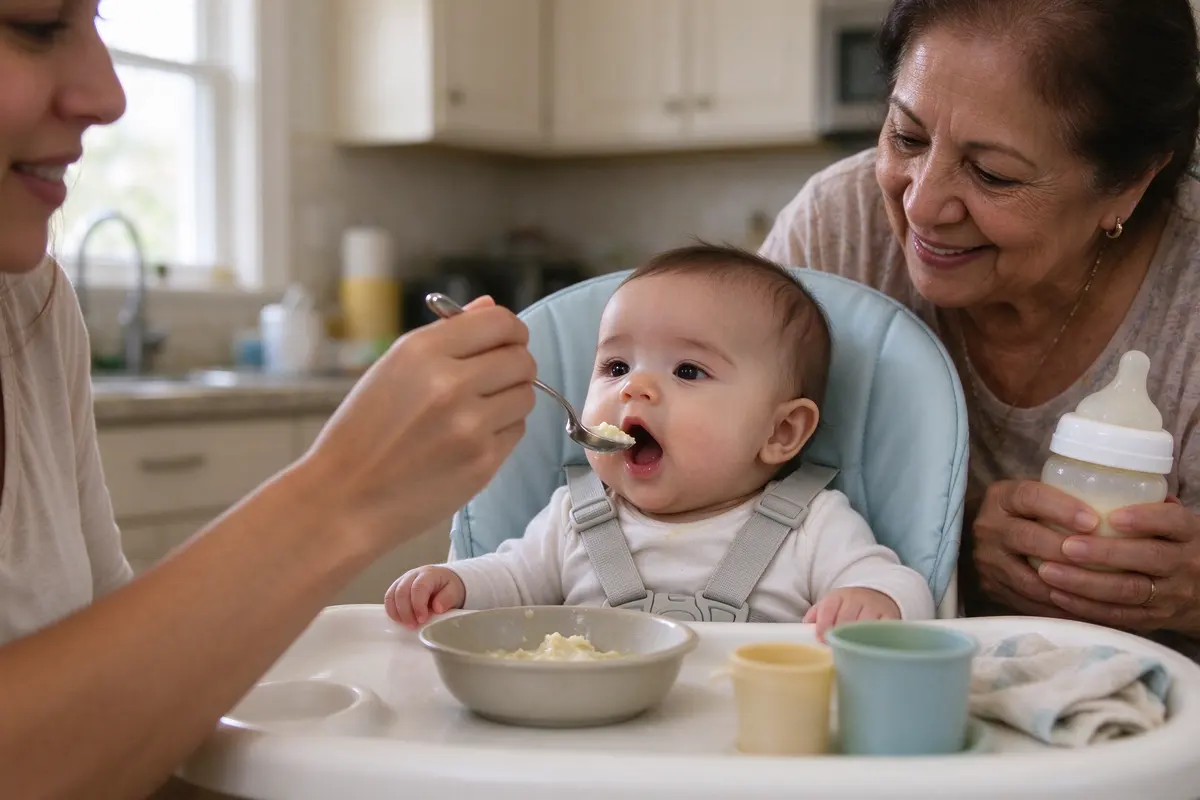
The half-spoon rule
Time: 5 minutes, at one meal
Offer a little breast milk or formula first, so your baby isn't starving when the spoon arrives (AAP).
Buckle them upright in the high chair (AAP) and put half a spoonful or less on the tip of a soft spoon.
Say the script: "Here comes some sweet potato. Mmm." Hold it near the lips and wait for the open mouth.
Stop at the first turn-away or closed lips, and try again another time (AAP).
Over the coming days, work up to a teaspoon or two, and no more for now (AAP).
Make it work:If it keeps coming straight back out, put the spoon away for a week or two and try again (AAP).
Watch for
Normal
most of the spoonful on the chin, the bib, and the tray.
Tell your pediatrician
if your baby struggles to swallow soft foods or can't sit up with support; the AAP says it's better to wait, and to ask (AAP).
Normal
a sputter and a cough on the first swallow, loud and brief (Children's Wisconsin).
Call 911
if your baby goes silent or squeaky, can't cry or cough, or turns pale or blue (Red Cross).
Normal
more milk than usual afterward; milk is still where the nutrition is (CDC).
For you
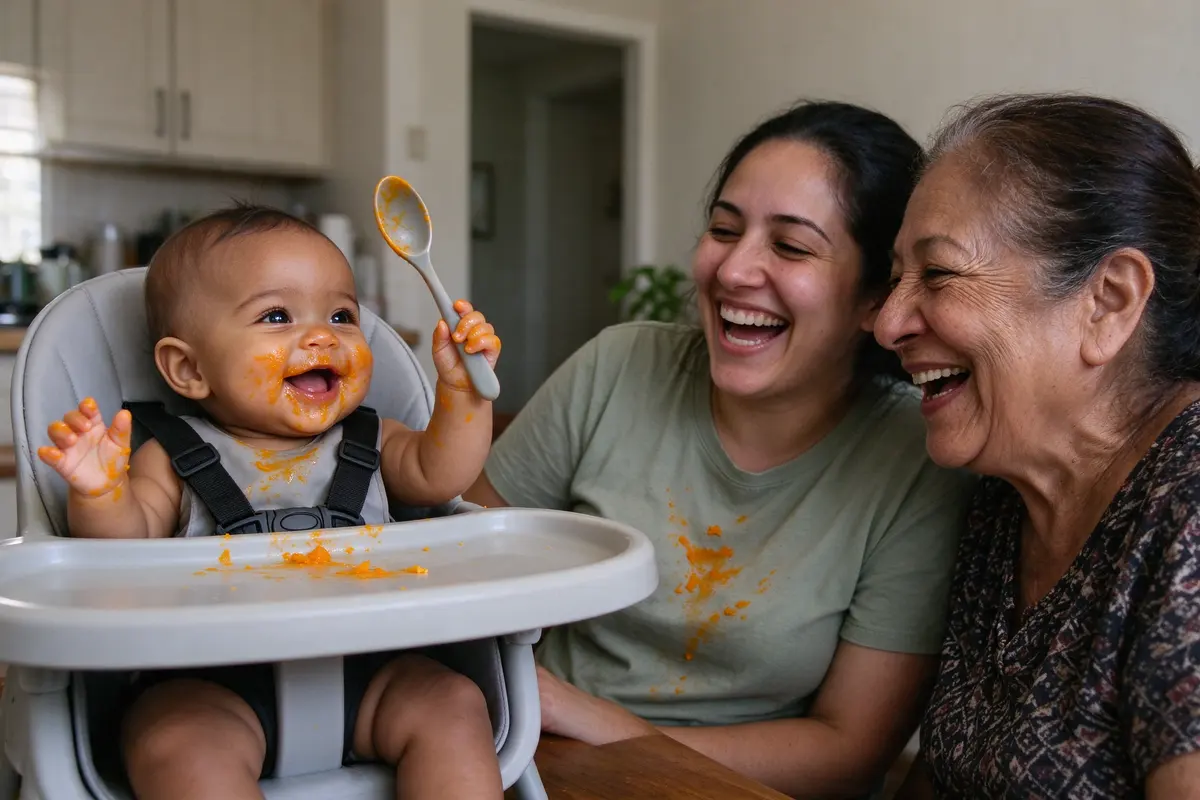
The mess is the point. A baby who ends a meal clean has either been fed by a very neat adult or hasn't touched the food, and only one of those is learning. Taking food from a spoon, resting between bites, and stopping when full are skills (AAP), and skills are practiced badly before they're practiced well. Put a towel under the chair and lower the standard.
Lower it for yourself too. Your own lunch counts even with one hand in the baby's: real food, sitting down, more than once a day, with plenty of water (OWH).
If you're the partner: take the bottle beforehand and the cloth afterward.
Sources
- American Academy of Pediatrics. "When Can Babies Start Solid Foods? Readiness & Feeding Tips." HealthyChildren.org, updated 2026. https://www.healthychildren.org/English/ages-stages/baby/feeding-nutrition/Pages/Starting-Solid-Foods.aspx
- Centers for Disease Control and Prevention. "Milestones by 6 Months." Learn the Signs. Act Early. program, updated 2026. https://www.cdc.gov/act-early/milestones/6-months.html
- Agbim IA, Hurtado CW. "Baby-Led Weaning: Is It Safe?" HealthyChildren.org, updated 2024. https://www.healthychildren.org/English/ages-stages/baby/feeding-nutrition/Pages/baby-led-weaning-is-it-safe.aspx
- Centers for Disease Control and Prevention. "Choking Hazards." 2026. https://www.cdc.gov/infant-toddler-nutrition/foods-and-drinks/choking-hazards.html
- Lehman P. "Choking vs. gagging: What parents need to know when introducing solid foods to children." Children's Wisconsin, 2024. https://childrenswi.org/at-every-turn/stories/2024/03/choking-vs-gagging-what-parents-need-to-know-when-introducing-solid-foods-to-children
- American Red Cross. "Infant Choking: How To Help." Accessed 2026. https://www.redcross.org/take-a-class/resources/learn-first-aid/infant-choking
- American Academy of Pediatrics. "Fever" (symptom checker). HealthyChildren.org, accessed 2026. https://www.healthychildren.org/English/tips-tools/symptom-checker/Pages/symptomviewer.aspx?symptom=Fever
- American Academy of Pediatrics. "Fever and Your Baby." HealthyChildren.org, updated 2025. https://www.healthychildren.org/English/health-issues/conditions/fever/Pages/Fever-and-Your-Baby.aspx
- Office on Women's Health. "Recovering from birth." US Department of Health and Human Services, 2021. https://womenshealth.gov/pregnancy/childbirth-and-beyond/recovering-birth
This guide is general education that summarizes published research and guidance from groups like the American Academy of Pediatrics, the CDC, and the WHO. It isn’t medical advice, and every child develops on their own timeline. Your pediatrician knows your child; if something feels wrong, call them. In an emergency, call 911.
Get each day’s note the morning it applies
Add your baby to a free Chorevia household with their date of birth, and every morning for 300 days the day’s note arrives in the app and by email: what’s developing, one thing to try, what to watch for, and a word for you.
Create your household