Day 184 of 300 · Week 25
Rotate the grains
Last reviewed · 3 min read · 11 sources · Plain-text version
Rice soaks up more arsenic than other crops, so rice cereal shouldn't be the first or only one. Oat, barley, multigrain, and what the AAP says heavy metals in baby food add up to.
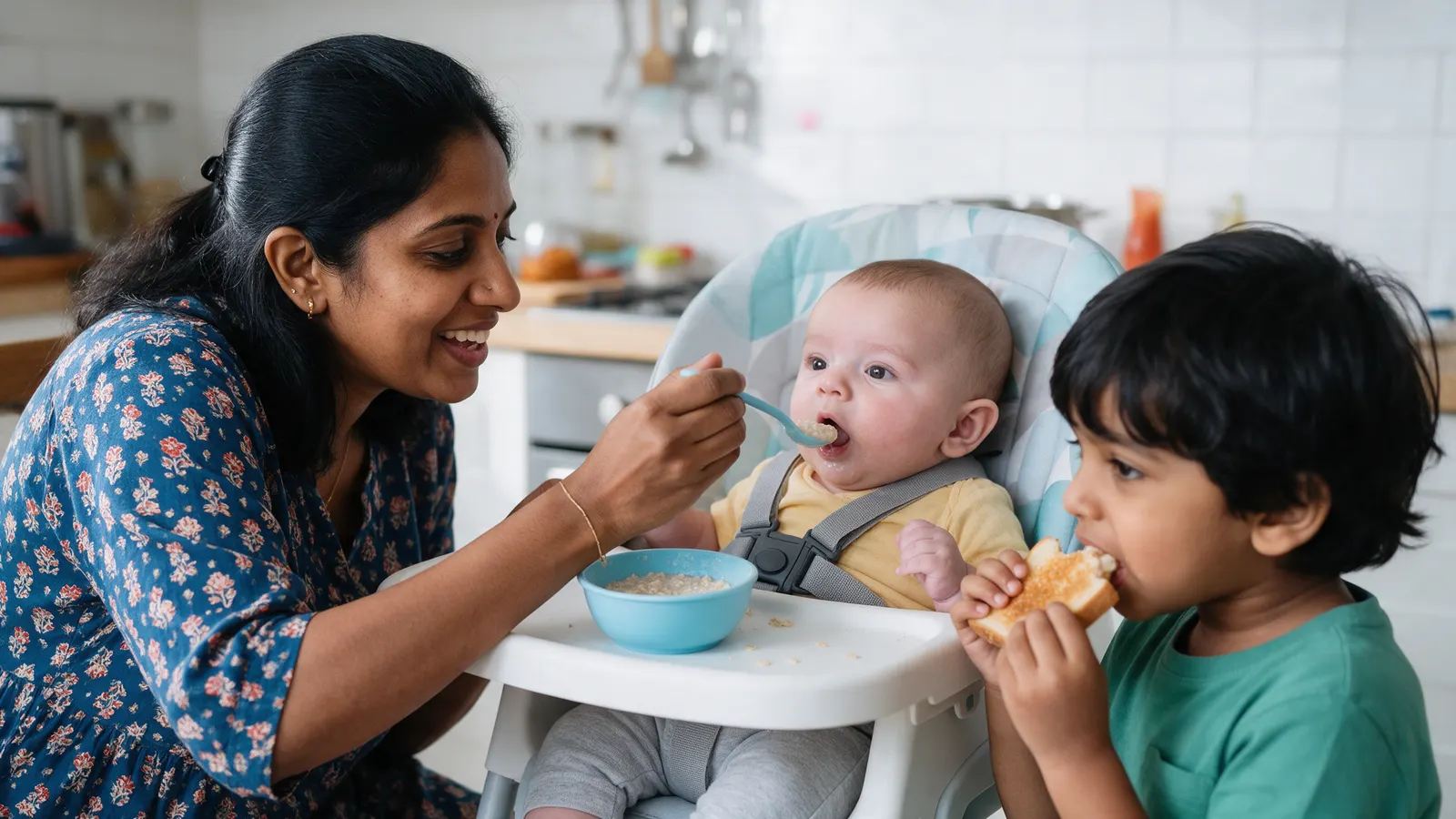
Cereal is the easy first food, and the box you grabbed is probably rice. Today is a one-word fix: rotate.
Heart
Rice absorbs more arsenic than other crops, so rice cereal shouldn't be the first or only cereal your baby eats; oat, barley, or multigrain work just as well on the spoon (AAP). Iron-fortified infant cereal is still a good early choice (AAP); the fix is the grain, not the cereal. And wherever the cereal comes from, it goes on a spoon: don't put cereal in a bottle (AAP).
Head
Here is the whole of what the AAP says about heavy metals in baby food, so the headlines don't get to fill in the rest. The low levels found in baby foods are likely a small part of a child's overall exposure, and serving a variety of foods lowers it further (AAP). That's it: a small part, and variety lowers it. Not zero, not a crisis, not a reason to make everything from scratch at midnight. Variety is the advice the rest of the week already gives you: one new single-ingredient food every 3 to 5 days, in no required order (AAP; CDC).
Body
Rotation is easier than it sounds, because the first foods already span the plate. Meat purees and iron-fortified cereal lead for iron, and eggs, fish, beans, lentils, and tofu carry it too (AAP; CDC). Vegetables, fruits, meats and other proteins, plain yogurt and cheese, and grains are all on the table by 7 to 8 months (CDC). A baby eating across that list is already rotating; the cereal box is just the one place a single crop can quietly become every breakfast. Rotate cereals instead of relying on rice (AAP).
Try today
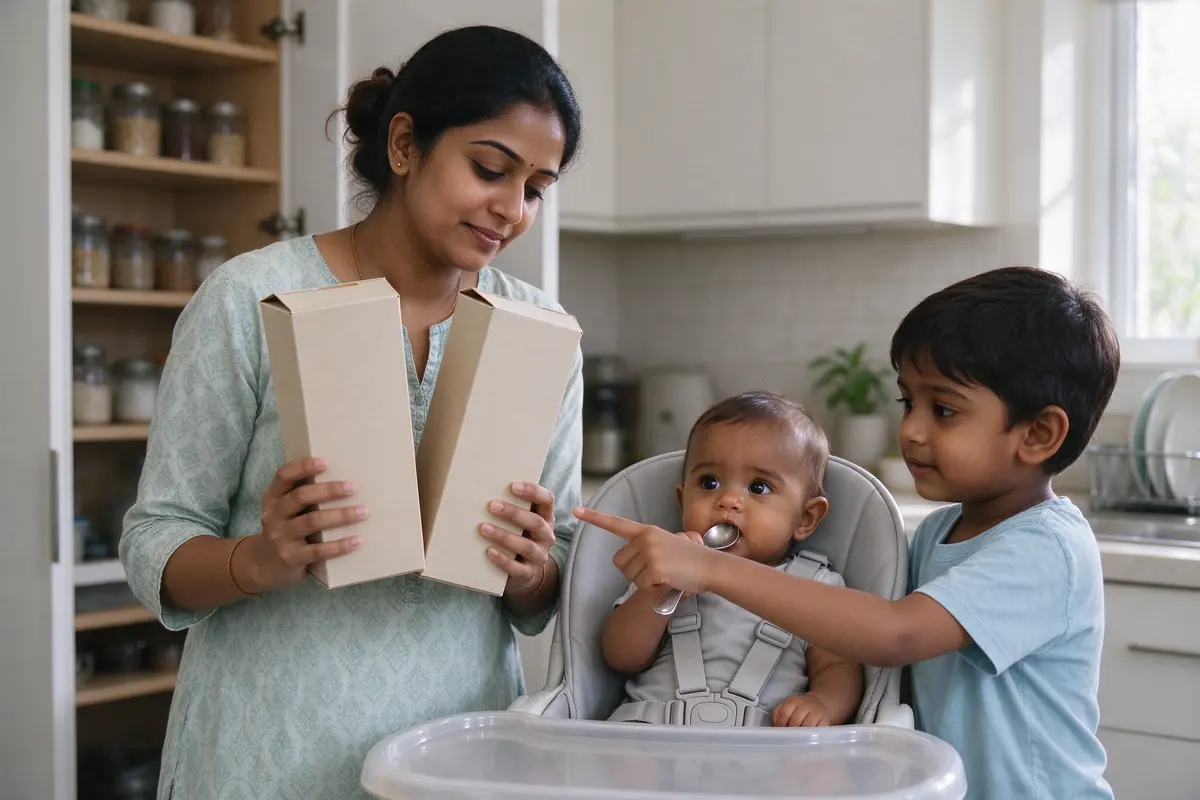
The cereal swap
Time: 5 minutes, at the store or the pantry
Read the box you have. If the first word is rice, finish it slowly and buy an oat, barley, or multigrain infant cereal next (AAP).
Keep it iron-fortified; that's what makes cereal a good early food (AAP).
Alternate grains across the week so no single crop is every breakfast (AAP).
Make it work:The same rule covers the rest of the menu: variety across foods lowers exposure further (AAP).
Watch for
Normal
a baby who reaches for the spoon and opens wide before it arrives; that's hunger, and you can follow it (CDC).
Call your pediatrician right away
if your baby seems dehydrated: no urine in more than 8 hours, dark urine, a very dry mouth, or no tears (AAP).
Normal
a lean forward onto the hands in the chair, which is why the harness is on (AAP).
Call your pediatrician
for any head injury in a baby under 1, including a tip from a chair (AAP).
Normal
pushing up on straight arms and rolling tummy to back on the floor after the meal (CDC).
Don't wait
to tell your pediatrician if your baby can't sit with help, doesn't roll in either direction, or doesn't bear some weight on their legs by 7 months (AAP).
For you
Variety is the whole strategy, not perfection. The AAP's own words on the metals are "small part" and "variety lowers it" (AAP); there is no version of this where you have to be a chemist. Buy a different box next time. That's the win.
Your own plate gets the same rule. Fresh fruits and vegetables and plenty of water are the Office on Women's Health's advice for your body after birth (OWH), and a bowl of the oatmeal you just bought for the baby counts.
If you're the partner: you buy the next box. Write "not rice" on the list.
Sources
- American Academy of Pediatrics. "Heavy Metals in Baby Food: Reducing Risk of Exposure." HealthyChildren.org, updated 2025. https://www.healthychildren.org/English/ages-stages/baby/feeding-nutrition/Pages/Metals-in-Baby-Food.aspx
- American Academy of Pediatrics. "When Can Babies Start Solid Foods? Readiness & Feeding Tips." HealthyChildren.org, updated 2026. https://www.healthychildren.org/English/ages-stages/baby/feeding-nutrition/Pages/Starting-Solid-Foods.aspx
- Centers for Disease Control and Prevention. "When, What, and How to Introduce Solid Foods." 2026. https://www.cdc.gov/infant-toddler-nutrition/foods-and-drinks/when-what-and-how-to-introduce-solid-foods.html
- Centers for Disease Control and Prevention. "Iron." Infant and Toddler Nutrition, 2026. https://www.cdc.gov/infant-toddler-nutrition/vitamins-minerals/iron.html
- Agbim IA, Hurtado CW. "Baby-Led Weaning: Is It Safe?" HealthyChildren.org, updated 2024. https://www.healthychildren.org/English/ages-stages/baby/feeding-nutrition/Pages/baby-led-weaning-is-it-safe.aspx
- Centers for Disease Control and Prevention. "Signs Your Child Is Hungry or Full." 2026. https://www.cdc.gov/infant-toddler-nutrition/mealtime/signs-your-child-is-hungry-or-full.html
- American Academy of Pediatrics. "Fever" (symptom checker). HealthyChildren.org, accessed 2026. https://www.healthychildren.org/English/tips-tools/symptom-checker/Pages/symptomviewer.aspx?symptom=Fever
- American Academy of Pediatrics. "Head Injury" (symptom checker). HealthyChildren.org, accessed 2026. https://www.healthychildren.org/English/tips-tools/symptom-checker/Pages/symptomviewer.aspx?symptom=Head+Injury
- Centers for Disease Control and Prevention. "Milestones by 6 Months." Learn the Signs. Act Early. program, updated 2026. https://www.cdc.gov/act-early/milestones/6-months.html
- American Academy of Pediatrics. "Developmental Milestones: 7 Months." HealthyChildren.org, updated 2009. https://www.healthychildren.org/English/ages-stages/baby/Pages/Developmental-Milestones-7-Months.aspx
- Office on Women's Health. "Recovering from birth." US Department of Health and Human Services, 2021. https://womenshealth.gov/pregnancy/childbirth-and-beyond/recovering-birth
This guide is general education that summarizes published research and guidance from groups like the American Academy of Pediatrics, the CDC, and the WHO. It isn’t medical advice, and every child develops on their own timeline. Your pediatrician knows your child; if something feels wrong, call them. In an emergency, call 911.
Get each day’s note the morning it applies
Add your baby to a free Chorevia household with their date of birth, and every morning for 300 days the day’s note arrives in the app and by email: what’s developing, one thing to try, what to watch for, and a word for you.
Create your household