Day 210 of 300 · Seven months
Seven months
Last reviewed · 4 min read · 20 sources · Plain-text version
First bites, first allergens, maybe a first tooth, and a sit that holds. What seven months changed, what the 9-month visit will ask, and where these notes go next.

Two hundred and ten days. This month changed the most: food went in, allergens went in, a tooth may have come through, and the baby who flopped onto their hands in week 25 can sit through a meal.
Heart
Read the 6-month list as a description, not a test. By about now, most babies know familiar people, laugh, take turns making sounds, blow raspberries, reach to grab a toy they want, close their lips to say "no more," roll from tummy to back, push up on straight arms, and lean on their hands to sit (CDC). Many now sit upright without leaning once set up, which the AAP puts at 6 to 8 months (AAP). Born early? Count from corrected age, as you have all along (AAP).
Head
The next fixed point is the 9-month visit. The AAP recommends a standardized developmental screening there (Lipkin & Macias, 2020; AAP, 2025), often a parent questionnaire like the Ages & Stages Questionnaires (ASQ), plus an exam, questions about sleep and pulling to stand, and fluoride varnish once teeth are in (AAP). The road ahead, from the 9-month list: sitting without support, looking when you call their name, lots of different sounds like "mamamama" and "bababababa," and shyness with strangers (CDC). The 7-to-12-month guide has the visit in full.
Body
From tomorrow, that guide is the source these notes draw on: crawling, the pincer grasp, first words, family food. The table doesn't change. Breast milk or formula is still the most important source of nutrition (CDC); meals happen upright and buckled in the high chair (AAP), with an adult watching the whole time (CDC); and peanut and egg stay in the rotation, never as whole nuts (AAP).
Try today
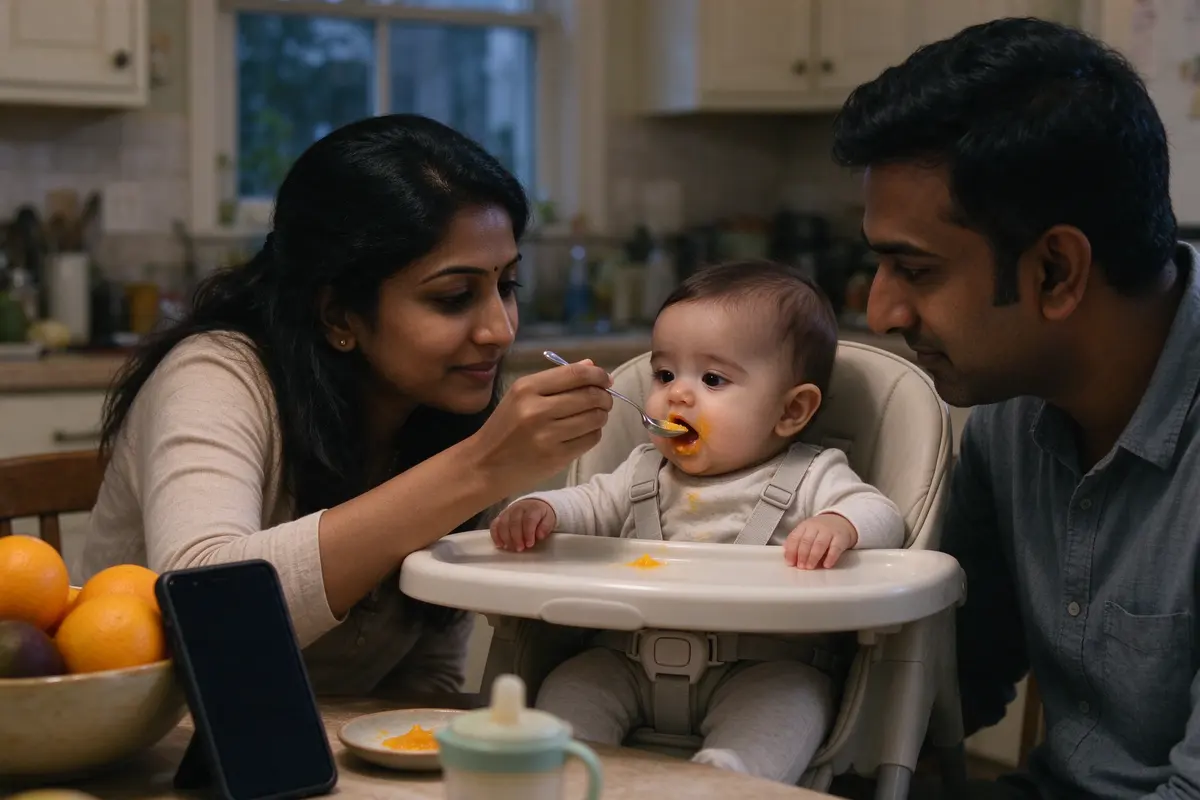
The first-bite video
Time: 2 minutes, at a meal your baby already likes · First tastes from a spoon in the guide
High chair, harness buckled, baby upright (AAP). Prop the phone against something so both of your hands are free.
Start recording, then offer half a spoonful of a puree your baby already eats, and wait for the open mouth (AAP).
Narrate as usual: "Here comes the sweet potato. Mmm."
Stop when they turn away or close their lips (AAP). Thirty seconds is plenty.
Save it beside the day-one photo and the sitting-up video.
Make it work:Your eyes stay on the baby, not the screen; watch at all times while they eat (CDC). A prop, not a hand, holds the phone.
Watch for
Normal
a sit that holds for a whole meal and a roll both ways on the floor afterward (AAP).
Talk with your pediatrician
if your baby can't sit with help, doesn't roll in either direction, or doesn't bear some weight on their legs by 7 months (AAP).
Normal
a face at a new food, then three more bites; it can take 10 to 15 tries (AAP).
Call 911
if your baby ever has trouble breathing, swelling of the lips, face, or tongue, widespread hives, or sudden floppiness after a food (NIAID).
Normal
"bababa" with no "mama" yet; repeated syllables are a 9-month skill (CDC).
Talk with your pediatrician
if your baby doesn't babble or imitate any sounds by 7 months (AAP).
Normal
knowing this baby better than anyone alive.
Call anyway
if your baby just doesn't seem right to you. Trust your instincts; seven months have built them (Lurie Children's).
For you

Seven months done. The 6-month visit was the last of the four checkups at which the AAP recommends screening the birthing parent for postpartum depression (Earls et al., 2019), so from here the watching is yours, and the partner's: about 10% of fathers have depression around a birth, with higher rates, 25.6%, reported at 3 to 6 months after (Paulson & Bazemore, 2010). Once more, lightly: the National Maternal Mental Health Hotline is 1-833-TLC-MAMA (1-833-852-6262), call or text; 988 is for anyone; in an emergency, 911 (CDC). Ask each other.
If you're the partner: name the thing she did this month that you'll remember. Then read what's next together: the 7-to-12-month guide, and the notes continue tomorrow at your eighth month.
Sources
- Centers for Disease Control and Prevention. "Milestones by 6 Months." Learn the Signs. Act Early. program, updated 2026. https://www.cdc.gov/act-early/milestones/6-months.html
- American Academy of Pediatrics. "Movement Milestones: Babies 4 to 7 Months." HealthyChildren.org, updated 2021. https://www.healthychildren.org/English/ages-stages/baby/Pages/Movement-4-to-7-Months.aspx
- American Academy of Pediatrics. "Corrected Age For Preemies." HealthyChildren.org, accessed 2026. https://www.healthychildren.org/English/ages-stages/baby/preemie/Pages/Corrected-Age-For-Preemies.aspx
- Lipkin PH, Macias MM; AAP Council on Children With Disabilities, Section on Developmental and Behavioral Pediatrics. "Promoting Optimal Development: Identifying Infants and Young Children With Developmental Disorders Through Developmental Surveillance and Screening." Pediatrics, 2020. https://pubmed.ncbi.nlm.nih.gov/31843861/
- American Academy of Pediatrics and Bright Futures. "Recommendations for Preventive Pediatric Health Care" (Periodicity Schedule). 2025. https://downloads.aap.org/AAP/PDF/periodicity_schedule.pdf
- Brookes Publishing. "About ASQ." Ages & Stages Questionnaires, accessed 2026. https://agesandstages.com/about-asq/
- American Academy of Pediatrics. "Checkup Checklist: 9 Months Old." HealthyChildren.org, updated 2021. https://www.healthychildren.org/English/ages-stages/Your-Childs-Checkups/Pages/Your-Checkup-Checklist-9-Months-Old.aspx
- Centers for Disease Control and Prevention. "Milestones by 9 Months." Learn the Signs. Act Early. program, updated 2026. https://www.cdc.gov/act-early/milestones/9-months.html
- Agbim IA, Hurtado CW. "Baby-Led Weaning: Is It Safe?" HealthyChildren.org, updated 2024. https://www.healthychildren.org/English/ages-stages/baby/feeding-nutrition/Pages/baby-led-weaning-is-it-safe.aspx
- Centers for Disease Control and Prevention. "Choking Hazards." 2026. https://www.cdc.gov/infant-toddler-nutrition/foods-and-drinks/choking-hazards.html
- Cox A, Pistiner M. "When to Introduce Egg, Peanut Butter & Other Common Food Allergens to a Baby." HealthyChildren.org, updated 2025. https://www.healthychildren.org/English/healthy-living/nutrition/Pages/when-to-introduce-egg-peanut-butter-and-other-common-food-allergens-to-your-baby-food-allergy-prevention-tips.aspx
- American Academy of Pediatrics. "When Can Babies Start Solid Foods? Readiness & Feeding Tips." HealthyChildren.org, updated 2026. https://www.healthychildren.org/English/ages-stages/baby/feeding-nutrition/Pages/Starting-Solid-Foods.aspx
- American Academy of Pediatrics. "Developmental Milestones: 7 Months." HealthyChildren.org, updated 2009. https://www.healthychildren.org/English/ages-stages/baby/Pages/Developmental-Milestones-7-Months.aspx
- American Academy of Pediatrics. "Checkup Checklist: 6 Months Old." HealthyChildren.org, updated 2023. https://www.healthychildren.org/English/ages-stages/Your-Childs-Checkups/Pages/Your-Checkup-Checklist-6-Months-Old.aspx
- National Institute of Allergy and Infectious Diseases. "Instructions for Home Feeding of Peanut Protein for Infants at Low Risk of an Allergic Reaction to Peanut" (Appendix D). 2017. https://www.niaid.nih.gov/sites/default/files/addendum_guidelines_peanut_appx_d.pdf
- American Academy of Pediatrics. "Language Development: 4 to 7 Months." HealthyChildren.org, updated 2009. https://www.healthychildren.org/English/ages-stages/baby/Pages/Language-Development-4-to-7-Months.aspx
- Lurie Children's Hospital of Chicago. "When to Call the Pediatrician for Your Newborn." 2024. https://www.luriechildrens.org/en/blog/when-to-call-the-pediatrician-for-your-newborn/
- Earls MF, Yogman MW, Mattson G, Rafferty J; AAP Committee on Psychosocial Aspects of Child and Family Health. "Incorporating Recognition and Management of Perinatal Depression Into Pediatric Practice." Pediatrics, 2019. https://pubmed.ncbi.nlm.nih.gov/30559120/
- Paulson JF, Bazemore SD. "Prenatal and postpartum depression in fathers and its association with maternal depression: a meta-analysis." JAMA, 2010. https://pubmed.ncbi.nlm.nih.gov/20483973/
- Centers for Disease Control and Prevention. "Symptoms of Depression Among Women." 2024. https://www.cdc.gov/reproductive-health/depression/index.html
This guide is general education that summarizes published research and guidance from groups like the American Academy of Pediatrics, the CDC, and the WHO. It isn’t medical advice, and every child develops on their own timeline. Your pediatrician knows your child; if something feels wrong, call them. In an emergency, call 911.
Get each day’s note the morning it applies
Add your baby to a free Chorevia household with their date of birth, and every morning for 300 days the day’s note arrives in the app and by email: what’s developing, one thing to try, what to watch for, and a word for you.
Create your household