Day 209 of 300 · Seven months
Fever and head bumps now
Last reviewed · 4 min read · 10 sources · Plain-text version
After 6 months the fever lines shift: call right away above 104°F, and 103°F may be a call too. Every head bump under 1 is a call. Two lists for the fridge, and a third for you.

The last time these notes gave you the fever lines, every number was lower. Today is the set for a baby over 6 months, plus the rule for the head bump that comes with sitting, on two cards for the fridge.
Heart
Over 6 months, the fever lines move. Call your pediatrician right away for a fever higher than 104°F (40°C) (AAP); the AAP also says you may need to call about a temperature of 103°F (39.4°C) or higher in babies over 6 months (AAP). Lower fevers are about time: call within a day for a fever lasting more than 48 hours with no other symptoms, or any fever for more than 3 days (AAP). Use a thermometer, not your hand (AAP). Teething doesn't cause fever (Massignan et al., 2016).
Head
The AAP's rule for the bump is simple: any head injury in a baby under 1 means a call to your pediatrician (AAP). Call 911 for a seizure or if your baby was knocked out for more than a minute; go to the ER now if, after a head injury, your baby vomits 2 or more times, cries and won't stop, or is awake but not alert (AAP). Most bumps end in a cuddle; the call is so the person who knows the exceptions hears about it.
Body
Two more lines for the card. Dehydration: no urine in more than 8 hours, dark urine, a very dry mouth, or no tears is a call right away (AAP). And food: a new rash, a few hives around the mouth or face, or diarrhea after a new food means hold off on that food and call; vomiting, swelling of the lips, face, or tongue, widespread hives, wheezing, trouble breathing, or sudden floppiness means 911 (NIAID; AAP).
Try today

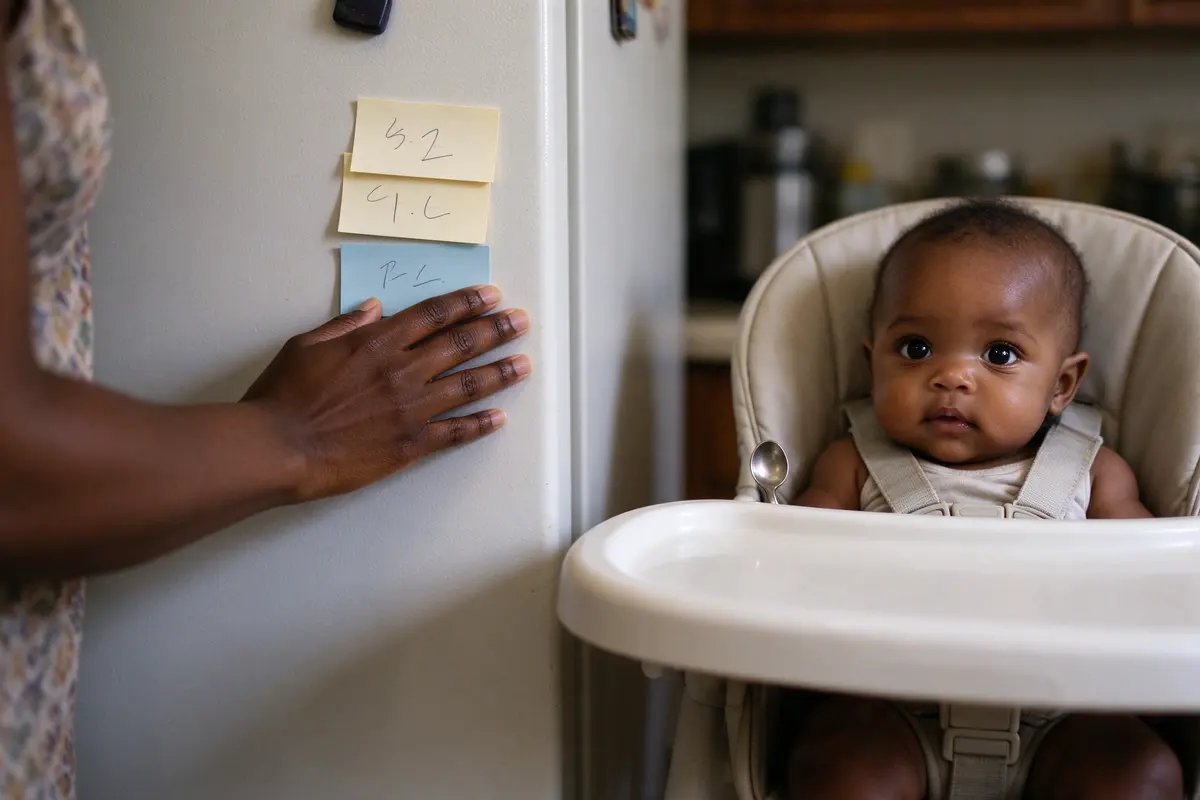
The two lists on the fridge
Time: 15 minutes, two index cards, a marker · Call your pediatrician right away if your baby in the guide
Card one, headed 911: can't cry, cough, or breathe; struggling for each breath or bluish lips; can't be woken or very weak; purple or blood-colored spots; a seizure or knocked out after a head injury; after a food, swelling of the lips, face, or tongue, widespread hives, or sudden floppiness (AAP; AAP; NIAID).
At the bottom of card two: "48 hours with nothing else, or 3 days: call within a day" (AAP).
Across the top of both: the pediatrician's number and Poison Help, 1-800-222-1222 (AAP).
Tape them to the fridge.
Make it work:Read both cards out loud to whoever else cares for your baby.
Watch for
Normal
a bump on the forehead from a sideways topple, a minute of crying, and a return to play.
Call your pediatrician right away
anyway; a call is advised for every head injury in a baby under 1 (AAP).
Normal
a warm, drooly, fussy baby with a tooth coming, under 100.4°F (AAP).
Normal
a puree-smeared cheek that's clean skin after a wipe.
Call your pediatrician right away
for a new rash, a few hives around the mouth or face, or diarrhea after a food, and hold off on that food (NIAID).
For you
Your own fever is still an urgent sign. A fever of 100.4°F or higher is on the CDC's list of urgent maternal warning signs, beside a headache that won't go away, chest pain, trouble breathing, and thoughts of harming yourself or your baby: seek care immediately, and tell any provider you were pregnant within the last year (CDC). A third card goes beside the baby's two. If something just isn't right, or you aren't sure if it's serious, talk to your health care provider (CDC).
If you're the partner: write her card. She'll write the baby's without being asked.
Sources
- American Academy of Pediatrics. "Fever" (symptom checker). HealthyChildren.org, accessed 2026. https://www.healthychildren.org/English/tips-tools/symptom-checker/Pages/symptomviewer.aspx?symptom=Fever
- American Academy of Pediatrics. "Fever and Your Baby." HealthyChildren.org, updated 2025. https://www.healthychildren.org/English/health-issues/conditions/fever/Pages/Fever-and-Your-Baby.aspx
- Massignan C, Cardoso M, Porporatti AL, et al. "Signs and Symptoms of Primary Tooth Eruption: A Meta-analysis." Pediatrics, 2016. https://pubmed.ncbi.nlm.nih.gov/26908659/
- American Academy of Pediatrics. "Head Injury" (symptom checker). HealthyChildren.org, accessed 2026. https://www.healthychildren.org/English/tips-tools/symptom-checker/Pages/symptomviewer.aspx?symptom=Head+Injury
- National Institute of Allergy and Infectious Diseases. "Instructions for Home Feeding of Peanut Protein for Infants at Low Risk of an Allergic Reaction to Peanut" (Appendix D). 2017. https://www.niaid.nih.gov/sites/default/files/addendum_guidelines_peanut_appx_d.pdf
- Cox A, Pistiner M. "When to Introduce Egg, Peanut Butter & Other Common Food Allergens to a Baby." HealthyChildren.org, updated 2025. https://www.healthychildren.org/English/healthy-living/nutrition/Pages/when-to-introduce-egg-peanut-butter-and-other-common-food-allergens-to-your-baby-food-allergy-prevention-tips.aspx
- American Academy of Pediatrics. "Home Safety: Tips for Families With Young Children." HealthyChildren.org, updated 2022. https://www.healthychildren.org/English/safety-prevention/at-home/Pages/Home-Safety-Heres-How.aspx
- DiMaggio D, Cernigliaro J. "Baby's First Tooth: 7 Facts Parents Should Know." HealthyChildren.org, updated 2022. https://www.healthychildren.org/English/ages-stages/baby/teething-tooth-care/Pages/Babys-First-Tooth-Facts-Parents-Should-Know.aspx
- Di Giovine M, Catenaccio E. "Febrile Seizures in Children." HealthyChildren.org, updated 2025. https://www.healthychildren.org/English/health-issues/conditions/fever/Pages/Febrile-Seizures.aspx
- Centers for Disease Control and Prevention. "Urgent Maternal Warning Signs and Symptoms." HEAR HER, 2024. https://www.cdc.gov/hearher/maternal-warning-signs/index.html
This guide is general education that summarizes published research and guidance from groups like the American Academy of Pediatrics, the CDC, and the WHO. It isn’t medical advice, and every child develops on their own timeline. Your pediatrician knows your child; if something feels wrong, call them. In an emergency, call 911.
Get each day’s note the morning it applies
Add your baby to a free Chorevia household with their date of birth, and every morning for 300 days the day’s note arrives in the app and by email: what’s developing, one thing to try, what to watch for, and a word for you.
Create your household