Day 201 of 300 · Week 27
Reading and pointing
Last reviewed · 3 min read · 7 sources · Plain-text version
Five to ten minutes a day with a board book, a finger on the picture, and a name for it. Why the AAP recommends shared reading from birth, and why the same book is fine.
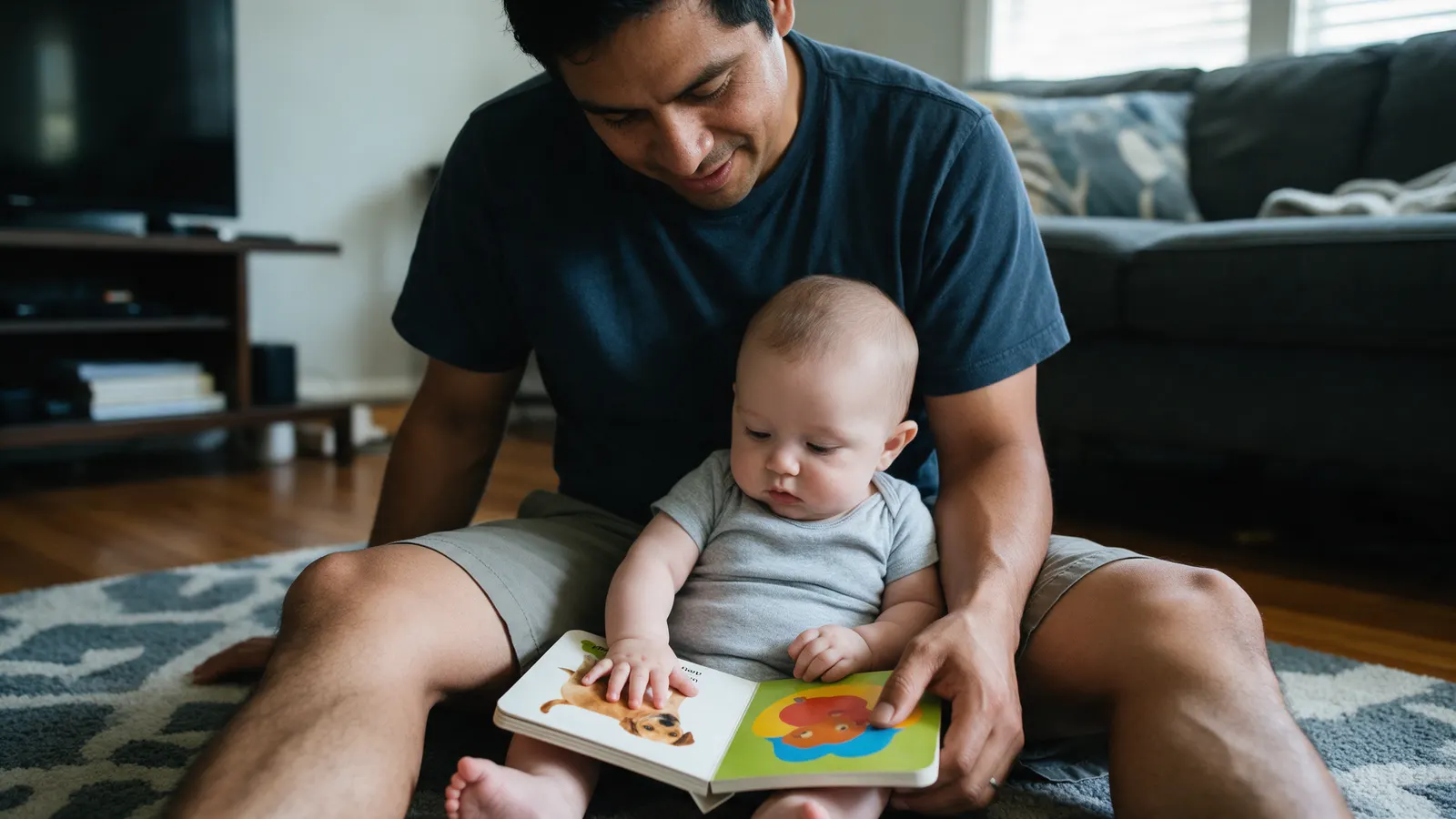
Yesterday was a letter. Today is a book, the kind with thick pages and one big picture per spread, and the smallest routine in this series: five minutes, a finger, a word.
Heart
Your baby doesn't need to understand a story to get something from a book. The AAP recommends shared reading from birth, a policy grounded in research with young children (Klass et al., 2024), and CDC's advice for this age is plainer still: "read" colorful pictures every day and talk about them (CDC). At this age reading is pointing and naming. You put a finger on the dog, you say "dog," your baby looks where you're looking. That's the whole lesson, and it's a good one.
Head
What makes it work is the back-and-forth. When your baby babbles or pats the page and you answer with eye contact and words, that serve and return helps build connections in the brain (Harvard Center on the Developing Child). Name what your baby looks at, not what you planned to read (CDC). From about 6 or 7 months, babies get much better at imitating the sounds you make (AAP), so when a "ba" comes out over the picture of a ball, say it back and give them the word: "Ba! Ball."
Body
Expect the book to be handled more than read. Around now, babies put things in their mouth to explore them (CDC), and between 6 and 8 months they learn to pass objects from hand to hand and to turn and twist them (AAP). A board book is a toy that happens to have pictures. Let them pat it, hold it, gum the corner, and flip it over; the sturdiest book you own is the right one.
Try today
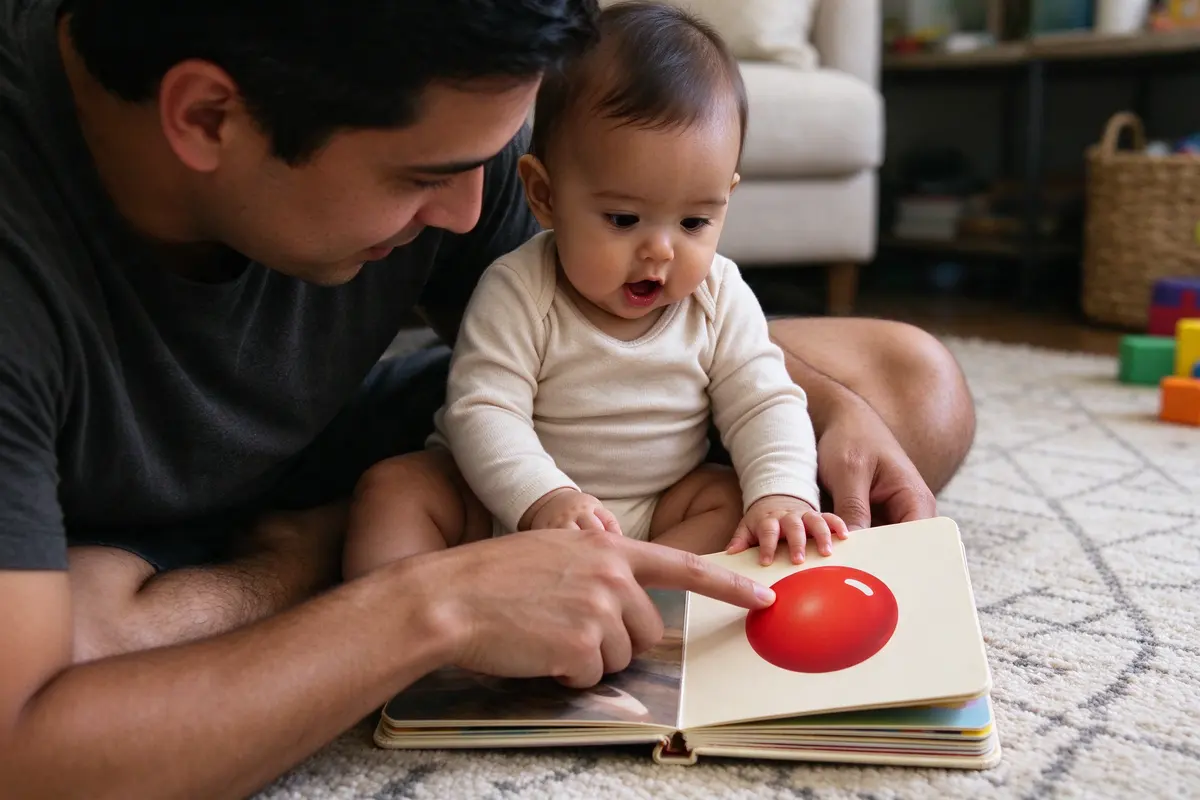
Read and point
Time: 5 to 10 minutes a day · Read and point in the guide
Sit your baby between your legs on the floor, or on your lap, with a sturdy board book that has big, clear pictures.
Put your finger on one picture and name it: "Dog." Pause.
Follow their eyes. Whatever they look at, that's the next word (CDC).
Let them pat, hold, and mouth the book; a bent corner is part of reading.
When they babble, answer with a word: "Yes, that's the doggy!"
Make it work:Stop when they turn away or arch. Two pages read with attention beat ten pages read at a wriggling baby.
Watch for
Normal
a baby who chews the corner of the book more than they look at it; mouthing is how they explore right now (CDC).
Talk with your pediatrician
if your baby doesn't babble or imitate any sounds by 7 months, which can signal a hearing problem (AAP).
Normal
turning away after two pages, then grabbing for the book again a minute later.
Call 911
if your baby is struggling for each breath, has stopped breathing, or has bluish lips or face (AAP).
Normal
wanting the same page over and over, every day this week.
Call your pediatrician right away
if your baby has a fever higher than 104°F (40°C) (AAP).
For you
The same book is fine. The point of reading at this age is the pointing and the naming and the answer to the babble (CDC), and a book you know by heart lets you look at your baby instead of the page. If you're bored of it, that's a sign it's working for them, not a sign you need to buy another.
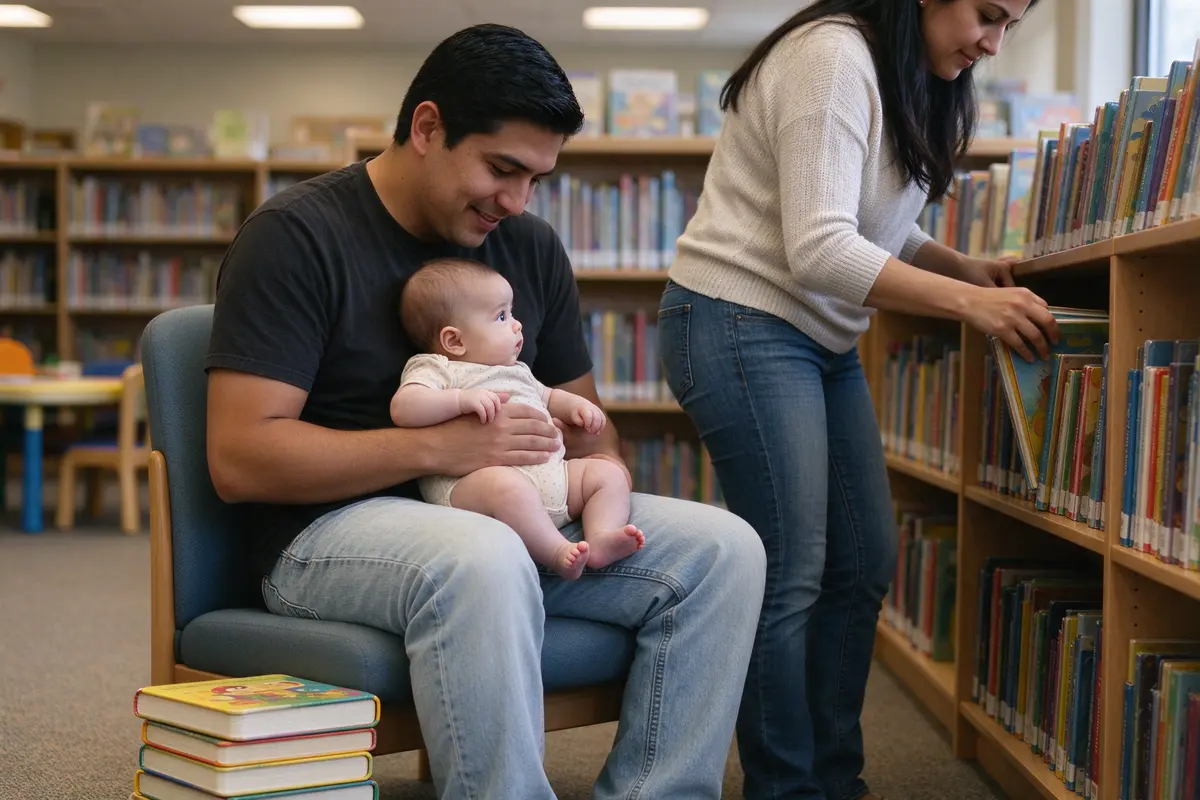
When you do want another, the library is free. The AAP's reading policy is built on getting books into families' hands (Klass et al., 2024), and a children's librarian will happily hand you three board books and a chair.
If you're the partner: take one of the five minutes today. Your finger, your voice, your word for the dog.
Sources
- Klass P, Miller-Fitzwater A, High PC; AAP Council on Early Childhood. "Literacy Promotion: An Essential Component of Primary Care Pediatric Practice: Policy Statement." Pediatrics, 2024. https://pubmed.ncbi.nlm.nih.gov/39342414/
- Centers for Disease Control and Prevention. "Milestones by 6 Months." Learn the Signs. Act Early. program, updated 2026. https://www.cdc.gov/act-early/milestones/6-months.html
- Center on the Developing Child at Harvard University. "Serve and Return." Accessed 2026. https://developingchild.harvard.edu/key-concept/serve-and-return/
- American Academy of Pediatrics. "Language Development: 4 to 7 Months." HealthyChildren.org, updated 2009. https://www.healthychildren.org/English/ages-stages/baby/Pages/Language-Development-4-to-7-Months.aspx
- American Academy of Pediatrics. "Movement Milestones: Babies 4 to 7 Months." HealthyChildren.org, updated 2021. https://www.healthychildren.org/English/ages-stages/baby/Pages/Movement-4-to-7-Months.aspx
- American Academy of Pediatrics. "Breathing Trouble" (symptom checker). HealthyChildren.org, accessed 2026. https://www.healthychildren.org/English/tips-tools/symptom-checker/Pages/symptomviewer.aspx?symptom=Breathing+Trouble
- American Academy of Pediatrics. "Fever" (symptom checker). HealthyChildren.org, accessed 2026. https://www.healthychildren.org/English/tips-tools/symptom-checker/Pages/symptomviewer.aspx?symptom=Fever
This guide is general education that summarizes published research and guidance from groups like the American Academy of Pediatrics, the CDC, and the WHO. It isn’t medical advice, and every child develops on their own timeline. Your pediatrician knows your child; if something feels wrong, call them. In an emergency, call 911.
Get each day’s note the morning it applies
Add your baby to a free Chorevia household with their date of birth, and every morning for 300 days the day’s note arrives in the app and by email: what’s developing, one thing to try, what to watch for, and a word for you.
Create your household