Day 194 of 300 · Week 26
Twenty-seven weeks: hand to hand
Last reviewed · 4 min read · 9 sources · Plain-text version
Between 6 and 8 months, babies learn to pass a toy from one hand to the other and turn it over. The two-toy test, bouncing feet, and the pincer grasp still to come.

Twenty-seven weeks. Watch the hands this week: the thing in the left one is about to end up in the right.
Heart
Between 6 and 8 months, babies learn to pass objects from hand to hand and to turn and twist them. The finger-and-thumb pincer grasp usually arrives around 9 months. And held upright with their feet on the floor, many babies bounce, a warm-up for standing (AAP). Moving things from one hand to the other is on the 9-month list (CDC), so a baby who drops the first toy to take the second is right where they should be. The next guide describes the rest of the arc: raking things in with the whole hand early on, pinching with thumb and finger by the end, and once they can let go on purpose, dropping and throwing as favorite games (AAP).
Head
The hands are built on the 6-month list: reaching to grab a toy they want, and putting things in their mouth to explore them (CDC). The mouth is still a hand, which sets the rules for what the hands get. Toys are lightweight, unbreakable, and too big to swallow (AAP). Better hands also find smaller things, so look at floor level for coins, buttons, small toy parts, and button batteries (AAP). A swallowed button battery is a call to Poison Help at 1-800-222-1222 at once, because one stuck in the esophagus can do severe damage in 2 hours (Poison Control).
Body
The feet are busy too. On your lap, feet planted on the floor, the bounce is the warm-up for standing (AAP), and bearing some weight on the legs by 7 months is on the AAP's list of things to mention if they're missing (AAP). Your lap is the equipment. The hand-to-hand and bouncing section of the guide has nothing in it you need to buy.
Try today
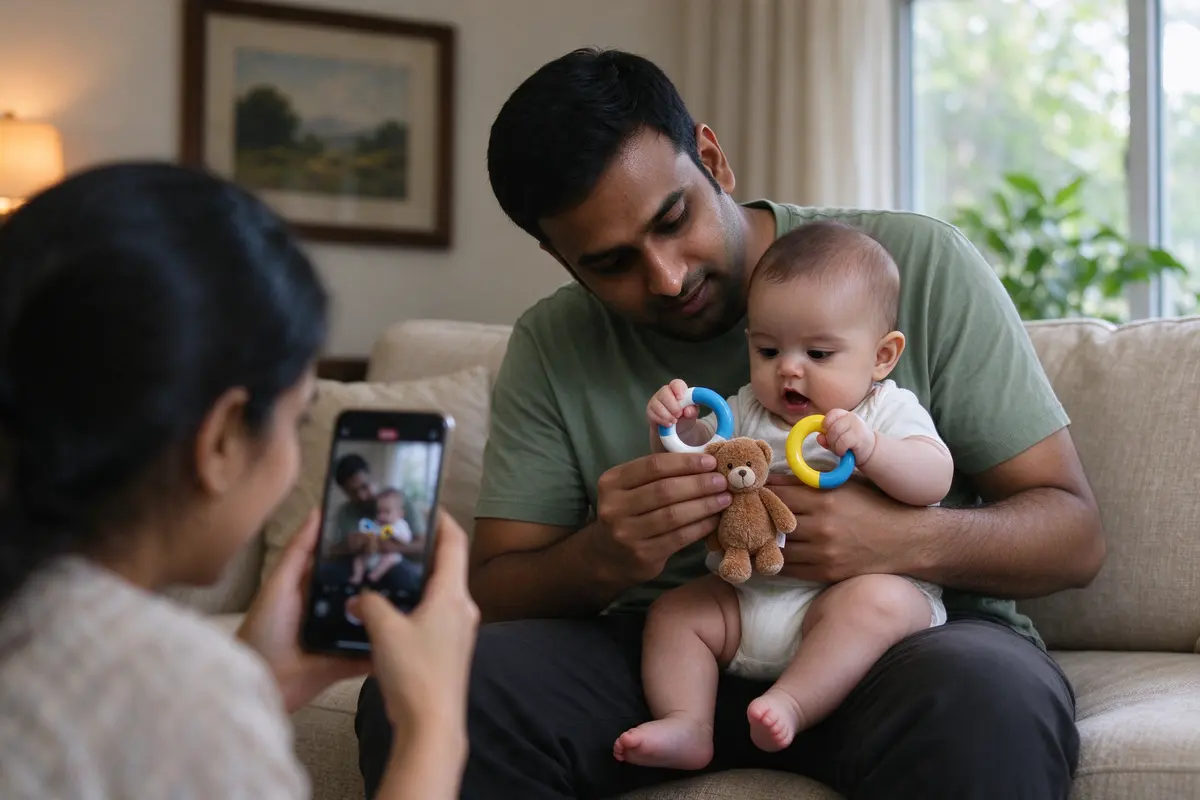
The hand-to-hand toy
Time: 5 minutes, sitting · Sitting, rolling, and reaching in the guide
Sit your baby on your lap or supported on the floor, and put a small rattle in one hand (AAP).
Offer a second toy to the empty hand and let them hold both.
Hold a third toy in front, at the middle. Watch what happens: a drop, a pass from one hand to the other, or a long stare. All three are right answers.
Narrate it: "You moved it to the other hand!" Then offer from the other side.
Watch for
Normal
a toy dropped the instant a new one appears; letting go on purpose is still being learned (AAP).
Call your pediatrician
if your baby reaches with only one hand, or doesn't reach for toys at all (AAP).
Normal
a found object headed straight for the mouth; exploring by mouth is on the 6-month list (CDC).
Call Poison Help at 1-800-222-1222 right away
if you think your baby swallowed a button battery, without waiting to see what happens (Poison Control).
Normal
hard bouncing on your lap with both feet planted (AAP).
Call your pediatrician
if your baby doesn't bear some weight on their legs by 7 months (AAP).
For you

Your own hands. Six months of lifting, carrying, and doing everything one-armed leaves a lot of mothers with sore wrists and thumbs, and nobody has asked about them. The maternal warning list is specific: severe swelling, redness, or pain of an arm or leg needs care immediately, because it can mean a clot (CDC). An ordinary ache isn't that. But the same page says that if you feel like something just isn't right, or you aren't sure if it's serious, talk to your health care provider (CDC). A pain that stops you lifting your baby is worth the call.
If you're the partner: the car seat is yours to carry from now on. Every time, without being asked.
Sources
- American Academy of Pediatrics. "Movement Milestones: Babies 4 to 7 Months." HealthyChildren.org, updated 2021. https://www.healthychildren.org/English/ages-stages/baby/Pages/Movement-4-to-7-Months.aspx
- Centers for Disease Control and Prevention. "Milestones by 9 Months." Learn the Signs. Act Early. program, updated 2026. https://www.cdc.gov/act-early/milestones/9-months.html
- American Academy of Pediatrics. "Hand and Finger Skills." HealthyChildren.org, updated 2009. https://www.healthychildren.org/English/ages-stages/baby/Pages/Hand-and-Finger-Skills.aspx
- Centers for Disease Control and Prevention. "Milestones by 6 Months." Learn the Signs. Act Early. program, updated 2026. https://www.cdc.gov/act-early/milestones/6-months.html
- American Academy of Pediatrics. "Cognitive Development in Infants: 4 to 7 Months." HealthyChildren.org, updated 2023. https://www.healthychildren.org/English/ages-stages/baby/Pages/Cognitive-Development-4-to-7-Months.aspx
- American Academy of Pediatrics. "Home Safety: Tips for Families With Young Children." HealthyChildren.org, updated 2022. https://www.healthychildren.org/English/safety-prevention/at-home/Pages/Home-Safety-Heres-How.aspx
- National Capital Poison Center. "Swallowed a button battery? Battery in the nose or ear?" Poison Control, accessed 2026. https://www.poison.org/battery
- American Academy of Pediatrics. "Developmental Milestones: 7 Months." HealthyChildren.org, updated 2009. https://www.healthychildren.org/English/ages-stages/baby/Pages/Developmental-Milestones-7-Months.aspx
- Centers for Disease Control and Prevention. "Urgent Maternal Warning Signs and Symptoms." HEAR HER, 2024. https://www.cdc.gov/hearher/maternal-warning-signs/index.html
This guide is general education that summarizes published research and guidance from groups like the American Academy of Pediatrics, the CDC, and the WHO. It isn’t medical advice, and every child develops on their own timeline. Your pediatrician knows your child; if something feels wrong, call them. In an emergency, call 911.
Get each day’s note the morning it applies
Add your baby to a free Chorevia household with their date of birth, and every morning for 300 days the day’s note arrives in the app and by email: what’s developing, one thing to try, what to watch for, and a word for you.
Create your household