Day 192 of 300 · Week 26
Meals together
Last reviewed · 4 min read · 14 sources · Plain-text version
The AAP encourages a seat at family meals from the very first feeding. Why the table matters more than the menu, and how one calm meal a day can work on a weeknight.
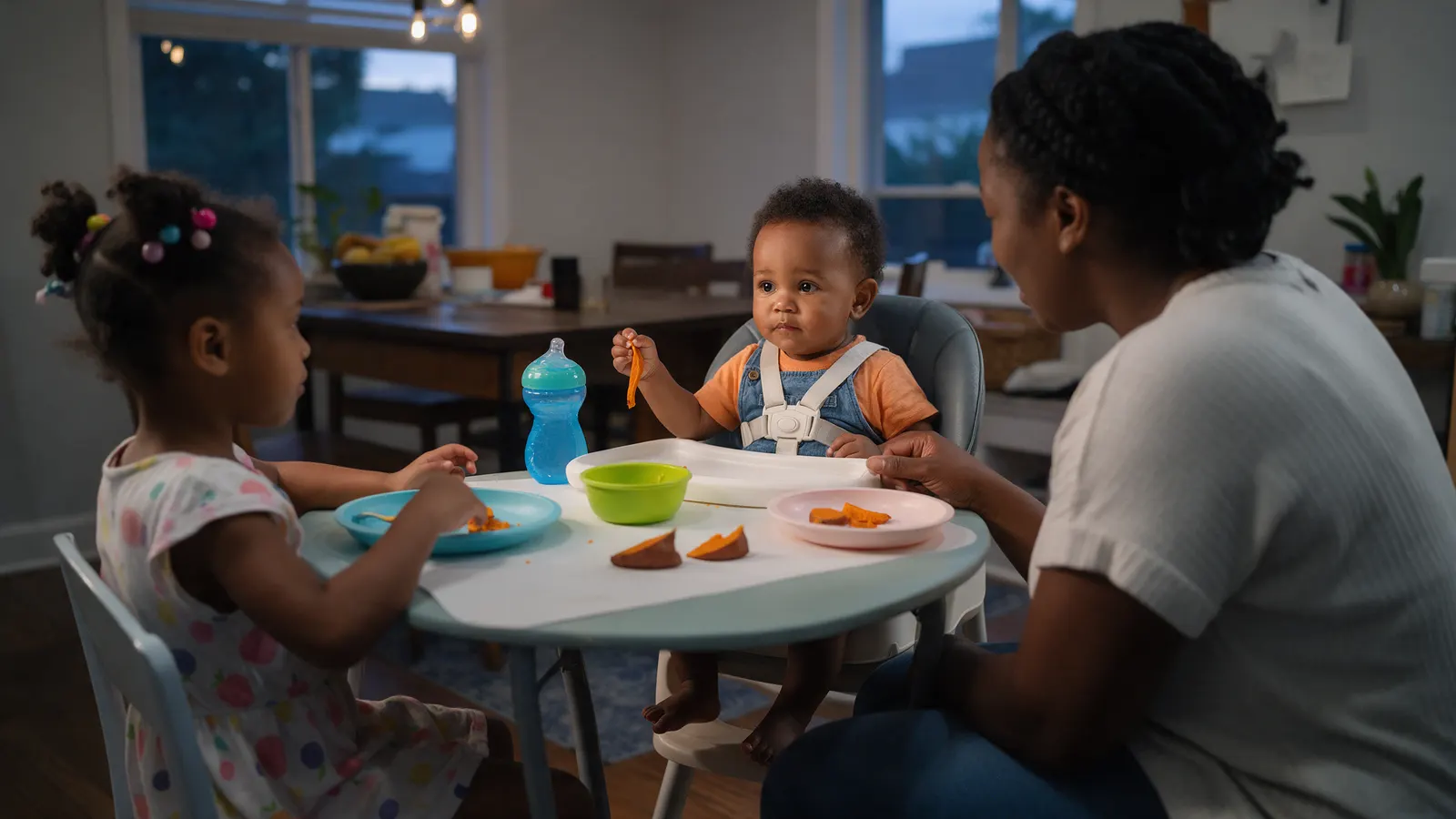
The high chair has been at the table since last month. Now there's food on the tray, and the family meal is a real thing.
Heart
The AAP encourages a seat at family meals from the very first feeding (AAP). Your baby's work is still eating, sleeping, playing, and learning, but babies watch everything, and the table is where they see what a family does with food and with each other. In lab studies, toddlers as young as 18 months readily helped adults reach their goals without being asked or rewarded (Warneken & Tomasello, 2006). That helping grows out of months of watching, and the watching starts now, from a high chair at the corner of the table (family life starts now).
Head
The table has rules, and they're the same whoever's eating. Upright and buckled, with the high-chair harness on (AAP); never food in a car seat or stroller or lying down; eyes on your baby the whole time they eat, with the meal calm and unhurried (CDC). Hot drinks stay away from the edge, and nobody carries a hot mug while holding the baby (AAP). And the chair is for the meal, not the evening: the WHO advises against more than an hour at a time strapped into a high chair, stroller, or carrier (WHO).
Body
The meal is also a language lesson. Name what your baby looks at, all day long (CDC), and dinner is where the most things go by: the hot pot, the bread, the sister's cup. Every babble you answer with eye contact and words is serve and return, the back-and-forth that builds connections in the brain (Harvard Center on the Developing Child). "Conversations take turns" is on the 6-month list; the table is where turns happen (CDC). Their puree, your plate, the same ten minutes.
Try today
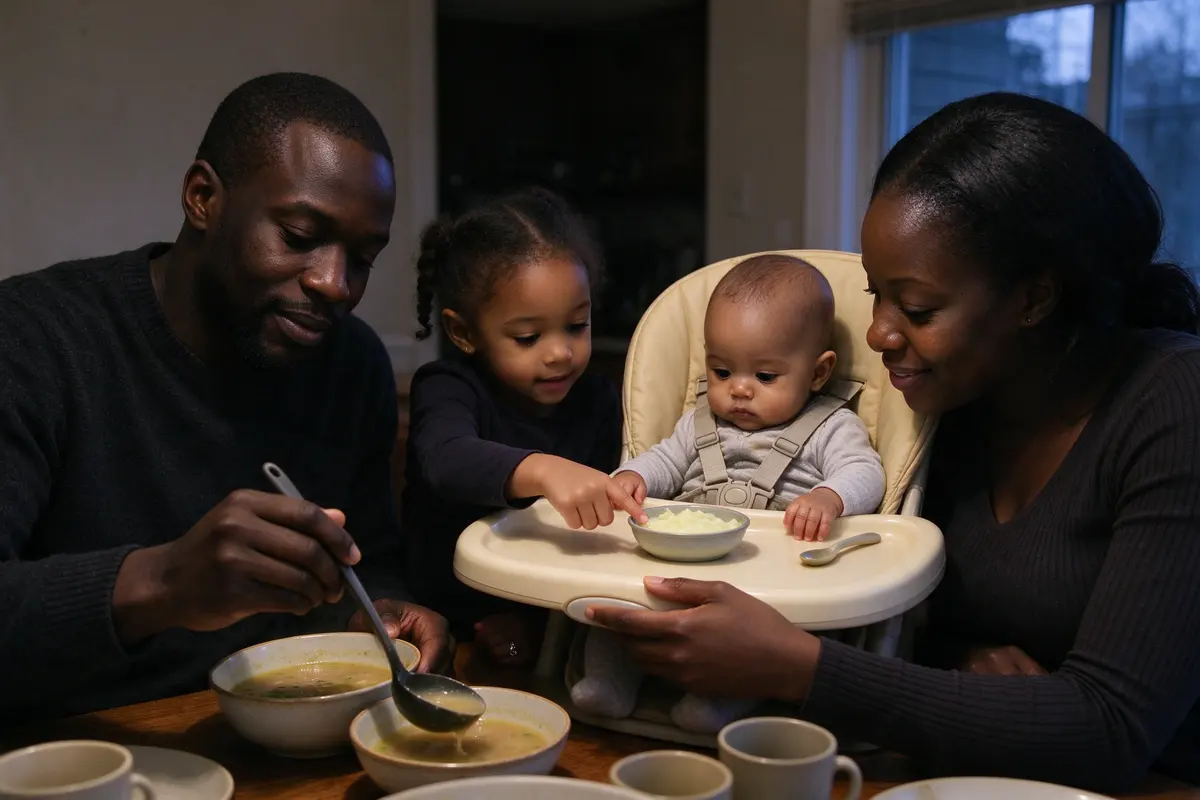
The family-meal seat
Time: One meal a day · A seat at the table in the guide
Pick the one meal most of the household is home for, and put the high chair, harness buckled, at the corner of the table nearest you (AAP).
Serve your baby's puree or soft strips at the same time as everyone else's food, and keep plates and any hot mug out of their reach (AAP).
Name what's on each plate as it goes by: "Rice. Hot soup, that's mine. Your sweet potato." (CDC).
Eat your own meal while watching theirs. Stop their food when they turn away or close their lips, and give them a spoon to hold while the rest of you finish (CDC).
Out of the chair when the meal ends; an hour strapped in is the limit (WHO).
Make it work:On nights the family eats late, the baby's meal still happens at the table, with one adult eating something alongside. The seat is the point, not the menu (AAP).
Watch for
Normal
gagging and coughing at a new texture, loud and messy (Children's Wisconsin).
Call 911
if your baby goes silent: a weak or no cough, high-pitched squeaks or no sound, unable to cry, pale or blue skin, a panicked look. Start back blows and chest thrusts (Red Cross).
Normal
a grab for your plate, your fork, the salt; reaching for food is a readiness sign (AAP).
Call your pediatrician right away
if your baby cries nonstop, cries when touched or moved, or won't move an arm or leg normally (AAP).
Normal
done after three spoonfuls and happier watching the rest of you (CDC).
Go to the ER now
for any trouble breathing, including ribs pulling in with each breath or loud wheezing (AAP).
For you
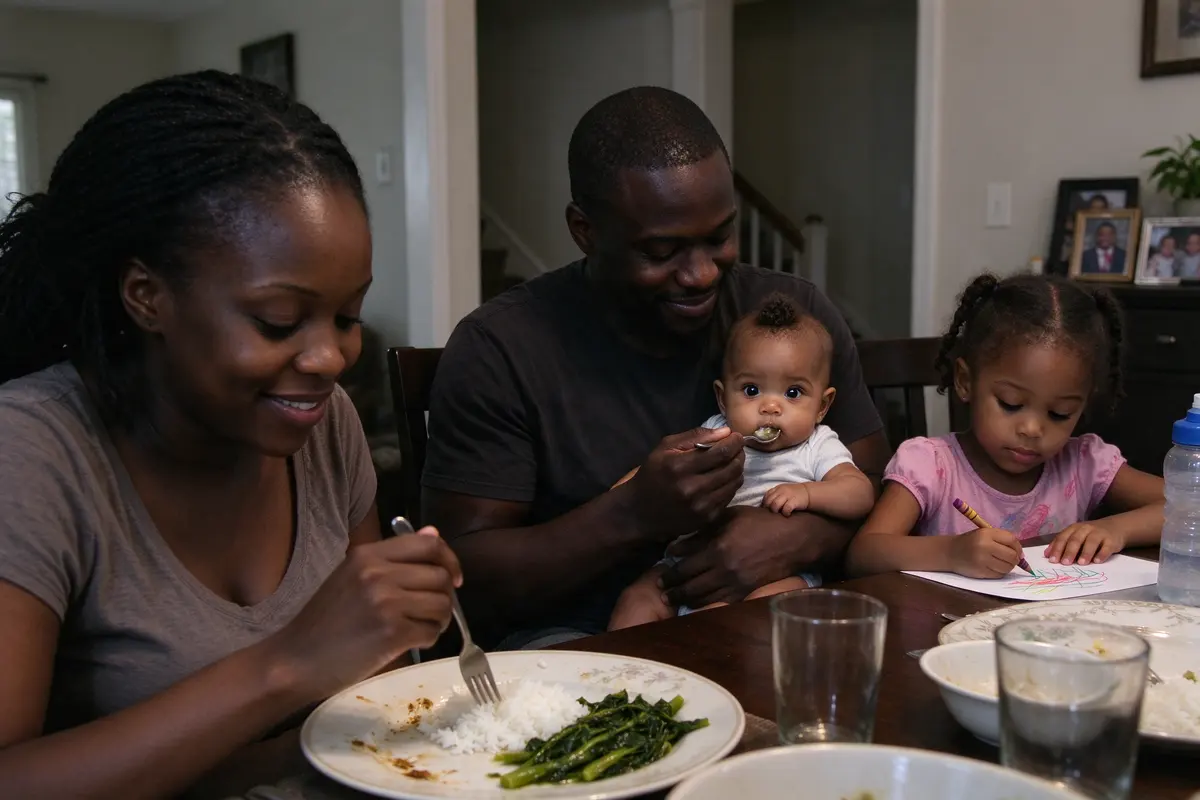
One meal a day sitting down with everyone, and that includes you. Six months of eating standing at the counter over a baby's head is a habit worth breaking now that the baby has a chair. The recovery advice from the Office on Women's Health still holds: plenty of water and fresh fruits and vegetables (OWH). The vegetables your baby is learning to like are on your plate too. Sit and eat them.
If you're the partner: you serve, so she sits down first. Then you sit.
Sources
- American Academy of Pediatrics. "When Can Babies Start Solid Foods? Readiness & Feeding Tips." HealthyChildren.org, updated 2026. https://www.healthychildren.org/English/ages-stages/baby/feeding-nutrition/Pages/Starting-Solid-Foods.aspx
- Warneken F, Tomasello M. "Altruistic helping in human infants and young chimpanzees." Science, 2006. https://pubmed.ncbi.nlm.nih.gov/16513986/
- Agbim IA, Hurtado CW. "Baby-Led Weaning: Is It Safe?" HealthyChildren.org, updated 2024. https://www.healthychildren.org/English/ages-stages/baby/feeding-nutrition/Pages/baby-led-weaning-is-it-safe.aspx
- Centers for Disease Control and Prevention. "Choking Hazards." 2026. https://www.cdc.gov/infant-toddler-nutrition/foods-and-drinks/choking-hazards.html
- American Academy of Pediatrics Council on Injury, Violence & Poison Prevention. "Infant Drowning Prevention & Water Safety: How to Protect Your Baby." HealthyChildren.org, updated 2026. https://www.healthychildren.org/English/safety-prevention/at-play/Pages/Infant-Water-Safety.aspx
- World Health Organization. "To grow up healthy, children need to sit less and play more." 2019. https://www.who.int/news/item/24-04-2019-to-grow-up-healthy-children-need-to-sit-less-and-play-more
- Centers for Disease Control and Prevention. "Milestones by 6 Months." Learn the Signs. Act Early. program, updated 2026. https://www.cdc.gov/act-early/milestones/6-months.html
- Center on the Developing Child at Harvard University. "Serve and Return." Accessed 2026. https://developingchild.harvard.edu/key-concept/serve-and-return/
- Centers for Disease Control and Prevention. "Signs Your Child Is Hungry or Full." 2026. https://www.cdc.gov/infant-toddler-nutrition/mealtime/signs-your-child-is-hungry-or-full.html
- Lehman P. "Choking vs. gagging: What parents need to know when introducing solid foods to children." Children's Wisconsin, 2024. https://childrenswi.org/at-every-turn/stories/2024/03/choking-vs-gagging-what-parents-need-to-know-when-introducing-solid-foods-to-children
- American Red Cross. "Infant Choking: How To Help." Accessed 2026. https://www.redcross.org/take-a-class/resources/learn-first-aid/infant-choking
- American Academy of Pediatrics. "Fever" (symptom checker). HealthyChildren.org, accessed 2026. https://www.healthychildren.org/English/tips-tools/symptom-checker/Pages/symptomviewer.aspx?symptom=Fever
- American Academy of Pediatrics. "Breathing Trouble" (symptom checker). HealthyChildren.org, accessed 2026. https://www.healthychildren.org/English/tips-tools/symptom-checker/Pages/symptomviewer.aspx?symptom=Breathing+Trouble
- Office on Women's Health. "Recovering from birth." US Department of Health and Human Services, 2021. https://womenshealth.gov/pregnancy/childbirth-and-beyond/recovering-birth
This guide is general education that summarizes published research and guidance from groups like the American Academy of Pediatrics, the CDC, and the WHO. It isn’t medical advice, and every child develops on their own timeline. Your pediatrician knows your child; if something feels wrong, call them. In an emergency, call 911.
Get each day’s note the morning it applies
Add your baby to a free Chorevia household with their date of birth, and every morning for 300 days the day’s note arrives in the app and by email: what’s developing, one thing to try, what to watch for, and a word for you.
Create your household