Day 196 of 300 · Week 27
The drop game
Last reviewed · 4 min read · 12 sources · Plain-text version
The spoon goes over the side again. Dropping on purpose is how babies learn that they make things happen, and the pick-up has a limit that you get to set.

The spoon hits the floor. You pick it up. It hits the floor. This isn't defiance. It's physics class.
Heart
Your baby is running experiments: shake the rattle, hear the noise; drop the spoon, watch you pick it up. Soon they drop things on purpose to see what happens (AAP). CDC's advice is to play along: pick up the dropped toy and hand it back, because that's how cause and effect gets learned (CDC). "I can make things happen" is the lesson, and banging, shaking, and dropping are the homework (AAP). In the next stage, once they can let go on purpose, dropping and throwing become favorite games (AAP). This is the start of a long season.
Head
Two things are being learned at once. One is cause and effect: my hand opens, the spoon goes, a sound comes, a face appears (AAP). The other is that things come back: the spoon left and returned, so the spoon still existed while it was gone. Looking for something dropped out of sight is a 9-month milestone (CDC), and every "uh-oh, here it is" is practice for it. Your part is the reply. A babble or a gesture answered with eye contact and words is serve and return, and it builds connections in the brain (Harvard Center on the Developing Child). A dropped spoon is a serve.
Body
The rules for what gets dropped: lightweight, unbreakable, and too big to swallow (AAP), from a high chair with the harness buckled (AAP). Nothing hot within reach of the tray, and no mug at the table's edge (AAP). And the floor they're dropping onto gets the same look as always: coins, buttons, small toy parts, button batteries (AAP). The drop game in the guide is three steps long, and the fourth is yours.
Try today
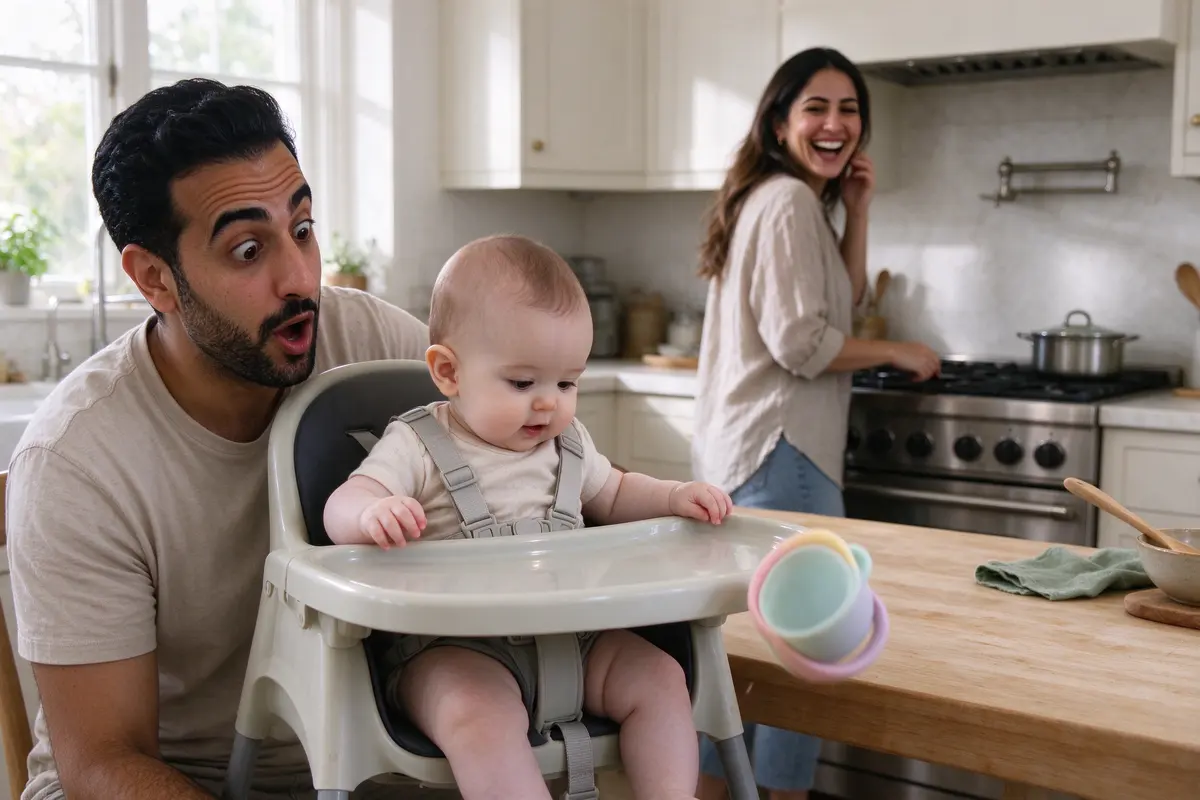
The drop game
Time: As long as your patience lasts · The drop game in the guide
Buckle your baby into the high chair and give them an unbreakable spoon, cup, or toy (AAP).
When it drops, say "Uh-oh!" and hand it back (CDC).
Narrate what happened: "It fell down. Here it is." (AAP).
Decide the number before you start; five is plenty. On the last one, say "All done," and put it away.
Make it work:Lightweight, unbreakable, too big to swallow (AAP). Nothing on a string: the guide's version has none, and five pick-ups and a stop is the whole game.
Watch for
Normal
the same spoon dropped ten times with a look at you each time (AAP).
Call your pediatrician
if your baby doesn't reach for toys, or has trouble getting things to their mouth (AAP).
Normal
a dropped toy that goes straight to the mouth once it's back (CDC).
Call 911
if something small goes in and your baby can't cry, cough, or breathe, or has a weak cough, high-pitched sounds, or blue or pale skin (Red Cross).
Normal
a lean over the tray to see where it went, held by the harness.
Call your pediatrician right away
for any head injury in a baby under 1, and go to the ER now if, after a bump, they vomit 2 or more times, cry and won't stop, or are awake but not alert (AAP).
For you
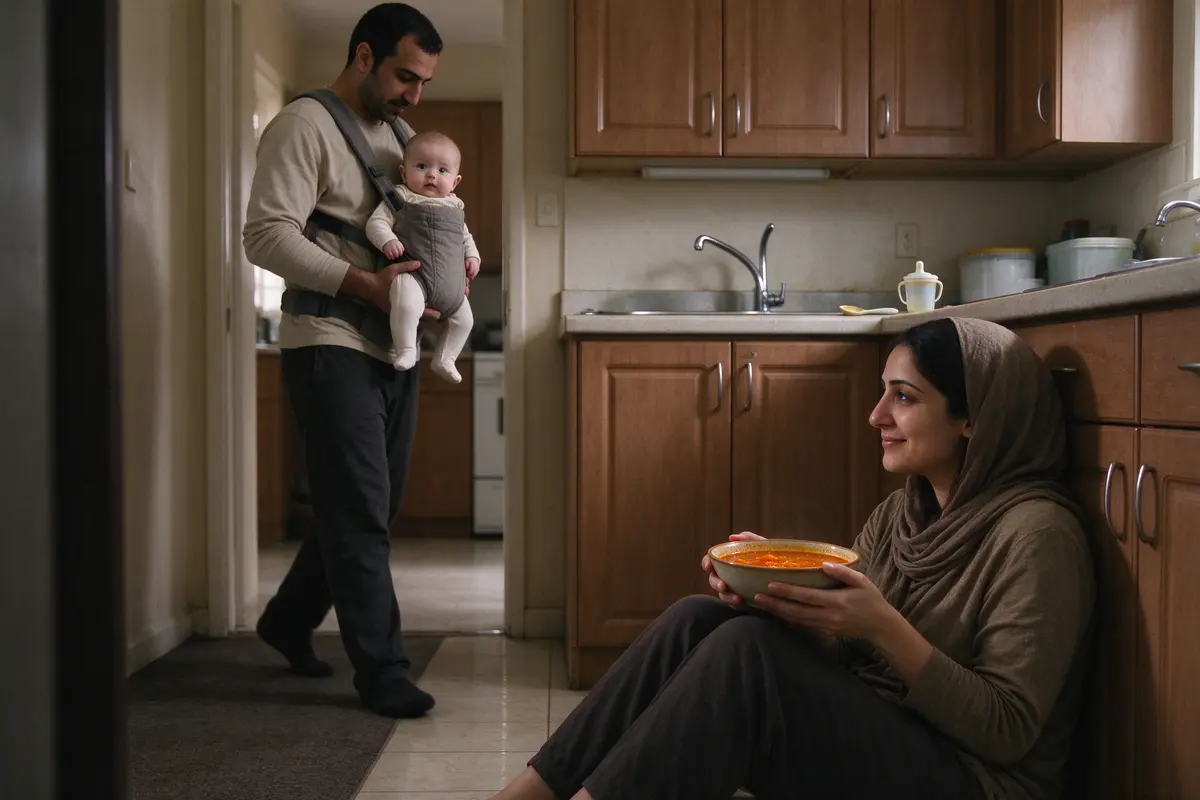
Patience is a finite resource, and the drop game is designed to spend it. The guide's time line is "as long as your patience lasts," which means your patience is part of the rules. Five pick-ups teach as well as fifty, and "all done" is a lesson too.
Ordinary tiredness at twenty-seven weeks is the job. Overwhelming tiredness is on the list of urgent maternal warning signs, the kind to seek care for right away (CDC). You know the difference between a long day and that. If you aren't sure which one you're in, that's the page's answer: talk to your provider (CDC).
If you're the partner: you take the next five. She eats sitting down.
Sources
- American Academy of Pediatrics. "Cognitive Development in Infants: 4 to 7 Months." HealthyChildren.org, updated 2023. https://www.healthychildren.org/English/ages-stages/baby/Pages/Cognitive-Development-4-to-7-Months.aspx
- Centers for Disease Control and Prevention. "Milestones by 6 Months." Learn the Signs. Act Early. program, updated 2026. https://www.cdc.gov/act-early/milestones/6-months.html
- American Academy of Pediatrics. "Hand and Finger Skills." HealthyChildren.org, updated 2009. https://www.healthychildren.org/English/ages-stages/baby/Pages/Hand-and-Finger-Skills.aspx
- Centers for Disease Control and Prevention. "Milestones by 9 Months." Learn the Signs. Act Early. program, updated 2026. https://www.cdc.gov/act-early/milestones/9-months.html
- Center on the Developing Child at Harvard University. "Serve and Return." Accessed 2026. https://developingchild.harvard.edu/key-concept/serve-and-return/
- Agbim IA, Hurtado CW. "Baby-Led Weaning: Is It Safe?" HealthyChildren.org, updated 2024. https://www.healthychildren.org/English/ages-stages/baby/feeding-nutrition/Pages/baby-led-weaning-is-it-safe.aspx
- American Academy of Pediatrics Council on Injury, Violence & Poison Prevention. "Infant Drowning Prevention & Water Safety: How to Protect Your Baby." HealthyChildren.org, updated 2026. https://www.healthychildren.org/English/safety-prevention/at-play/Pages/Infant-Water-Safety.aspx
- American Academy of Pediatrics. "Home Safety: Tips for Families With Young Children." HealthyChildren.org, updated 2022. https://www.healthychildren.org/English/safety-prevention/at-home/Pages/Home-Safety-Heres-How.aspx
- American Academy of Pediatrics. "Developmental Milestones: 7 Months." HealthyChildren.org, updated 2009. https://www.healthychildren.org/English/ages-stages/baby/Pages/Developmental-Milestones-7-Months.aspx
- American Red Cross. "Infant Choking: How To Help." Accessed 2026. https://www.redcross.org/take-a-class/resources/learn-first-aid/infant-choking
- American Academy of Pediatrics. "Head Injury" (symptom checker). HealthyChildren.org, accessed 2026. https://www.healthychildren.org/English/tips-tools/symptom-checker/Pages/symptomviewer.aspx?symptom=Head+Injury
- Centers for Disease Control and Prevention. "Urgent Maternal Warning Signs and Symptoms." HEAR HER, 2024. https://www.cdc.gov/hearher/maternal-warning-signs/index.html
This guide is general education that summarizes published research and guidance from groups like the American Academy of Pediatrics, the CDC, and the WHO. It isn’t medical advice, and every child develops on their own timeline. Your pediatrician knows your child; if something feels wrong, call them. In an emergency, call 911.
Get each day’s note the morning it applies
Add your baby to a free Chorevia household with their date of birth, and every morning for 300 days the day’s note arrives in the app and by email: what’s developing, one thing to try, what to watch for, and a word for you.
Create your household