Day 204 of 300 · Week 28
Night waking at six months
Last reviewed · 4 min read · 9 sources · Plain-text version
Waking and resettling at six months is normal, and a study of 388 babies found no link between sleeping through and development or a mother's mood. The routine comes before any method.
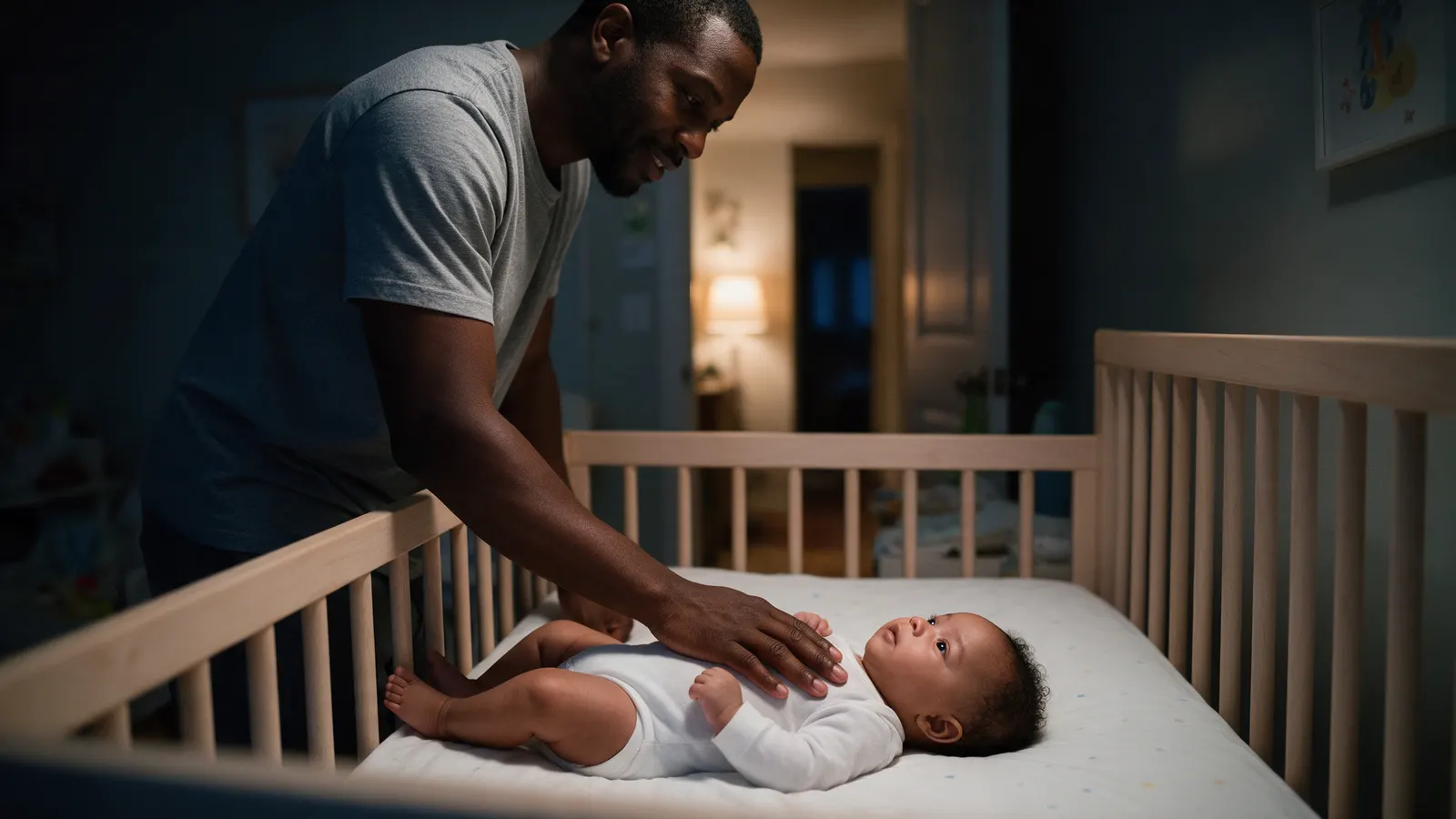
Somebody has asked you by now whether the baby sleeps through. Today is the honest answer, and the one thing that's worth doing before you try to change anything.
Heart
The AAP says it's normal for a 6-month-old to wake during the night and go back to sleep after a few minutes (AAP). Sleep experts recommend 12 to 16 hours in 24, naps included, for babies 4 to 12 months (Paruthi et al., 2016; WHO), and nothing in that number says the hours have to come in one piece. A baby who wakes, grumbles, and drifts off again is doing what six-month-olds do. So is a baby who wakes and needs you.
Head
"Sleeping through" is a moving target. In a Canadian study of 388 babies, depending on whether it meant 6 or 8 hours, 27.9% to 57.0% of 6- and 12-month-olds didn't sleep through, and that wasn't linked to their development or to their mothers' mood (Pennestri et al., 2018). By the stricter definition, more than half didn't, and they developed the same as the ones who did.
Body
Before any method, the routine. The AAP's version is "Brush, Book, Bed" at a regular bedtime (AAP). In a survey of mothers of 10,085 young children, more consistent routines went with better sleep, though a survey can't prove cause (Mindell et al., 2015). Then, for babies 4 months and older, the AAP suggests putting them down drowsy but awake and giving them a few minutes to resettle after waking; you can still feed, change, or comfort them when needed (AAP). Tonight is about whether your three steps are the same three steps.
Try today
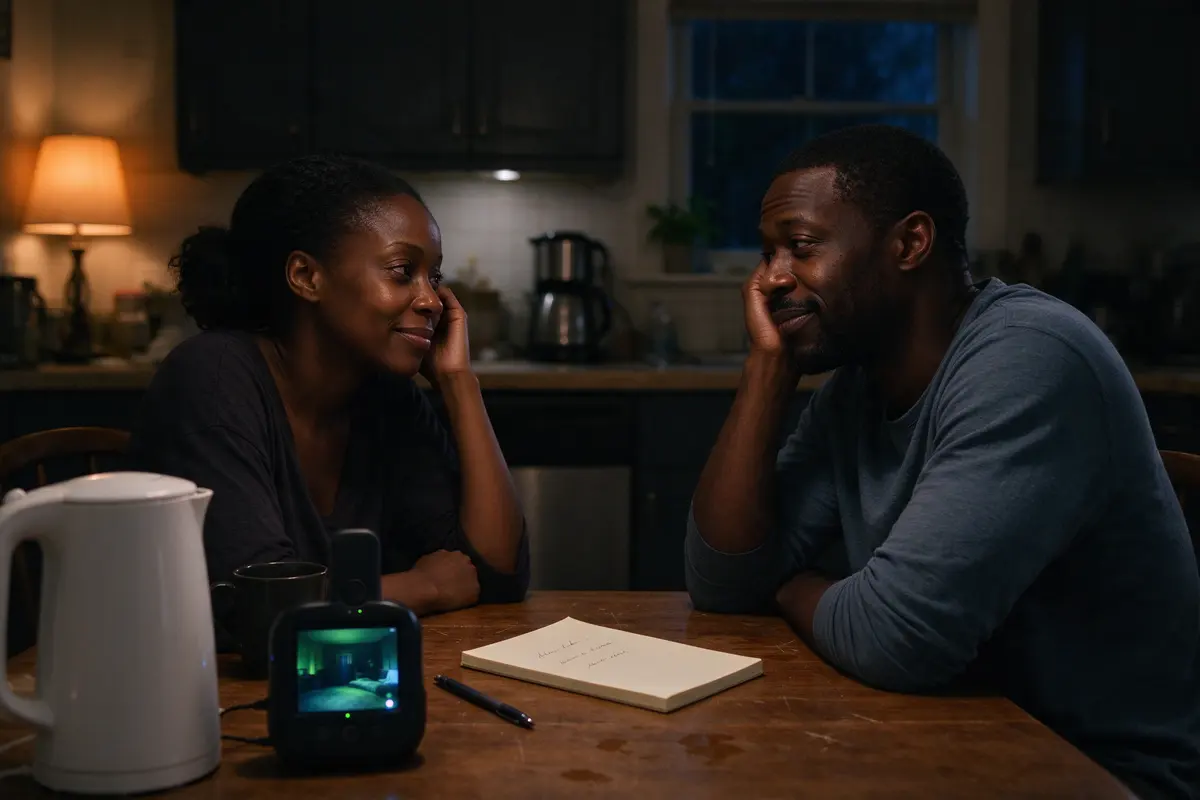
The routine audit
Time: 5 minutes after bedtime, with a pen · Brush, book, bed in the guide
Once your baby is down, write tonight's bedtime as it actually happened, in order, in three or four lines: what you did, where, and roughly when.
Circle the step that changes most from night to night: the start time, the room, who does it, or whether the feed comes before or after the book.
Fix that one step for a week. Consistency is what went with better sleep in the survey (Mindell et al., 2015).
Make it work:One step held steady for seven nights tells you more than four steps changed at once.
Watch for
Normal
a wake at 1 a.m. that ends with a grumble and a sigh, with no one going in (AAP).
Call your pediatrician right away
if your baby seems dehydrated: no urine in more than 8 hours, dark urine, a very dry mouth, or no tears (AAP).
Normal
a wake at 3 a.m. that needs a feed, a change, or a hand on the chest; the AAP's drowsy-but-awake advice still allows all three (AAP).
Call 911
if your baby can't be woken, isn't moving, or is very weak (AAP).
Normal
rolling onto the tummy in the crib and staying there; a baby who rolls both ways comfortably can be left, as long as the crib is bare (AAP).
Go to the ER now
if your baby is hard to wake or not alert when awake (AAP).
For you
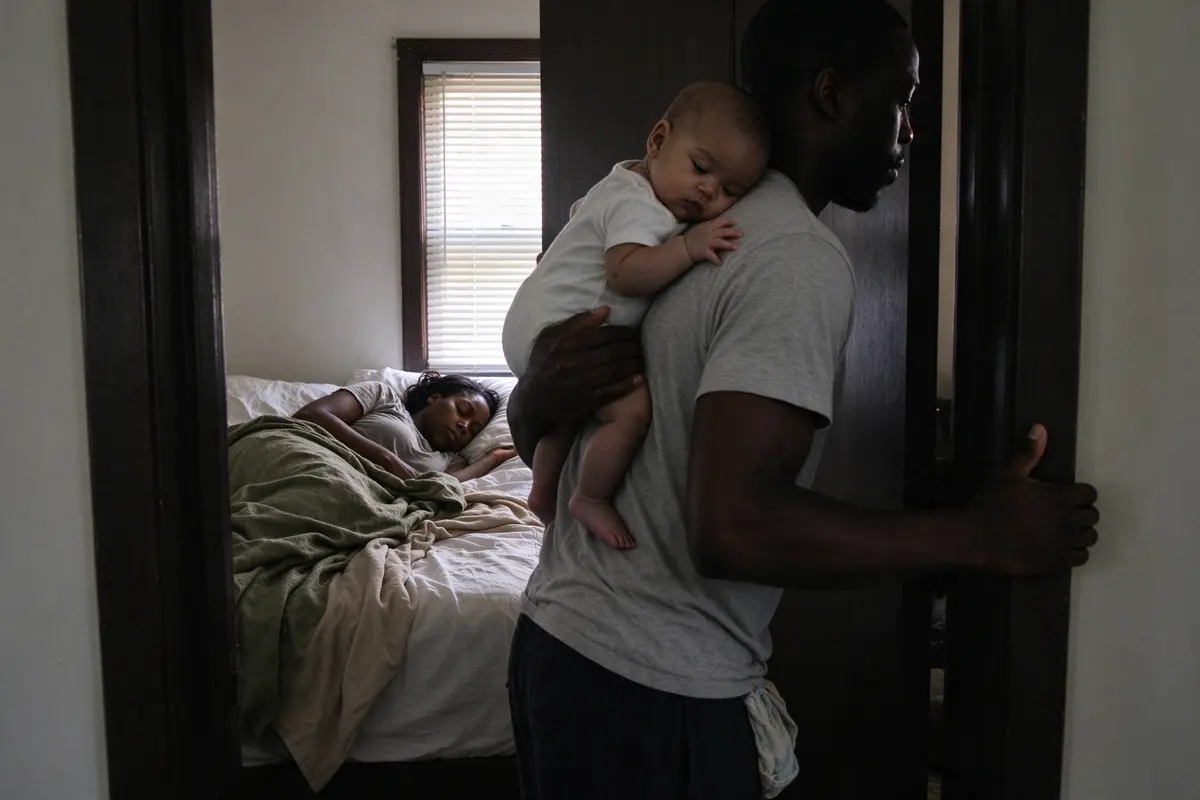
Both patterns are normal. A baby who sleeps 8 hours and a baby who wakes twice are both inside the range that study found, and neither pattern predicted how the mothers felt (Pennestri et al., 2018). The question isn't whether your baby's nights are normal; they are. It's whether they're working for your family. If they are, you're done. If they aren't, that's a real reason to ask your pediatrician about options, and tomorrow's note is the research behind them (Price et al., 2012).
If you're the partner: do the audit together, and take the 3 a.m. wake tonight. Her answer to "is it working?" depends a lot on who's been getting up.
Sources
- American Academy of Pediatrics. "Getting Your Baby to Sleep." HealthyChildren.org, updated 2024. https://www.healthychildren.org/English/ages-stages/baby/sleep/Pages/getting-your-baby-to-sleep.aspx
- Paruthi S, Brooks LJ, D'Ambrosio C, et al. "Recommended Amount of Sleep for Pediatric Populations: A Consensus Statement of the American Academy of Sleep Medicine." Journal of Clinical Sleep Medicine, 2016. https://pubmed.ncbi.nlm.nih.gov/27250809/
- World Health Organization. "To grow up healthy, children need to sit less and play more." 2019. https://www.who.int/news/item/24-04-2019-to-grow-up-healthy-children-need-to-sit-less-and-play-more
- Pennestri MH, Laganière C, Bouvette-Turcot AA, et al. "Uninterrupted Infant Sleep, Development, and Maternal Mood." Pediatrics, 2018. https://pubmed.ncbi.nlm.nih.gov/30420470/
- American Academy of Pediatrics. "Brush, Book, Bed: How to Structure Your Child's Nighttime Routine." HealthyChildren.org, updated 2024. https://www.healthychildren.org/English/healthy-living/oral-health/Pages/Brush-Book-Bed.aspx
- Mindell JA, Li AM, Sadeh A, et al. "Bedtime routines for young children: a dose-dependent association with sleep outcomes." Sleep, 2015. https://pubmed.ncbi.nlm.nih.gov/25325483/
- American Academy of Pediatrics. "Fever" (symptom checker). HealthyChildren.org, accessed 2026. https://www.healthychildren.org/English/tips-tools/symptom-checker/Pages/symptomviewer.aspx?symptom=Fever
- Moon RY. "How to Keep Your Sleeping Baby Safe: AAP Policy Explained." HealthyChildren.org, updated 2026. https://www.healthychildren.org/English/ages-stages/baby/sleep/Pages/a-parents-guide-to-safe-sleep.aspx
- Price AMH, Wake M, Ukoumunne OC, Hiscock H. "Five-year follow-up of harms and benefits of behavioral infant sleep intervention: randomized trial." Pediatrics, 2012. https://pubmed.ncbi.nlm.nih.gov/22966034/
This guide is general education that summarizes published research and guidance from groups like the American Academy of Pediatrics, the CDC, and the WHO. It isn’t medical advice, and every child develops on their own timeline. Your pediatrician knows your child; if something feels wrong, call them. In an emergency, call 911.
Get each day’s note the morning it applies
Add your baby to a free Chorevia household with their date of birth, and every morning for 300 days the day’s note arrives in the app and by email: what’s developing, one thing to try, what to watch for, and a word for you.
Create your household