Day 191 of 300 · Week 26
Hungry, full, done
Last reviewed · 4 min read · 10 sources · Plain-text version
Closed lips, a turned head, a hand on the spoon: your baby already says when they're done. How to read hunger and fullness, and why a grimace isn't a verdict.

Ten days into solids, the question has changed from what to how much. Your baby decides, and they're already telling you.
Heart
Hunger looks like reaching for food, opening up for the spoon, or getting excited when food appears. Full looks like pushing food away, closing the mouth, or turning the head (CDC). Closing their lips to show they don't want more is on the 6-month milestone list: a skill, not a refusal (CDC). Let your baby decide how much. They don't need to finish the jar, and food shouldn't be a reward or a punishment (CDC). If they cry or turn away, stop and try again another time (AAP).
Head
Taste is learned slowly. When 36 babies 4 to 6 months old were fed a new vegetable 10 times, all of them ate more of it afterward (Sullivan & Birch, 1994). In a trial of 45 babies, 8 days of green beans raised intake from 56.8 to 93.6 grams, even though many kept making faces (Forestell & Mennella, 2007). The AAP puts the number at 10 to 15 tries before a baby accepts a new food (AAP). The face your baby made at carrots on Tuesday is try one of fifteen.
Body
A little breast milk or formula first keeps a very hungry baby from getting frustrated, and the serving is still half a spoonful or less, working up to a teaspoon or two (AAP). Hold the spoon near their lips and wait for the open mouth, or not. A gag isn't a no: at 6 months the gag reflex sits far forward, so coughing, gagging, and pushing food out are expected in the first months of solids (Children's Wisconsin). The no is the closed lips and the turned head.
Try today
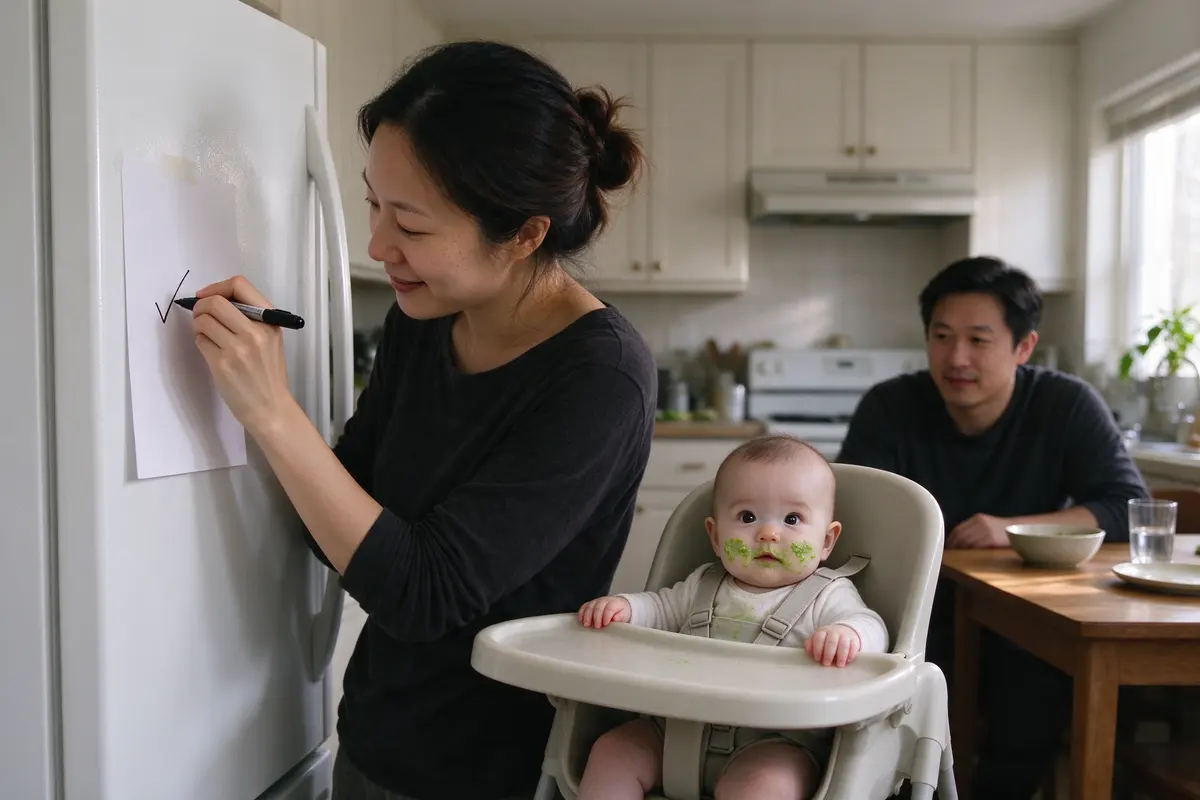
Ten tries of green beans
Time: 5 minutes, at one meal · Feed with your baby, not at them in the guide
Pick the food your baby turned down this week and serve it after a little milk, so hunger doesn't run the show (AAP).
In the high chair, buckled, hold half a spoonful near their lips and wait for the open mouth; if it doesn't come, that's today's answer (AAP).
Stop at the first closed lips, turned head, or push (CDC).
On a sheet on the fridge, write the food and a tick: "green beans, 3." Grimaces don't count against it (Forestell & Mennella, 2007).
Offer it again in a day or two, until the ticks reach ten (Sullivan & Birch, 1994).
Make it work:A try is a taste offered, not swallowed. Nothing goes into a crying baby; stop and try another time (AAP).
Watch for
Normal
lips clamped shut at the third spoonful; the 6-month list calls that communication (CDC).
Call your pediatrician right away
for a mild reaction after a new food, like a new rash, a few hives around the mouth or face, or diarrhea, and hold that food until you've talked (NIAID).
Normal
a face like you've served a lemon, then an open mouth for more (Forestell & Mennella, 2007).
Call 911
for swelling of the lips, face, or tongue, widespread hives, vomiting, wheezing, repeated coughing, pale or blue skin, or sudden floppiness after a food (NIAID).
Normal
a big eater one day and no interest the next; breast milk or formula is still the main nutrition (CDC).
Call your pediatrician right away
if your baby seems dehydrated: no urine in more than 8 hours, dark urine, a very dry mouth, or no tears (AAP).
For you

A grimace isn't a verdict, for the baby or for you. The green-bean babies made faces for eight days and ate more anyway (Forestell & Mennella, 2007). You'll make faces at this month too: the mess, the waste, the third bib before noon. A face at a bad day isn't a verdict on it.
What is a verdict is duration: feelings that are severe or last longer than 2 weeks may be postpartum depression, and it responds to treatment (NIMH). One bad meal is a tick on the sheet, nothing more.
If you're the partner: you write the ticks. A small job that says the tries are counted by both of you.
Sources
- Centers for Disease Control and Prevention. "Signs Your Child Is Hungry or Full." 2026. https://www.cdc.gov/infant-toddler-nutrition/mealtime/signs-your-child-is-hungry-or-full.html
- Centers for Disease Control and Prevention. "Milestones by 6 Months." Learn the Signs. Act Early. program, updated 2026. https://www.cdc.gov/act-early/milestones/6-months.html
- American Academy of Pediatrics. "When Can Babies Start Solid Foods? Readiness & Feeding Tips." HealthyChildren.org, updated 2026. https://www.healthychildren.org/English/ages-stages/baby/feeding-nutrition/Pages/Starting-Solid-Foods.aspx
- Sullivan SA, Birch LL. "Infant dietary experience and acceptance of solid foods." Pediatrics, 1994. https://pubmed.ncbi.nlm.nih.gov/8121740/
- Forestell CA, Mennella JA. "Early determinants of fruit and vegetable acceptance." Pediatrics, 2007. https://pubmed.ncbi.nlm.nih.gov/18055673/
- American Academy of Pediatrics. "Checkup Checklist: 6 Months Old." HealthyChildren.org, updated 2023. https://www.healthychildren.org/English/ages-stages/Your-Childs-Checkups/Pages/Your-Checkup-Checklist-6-Months-Old.aspx
- Lehman P. "Choking vs. gagging: What parents need to know when introducing solid foods to children." Children's Wisconsin, 2024. https://childrenswi.org/at-every-turn/stories/2024/03/choking-vs-gagging-what-parents-need-to-know-when-introducing-solid-foods-to-children
- National Institute of Allergy and Infectious Diseases. "Instructions for Home Feeding of Peanut Protein for Infants at Low Risk of an Allergic Reaction to Peanut" (Appendix D). 2017. https://www.niaid.nih.gov/sites/default/files/addendum_guidelines_peanut_appx_d.pdf
- American Academy of Pediatrics. "Fever" (symptom checker). HealthyChildren.org, accessed 2026. https://www.healthychildren.org/English/tips-tools/symptom-checker/Pages/symptomviewer.aspx?symptom=Fever
- National Institute of Mental Health. "Perinatal Depression." 2023. https://www.nimh.nih.gov/health/publications/perinatal-depression
This guide is general education that summarizes published research and guidance from groups like the American Academy of Pediatrics, the CDC, and the WHO. It isn’t medical advice, and every child develops on their own timeline. Your pediatrician knows your child; if something feels wrong, call them. In an emergency, call 911.
Get each day’s note the morning it applies
Add your baby to a free Chorevia household with their date of birth, and every morning for 300 days the day’s note arrives in the app and by email: what’s developing, one thing to try, what to watch for, and a word for you.
Create your household