Day 188 of 300 · Week 26
Spoon, fingers, or both
Last reviewed · 4 min read · 11 sources · Plain-text version
Spoon-feeding and baby-led weaning both work, and the trials say the label matters less than the shape of the food and the eyes on the baby. Today, a strip of avocado on the tray.
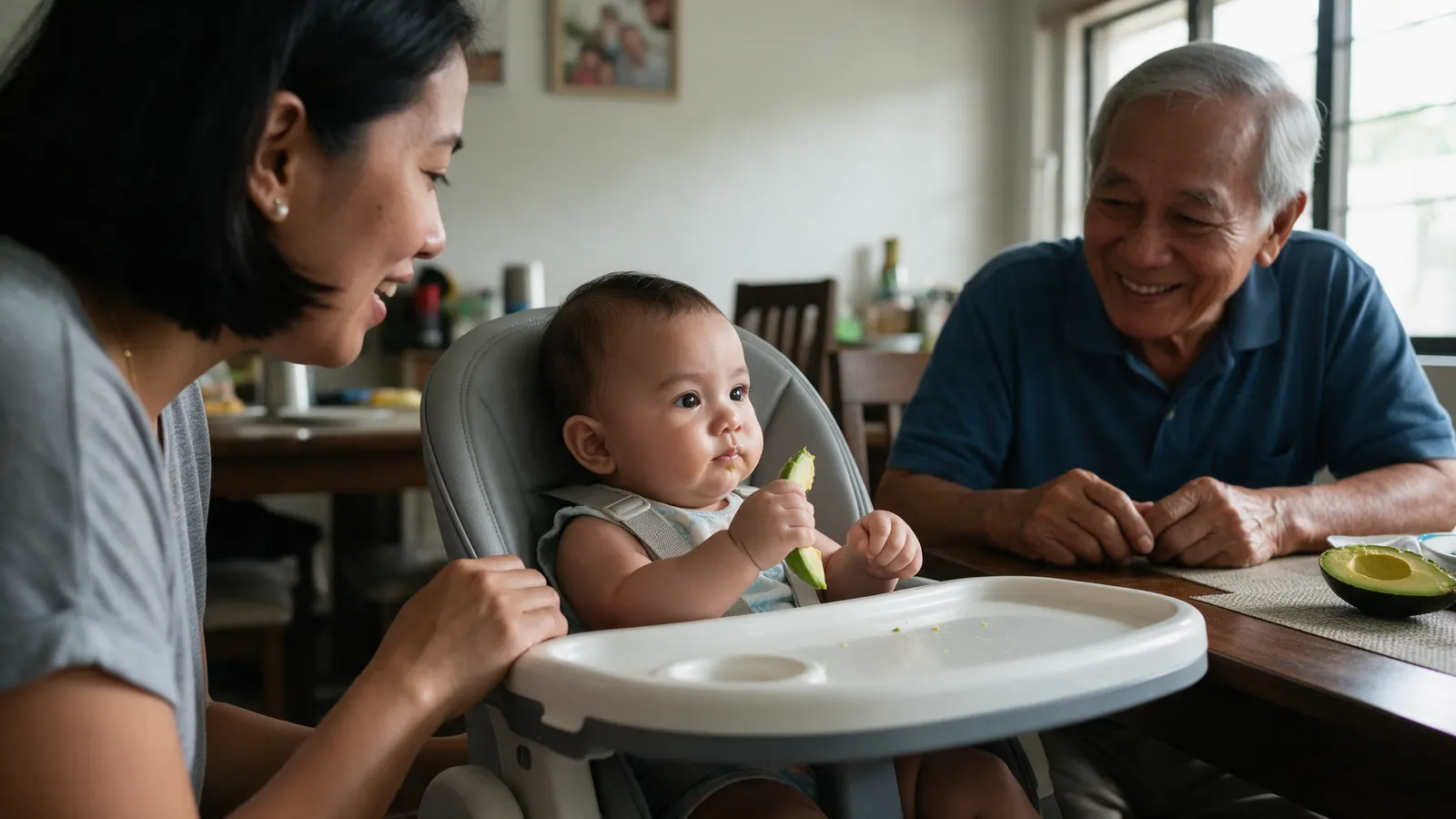
There's a spoon camp and a finger-food camp, and your baby is in neither. Today is what the trials actually found.
Heart
There's no single right way. The AAP says families can flex baby-led weaning to fit: babies who are spoon-fed for a while still learn to feed themselves, and you may need to take the lead on allergens like peanut and egg (AAP). Mixing spoon-feeding with finger foods is fine, with the AAP's one caution that babies who only feed themselves may get too few calories or too little iron (AAP). The label isn't the decision; the food is.
Head
New Zealand's BLISS trial followed 206 families whose babies fed themselves soft finger foods, with coaching on iron and choking. Their body mass at ages 1 and 2 was similar to spoon-fed babies (Taylor et al., 2017), their iron levels at age 1 were similar when parents were coached to offer a high-iron food at each meal (Daniels et al., 2018), and they didn't choke more. But 35% of all the babies in the trial choked at least once between 6 and 8 months, and 52% were offered a choking-risk food during a 3-day food record at 7 months (Fangupo et al., 2016). A review of 7 studies (Correia et al., 2024) and one of 4 randomized trials (Márquez-Díaz et al., 2026) found no clear difference in choking between approaches, while noting the evidence is limited. The approach doesn't decide the risk; the food and the supervision do.
Body
Either way, four rules. Upright and buckled in the high chair with the harness on (AAP), never eating in a car seat or stroller or lying down (CDC). Soft enough to mash with the gums, cut into strips about the size of a small baby carrot, never round coin-shaped slices (AAP). Iron at every meal, the coaching that kept the BLISS babies' iron normal (Daniels et al., 2018). And eyes on your baby the whole time, with meals calm and unhurried (CDC).
Try today
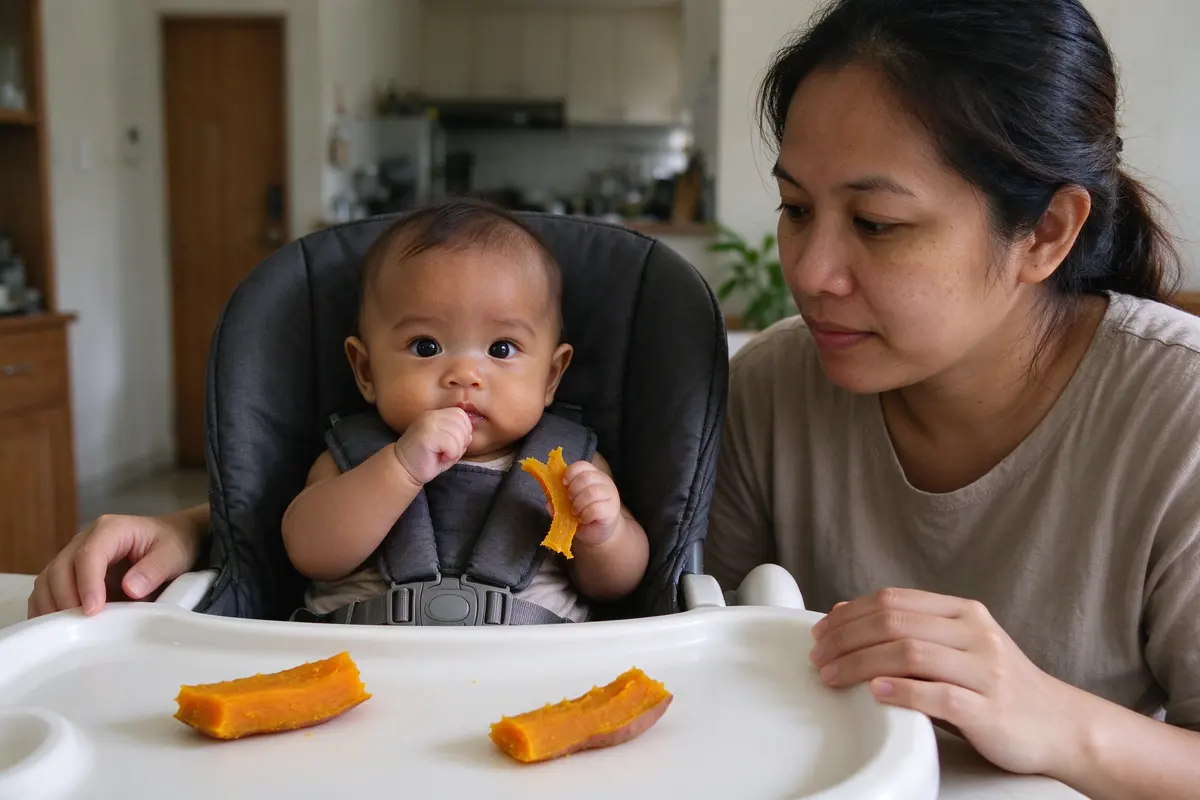
Soft finger-food practice
Time: Part of one meal a day · Soft finger-food practice in the guide
Cut a soft food, like ripe avocado or well-steamed sweet potato, into finger-length strips about the size of a small baby carrot (AAP).
Press one between your fingers: it should mash the way gums would.
With your baby upright and buckled, put a piece or two on the tray and let them explore, gum, and spit out.
Stay at the table and watch the whole time (CDC).
Make it work:Skip round, coin-shaped slices, which raise choking risk (AAP).
Watch for
Normal
squished strips, a mouthful spat out, and almost nothing swallowed; closing their lips to show they're done is a 6-month skill (CDC).
Call 911
if your baby goes silent or squeaky, can't cry or cough, or turns pale or blue (Red Cross).
Normal
a gag on the first strip; the reflex sits forward at 6 months (Children's Wisconsin).
Tell your pediatrician
if your baby seems to eat very little by hand; the AAP's caution is calories and iron, and the fix may be a spoon alongside (AAP).
Normal
a lean forward onto the hands over the tray; that's why the harness is on (AAP).
Call your pediatrician
for any head injury in a baby under 1 (AAP).
For you
Pick the approach that fits your family. The trials gave you permission in both directions: self-feeders grew the same, kept their iron with a high-iron food each meal, and didn't choke more (Taylor et al., 2017; Daniels et al., 2018; Fangupo et al., 2016), and the reviews can't tell the two approaches apart on choking (Correia et al., 2024; Márquez-Díaz et al., 2026). If spoon-feeding keeps you calm, spoon-feed. If the tray keeps the baby busy while you eat, use the tray. If a strip of avocado makes your chest tight, it's the spoon this week and the strip next.
If you're the partner: whichever way she feeds the baby, feed the baby that way too. One method per household is easier on everyone.
Sources
- Agbim IA, Hurtado CW. "Baby-Led Weaning: Is It Safe?" HealthyChildren.org, updated 2024. https://www.healthychildren.org/English/ages-stages/baby/feeding-nutrition/Pages/baby-led-weaning-is-it-safe.aspx
- Taylor RW, Williams SM, Fangupo LJ, et al. "Effect of a Baby-Led Approach to Complementary Feeding on Infant Growth and Overweight: A Randomized Clinical Trial." JAMA Pediatrics, 2017. https://pubmed.ncbi.nlm.nih.gov/28692728/
- Daniels L, Taylor RW, Williams SM, et al. "Impact of a modified version of baby-led weaning on iron intake and status: a randomised controlled trial." BMJ Open, 2018. https://pubmed.ncbi.nlm.nih.gov/29950456/
- Fangupo LJ, Heath AM, Williams SM, et al. "A Baby-Led Approach to Eating Solids and Risk of Choking." Pediatrics, 2016. https://pubmed.ncbi.nlm.nih.gov/27647715/
- Correia L, Sousa AR, Capitão C, Pedro AR. "Complementary feeding approaches and risk of choking: A systematic review." Journal of Pediatric Gastroenterology and Nutrition, 2024. https://pubmed.ncbi.nlm.nih.gov/38937992/
- Márquez-Díaz RR, Ruíz-Fernández MD, Arcas-Rueda M, et al. "Baby-Led Weaning vs Traditional Spoon-Feeding: A Systematic Review of Infant Growth, Choking Risk, and Iron Status Among Infants Aged 6-12 Months." Nutrition Reviews, 2026. https://pubmed.ncbi.nlm.nih.gov/41528760/
- Centers for Disease Control and Prevention. "Choking Hazards." 2026. https://www.cdc.gov/infant-toddler-nutrition/foods-and-drinks/choking-hazards.html
- Centers for Disease Control and Prevention. "Milestones by 6 Months." Learn the Signs. Act Early. program, updated 2026. https://www.cdc.gov/act-early/milestones/6-months.html
- American Red Cross. "Infant Choking: How To Help." Accessed 2026. https://www.redcross.org/take-a-class/resources/learn-first-aid/infant-choking
- Lehman P. "Choking vs. gagging: What parents need to know when introducing solid foods to children." Children's Wisconsin, 2024. https://childrenswi.org/at-every-turn/stories/2024/03/choking-vs-gagging-what-parents-need-to-know-when-introducing-solid-foods-to-children
- American Academy of Pediatrics. "Head Injury" (symptom checker). HealthyChildren.org, accessed 2026. https://www.healthychildren.org/English/tips-tools/symptom-checker/Pages/symptomviewer.aspx?symptom=Head+Injury
This guide is general education that summarizes published research and guidance from groups like the American Academy of Pediatrics, the CDC, and the WHO. It isn’t medical advice, and every child develops on their own timeline. Your pediatrician knows your child; if something feels wrong, call them. In an emergency, call 911.
Get each day’s note the morning it applies
Add your baby to a free Chorevia household with their date of birth, and every morning for 300 days the day’s note arrives in the app and by email: what’s developing, one thing to try, what to watch for, and a word for you.
Create your household