Day 189 of 300 · Week 26
Sips of water
Last reviewed · 3 min read · 9 sources · Plain-text version
A few sips of water from a cup are fine now, up to 4 to 8 ounces a day, and juice, cow's milk, and honey all wait for the first birthday. Today, the first open cup.
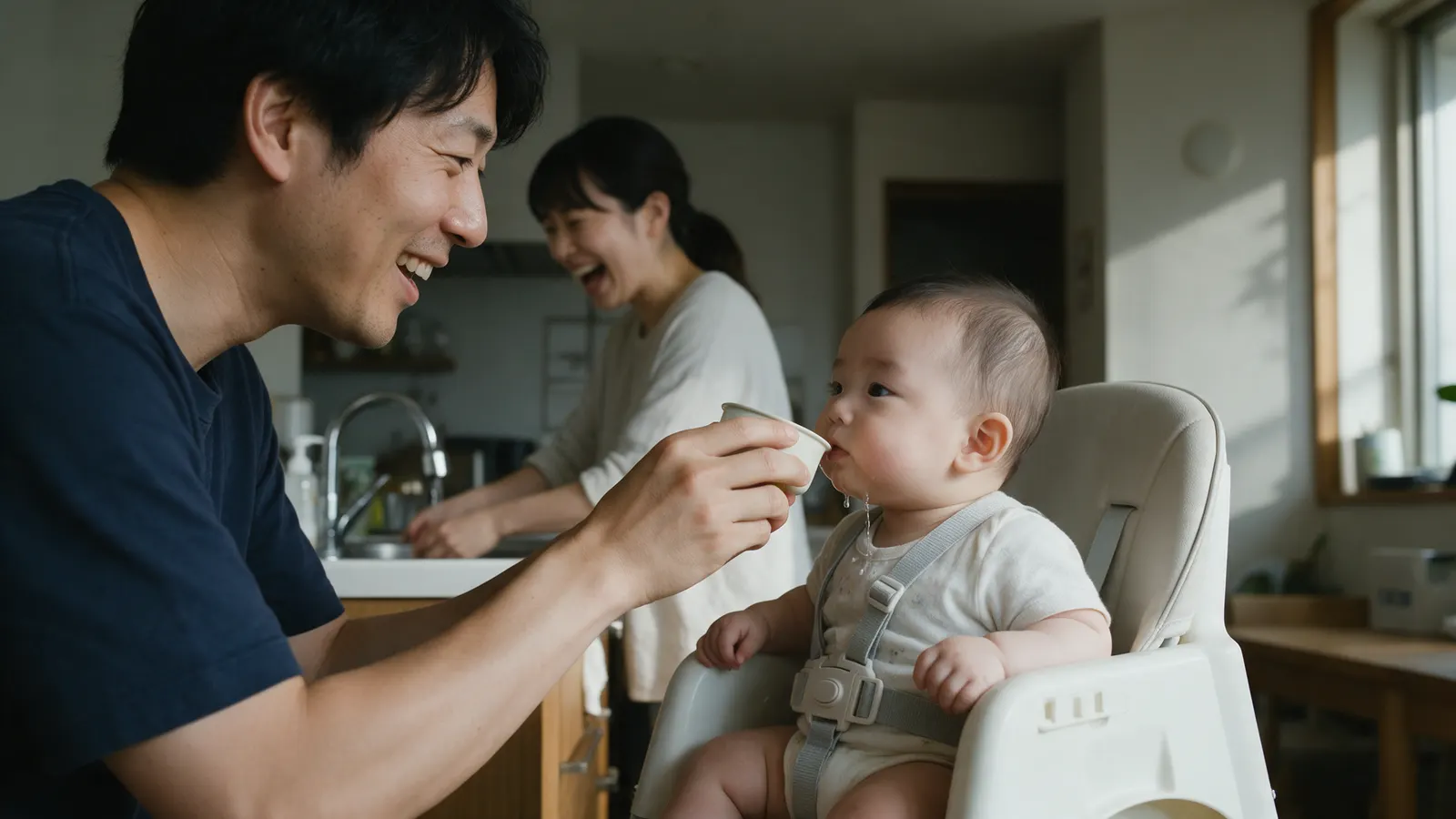
With solids on the tray, there's a new question at the table: what goes in the cup. Today it's water, a few sips, and a short list of what doesn't.
Heart
Breast milk or formula is still the main drink at 6 months, plus a few sips of water from a cup (AAP). You can offer up to 4 to 8 ounces of water a day in an open, sippy, or straw cup, and fluoridated tap water helps protect teeth (AAP). The AAP suggests small amounts of water in a cup from about 6 months to build cup skills; that's expert advice, not something tested in trials (AAP). The point of the cup this month is practice, not thirst.
Head
What doesn't go in the cup is a short list with reasons. No juice before 12 months (AAP). No cow's milk as a drink before 12 months, because it can cause intestinal bleeding (CDC); plain yogurt and cheese are fine (CDC). No honey before 12 months, not even on a pacifier, because it can cause botulism, and nothing with added sugar or caffeine (CDC). That leaves milk and water, which is the whole menu.
Body
The open cup is the guide's pick because it teaches the most: a tablespoon or two of water, the cup tipped just enough for a sip, your baby's hands on it alongside yours (AAP). Expect a cough and a dribble, and keep hold of the cup; closing their lips when they've had enough is a 6-month skill (CDC). A sippy or straw cup is fine too (AAP). Keep the total to 4 to 8 ounces a day at most (AAP), because every ounce of water is an ounce of milk your baby didn't drink, and milk is still where the nutrition is (CDC).
Try today
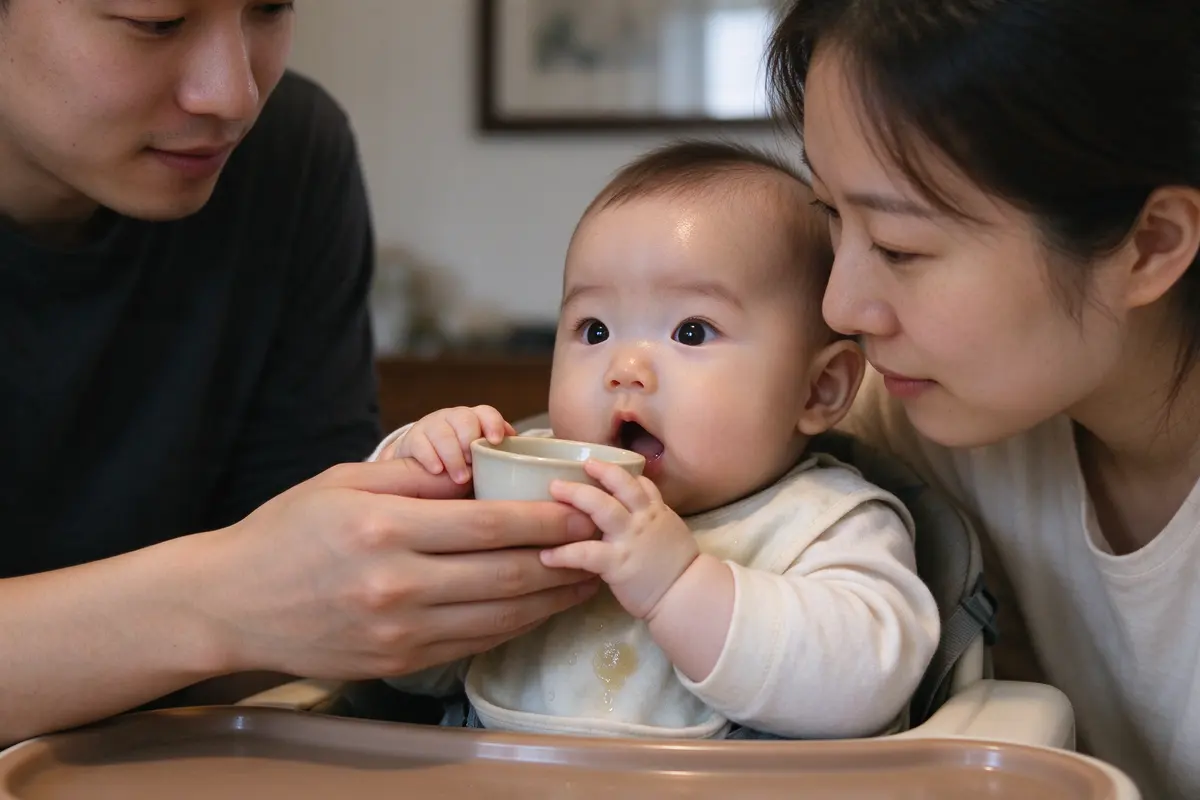
Sips from an open cup
Time: A few sips with meals · Sips from an open cup in the guide
Pour a tablespoon or two of water into a small open cup (AAP).
With your baby upright and buckled, hold it to their lips and tip it just enough for a sip.
Let your baby put their hands on the cup alongside yours.
Stop when they close their lips or turn away; a few sips is the whole lesson.
Make it work:Keep water to 4 to 8 ounces a day at most. Breast milk or formula is still the main drink (AAP).
Watch for
Normal
a cough and a splutter at the cup, and water down the bib.
Call 911
if your baby goes silent, can't cry or cough, or turns pale or blue (Red Cross).
Normal
a few sips and then nothing; water isn't the nutrition, milk is (CDC).
Call your pediatrician right away
if your baby seems dehydrated: no urine in more than 8 hours, dark urine, a very dry mouth, or no tears (AAP).
Normal
a cup grabbed with both hands and flung off the tray; dropping things on purpose is how babies learn cause and effect (AAP).
Call within a day
for any fever that has lasted more than 3 days (AAP).
For you
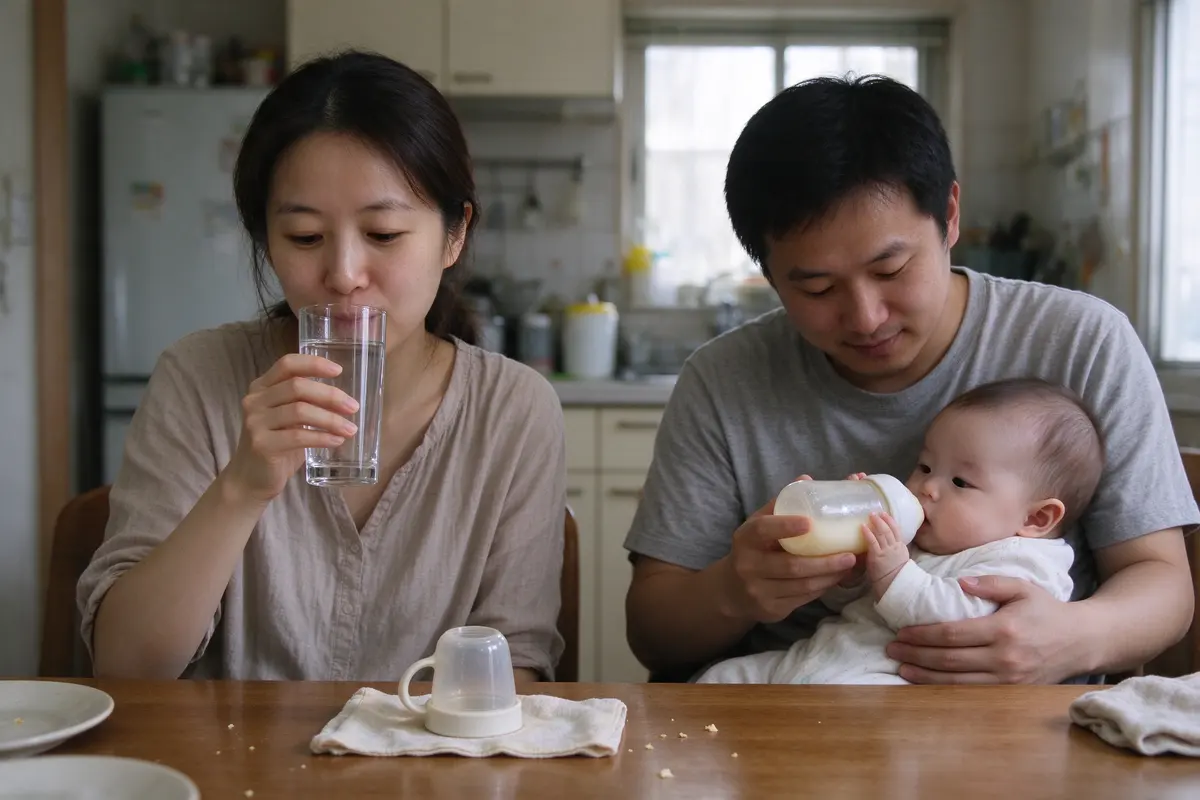
Your own glass of water at every feed. The baby gets 4 to 8 ounces as a ceiling (AAP); you get no ceiling at all. Plenty of water is on the Office on Women's Health's list for your body after birth (OWH), and most of us drink less when we're the one holding the spoon, the cup, and the cloth. Fill a glass before you sit down to feed the baby. Finish it before you stand up.
If you're the partner: a full glass next to her chair before every meal. It's the smallest job in this series, and it's yours.
Sources
- Muth ND. "Recommended Drinks for Children Age 5 & Younger." HealthyChildren.org, updated 2023. https://www.healthychildren.org/English/healthy-living/nutrition/Pages/Recommended-Drinks-for-Young-Children-Ages-0-5.aspx
- American Academy of Pediatrics. "When Can Babies Start Solid Foods? Readiness & Feeding Tips." HealthyChildren.org, updated 2026. https://www.healthychildren.org/English/ages-stages/baby/feeding-nutrition/Pages/Starting-Solid-Foods.aspx
- Centers for Disease Control and Prevention. "Foods and Drinks to Avoid or Limit." 2026. https://www.cdc.gov/infant-toddler-nutrition/foods-and-drinks/foods-and-drinks-to-avoid-or-limit.html
- Centers for Disease Control and Prevention. "When, What, and How to Introduce Solid Foods." 2026. https://www.cdc.gov/infant-toddler-nutrition/foods-and-drinks/when-what-and-how-to-introduce-solid-foods.html
- Centers for Disease Control and Prevention. "Milestones by 6 Months." Learn the Signs. Act Early. program, updated 2026. https://www.cdc.gov/act-early/milestones/6-months.html
- American Red Cross. "Infant Choking: How To Help." Accessed 2026. https://www.redcross.org/take-a-class/resources/learn-first-aid/infant-choking
- American Academy of Pediatrics. "Fever" (symptom checker). HealthyChildren.org, accessed 2026. https://www.healthychildren.org/English/tips-tools/symptom-checker/Pages/symptomviewer.aspx?symptom=Fever
- American Academy of Pediatrics. "Cognitive Development in Infants: 4 to 7 Months." HealthyChildren.org, updated 2023. https://www.healthychildren.org/English/ages-stages/baby/Pages/Cognitive-Development-4-to-7-Months.aspx
- Office on Women's Health. "Recovering from birth." US Department of Health and Human Services, 2021. https://womenshealth.gov/pregnancy/childbirth-and-beyond/recovering-birth
This guide is general education that summarizes published research and guidance from groups like the American Academy of Pediatrics, the CDC, and the WHO. It isn’t medical advice, and every child develops on their own timeline. Your pediatrician knows your child; if something feels wrong, call them. In an emergency, call 911.
Get each day’s note the morning it applies
Add your baby to a free Chorevia household with their date of birth, and every morning for 300 days the day’s note arrives in the app and by email: what’s developing, one thing to try, what to watch for, and a word for you.
Create your household