Day 202 of 300 · Week 28
Twenty-eight weeks: the first tooth
Last reviewed · 4 min read · 6 sources · Plain-text version
Most first teeth arrive between 6 and 12 months, lower front first, and some babies have none by one year. What teething does and doesn't do, and the first brush with a rice-grain smear.
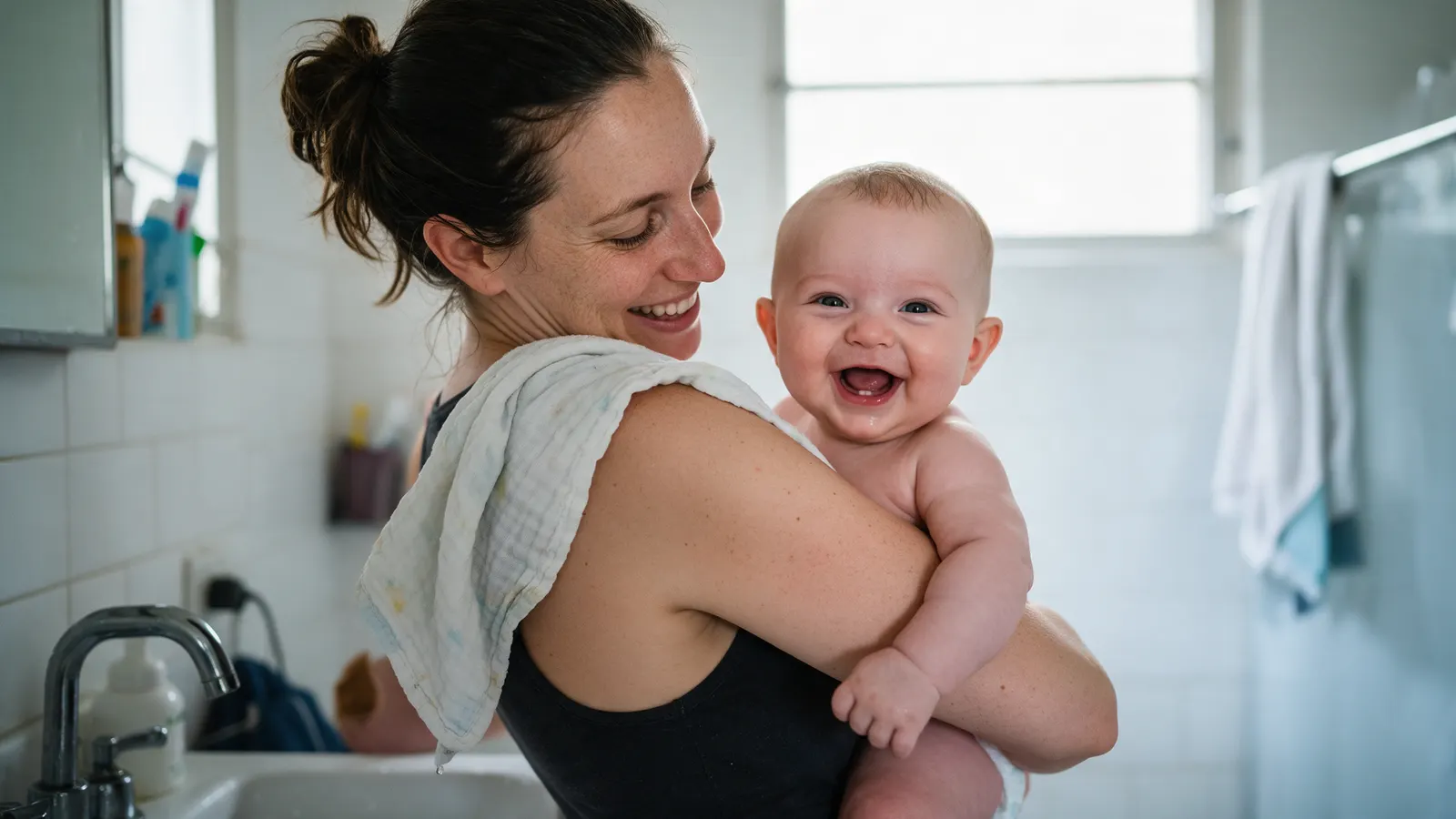
Twenty-eight weeks. Run a clean finger along the lower gum this morning. Maybe there's a hard ridge, maybe a white fleck, maybe nothing at all, and all three are on schedule.
Heart
Most babies get their first teeth between 6 and 12 months, usually starting with the lower front teeth, and some have none by their first birthday (AAP). So a seven-month-old with a tooth and a seven-month-old with a smooth gum are both doing fine. The first tooth is a small thing and a big moment, and the mouth it arrives in is the same one that's learning to take food from a spoon this month, which is why today is about care, not just celebration.
Head
Teething gets blamed for a lot. A 2016 meta-analysis of 16 studies, covering 3,506 children, found that gum irritation, irritability, and drooling were the most common signs, and that teething could nudge temperature up but didn't cause fever (Massignan et al., 2016). The line to remember: a temperature over 100.4°F (38°C) points to an illness, not teeth (AAP; Massignan et al., 2016). A cranky, drooly baby with a tooth on the way is teething. A hot baby is sick, and the tooth is a coincidence.
Body
Care starts the day the tooth shows. Brush twice a day with a smear of fluoride toothpaste the size of a grain of rice (AAP), after the last drink or food of the day, and don't put your baby to bed with a bottle (AAP). If there's no tooth yet, keep wiping the gums with a clean, damp washcloth after feedings, as the gum wipe started last month, and don't share spoons or pacifiers mouth to mouth (AAP). The first teeth section of the guide has the rest.
Try today
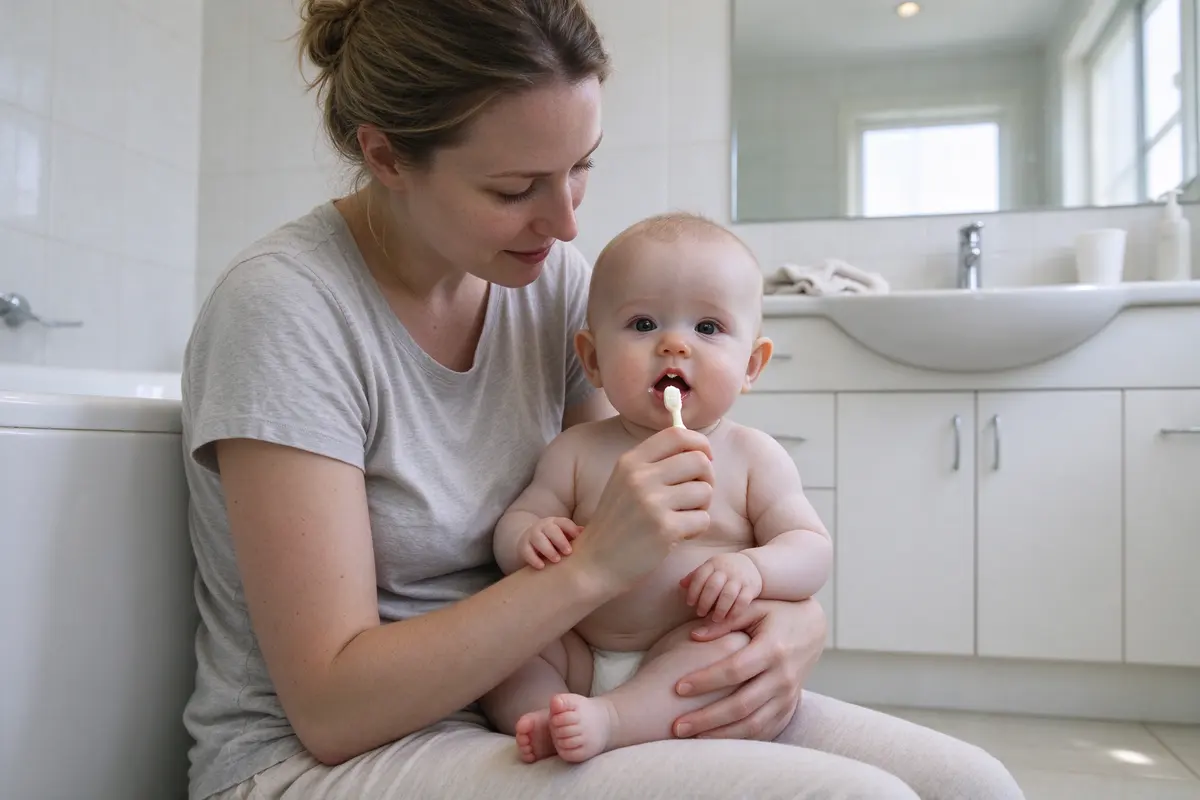
The first brush
Time: 1 minute, twice a day · Caring for first teeth in the guide
After the last feed of the evening, sit your baby on your lap facing out, or in the high chair, buckled.
Put a smear of fluoride toothpaste the size of a grain of rice on a soft baby toothbrush (AAP).
Brush the tooth gently, front and back, for a few seconds each, narrating as you go: "Brushing the tooth. All clean."
No tooth yet? Wipe the gums with a clean, damp washcloth instead, and check again next week (AAP).
Do it again in the morning. Twice a day is the rule from the first tooth on (AAP).
Make it work:Nothing goes in the mouth after the brush but water or the breast. Milk at bedtime, then brush, then bed (AAP).
Watch for
Normal
drool, a chewed fist, and a baby who's crankier than usual for a few days; those are the common teething signs (Massignan et al., 2016).
Normal
a gum that looks puffy where a tooth is coming, and a baby who bites down on everything.
Call your pediatrician right away
if your baby cries nonstop, cries when touched or moved, or won't move an arm or leg normally (AAP).
Normal
no tooth at all yet; some babies have none by their first birthday (AAP).
Go to the ER now
if your baby is hard to wake or not alert when awake (AAP).
For you
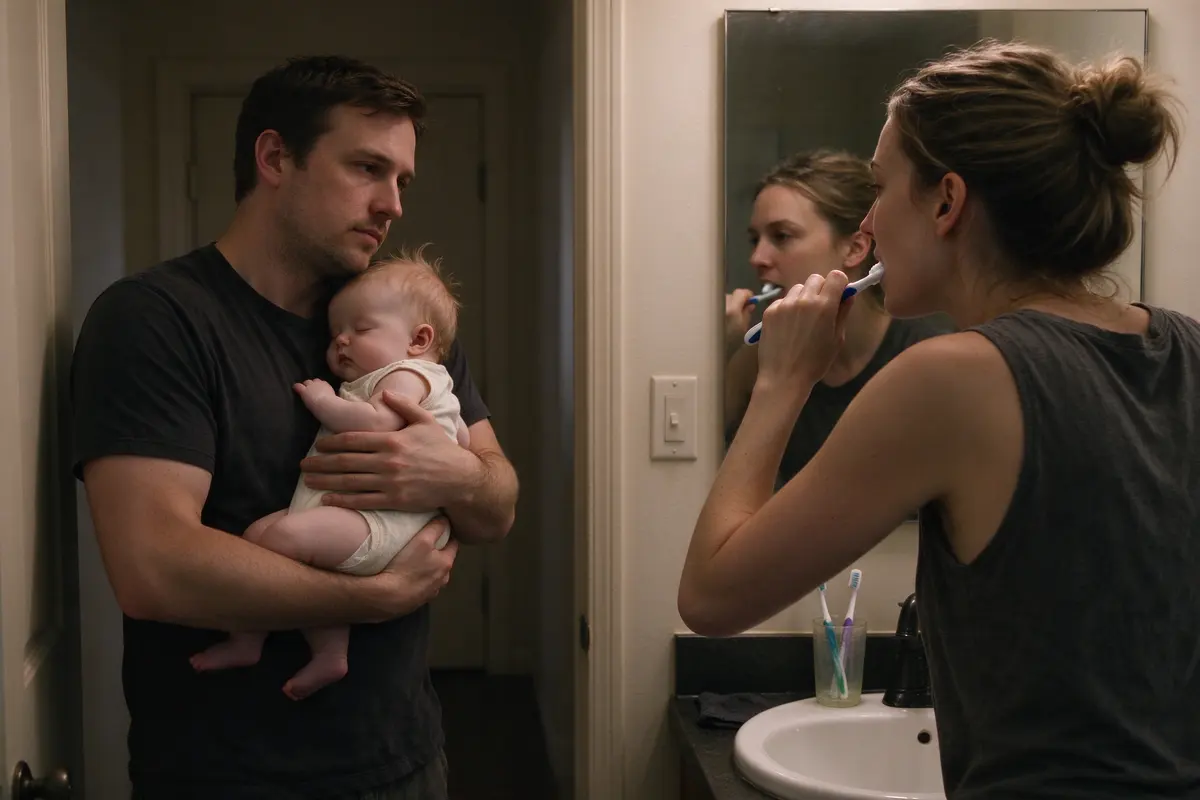
Your own toothbrush, twice a day, counts as self-care. It's two minutes you spend on nobody but yourself, and it's also one of the few things on your list that protects your baby's mouth as well as yours: the AAP's advice not to share spoons or pacifiers mouth to mouth is about the bacteria in an adult's mouth reaching a baby's (AAP). A clean mouth of your own is part of the plan.
If you're the partner: you take the morning brush, she takes the evening one. One tooth, two people, no excuses.
Sources
- DiMaggio D, Cernigliaro J. "Baby's First Tooth: 7 Facts Parents Should Know." HealthyChildren.org, updated 2022. https://www.healthychildren.org/English/ages-stages/baby/teething-tooth-care/Pages/Babys-First-Tooth-Facts-Parents-Should-Know.aspx
- Massignan C, Cardoso M, Porporatti AL, et al. "Signs and Symptoms of Primary Tooth Eruption: A Meta-analysis." Pediatrics, 2016. https://pubmed.ncbi.nlm.nih.gov/26908659/
- American Academy of Pediatrics Section on Oral Health. "Fluoride for Children: Parent FAQs." HealthyChildren.org, updated 2025. https://www.healthychildren.org/English/healthy-living/oral-health/Pages/FAQ-Fluoride-and-Children.aspx
- Braun P. "Why It's Important to Take Care of Baby Teeth." HealthyChildren.org, updated 2026. https://www.healthychildren.org/English/ages-stages/baby/teething-tooth-care/Pages/How-to-Prevent-Tooth-Decay-in-Your-Baby.aspx
- American Academy of Pediatrics. "Fever" (symptom checker). HealthyChildren.org, accessed 2026. https://www.healthychildren.org/English/tips-tools/symptom-checker/Pages/symptomviewer.aspx?symptom=Fever
- American Academy of Pediatrics. "Fever and Your Baby." HealthyChildren.org, updated 2025. https://www.healthychildren.org/English/health-issues/conditions/fever/Pages/Fever-and-Your-Baby.aspx
This guide is general education that summarizes published research and guidance from groups like the American Academy of Pediatrics, the CDC, and the WHO. It isn’t medical advice, and every child develops on their own timeline. Your pediatrician knows your child; if something feels wrong, call them. In an emergency, call 911.
Get each day’s note the morning it applies
Add your baby to a free Chorevia household with their date of birth, and every morning for 300 days the day’s note arrives in the app and by email: what’s developing, one thing to try, what to watch for, and a word for you.
Create your household