Day 195 of 300 · Week 27
Roll to reach
Last reviewed · 3 min read · 8 sources · Plain-text version
Many babies roll both ways by the end of this month, and the floor is where it happens. A toy just out of reach, the WHO's case for floor play, and why the walker is still a no.
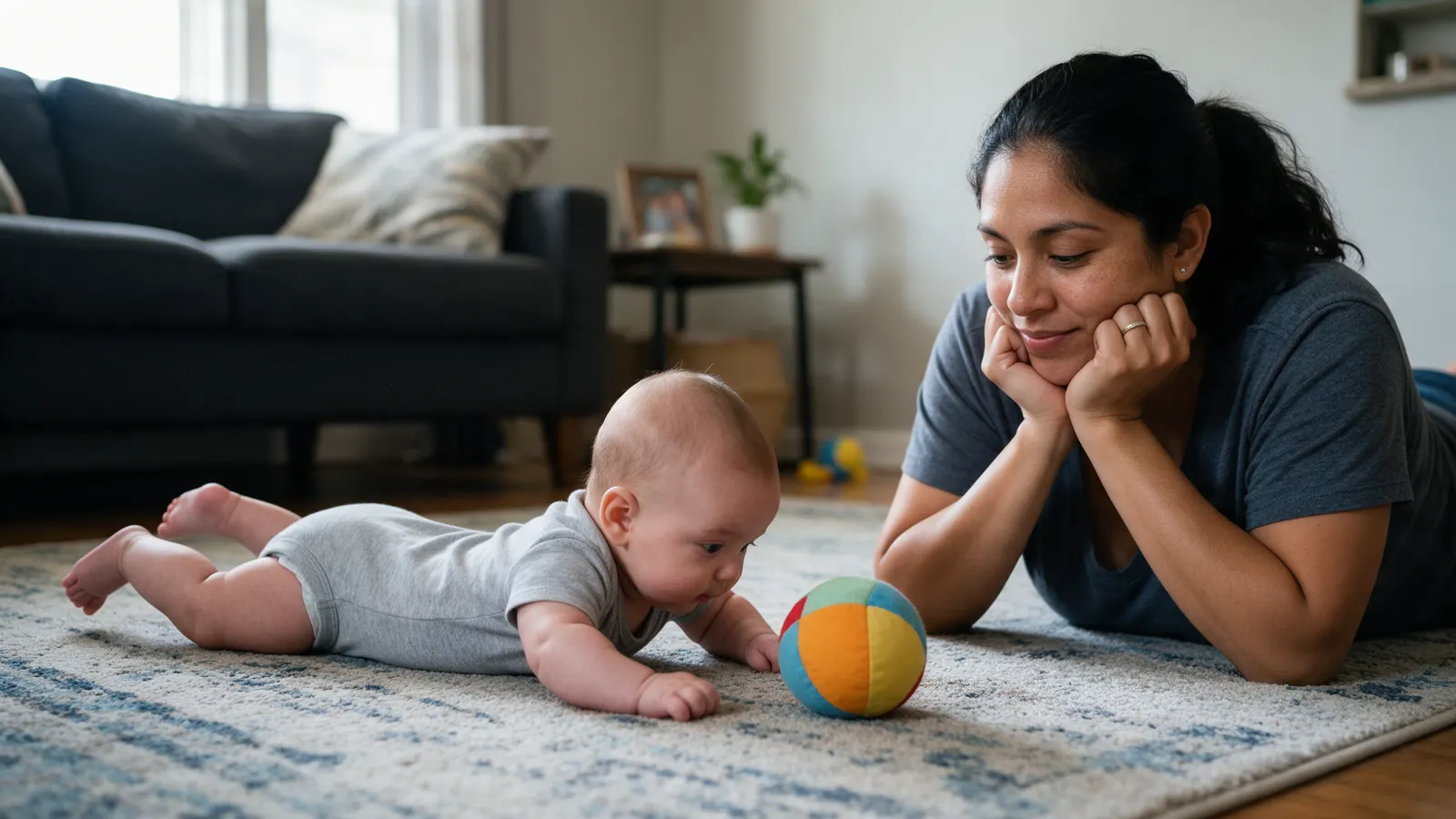
The roll was a trick last month. Now it's transportation.
Heart
By the end of this stage, many babies roll both ways; most roll tummy to back first (AAP). Rolling from tummy to back is on the 6-month list, and CDC's tip for the other direction is simple: put a toy just out of reach to encourage rolling (CDC). A baby who wants the ball and can't crawl yet has one option, and they'll find it. The floor is the classroom, and the toy is the lesson plan.
Head
Why the floor and not the seat: the WHO recommends interactive floor play several times a day for babies and advises against keeping them strapped into strollers, high chairs, or carriers for more than an hour at a time (WHO). The walker is the opposite of the floor. Walkers don't help babies learn to walk and can delay it, and they send thousands of children to hospitals each year, mostly from falls down stairs. The AAP has called for a ban; a stationary activity center is the safer swap (AAP). A baby who rolls to reach is learning to move; a baby in a walker is being moved.
Body
A rolling baby rolls at night too. Keep placing your baby on their back to sleep; if they roll both ways comfortably, you don't need to flip them back, as long as the crib is bare (AAP). And a rolling baby rolls toward whatever is on the floor, so the sweep comes first: coins, buttons, small toy parts, and button batteries at floor level (AAP). Then the blanket goes down, and the toy goes just past the fingertips. Babyproof before your baby moves is the guide's list; they're moving.
Try today
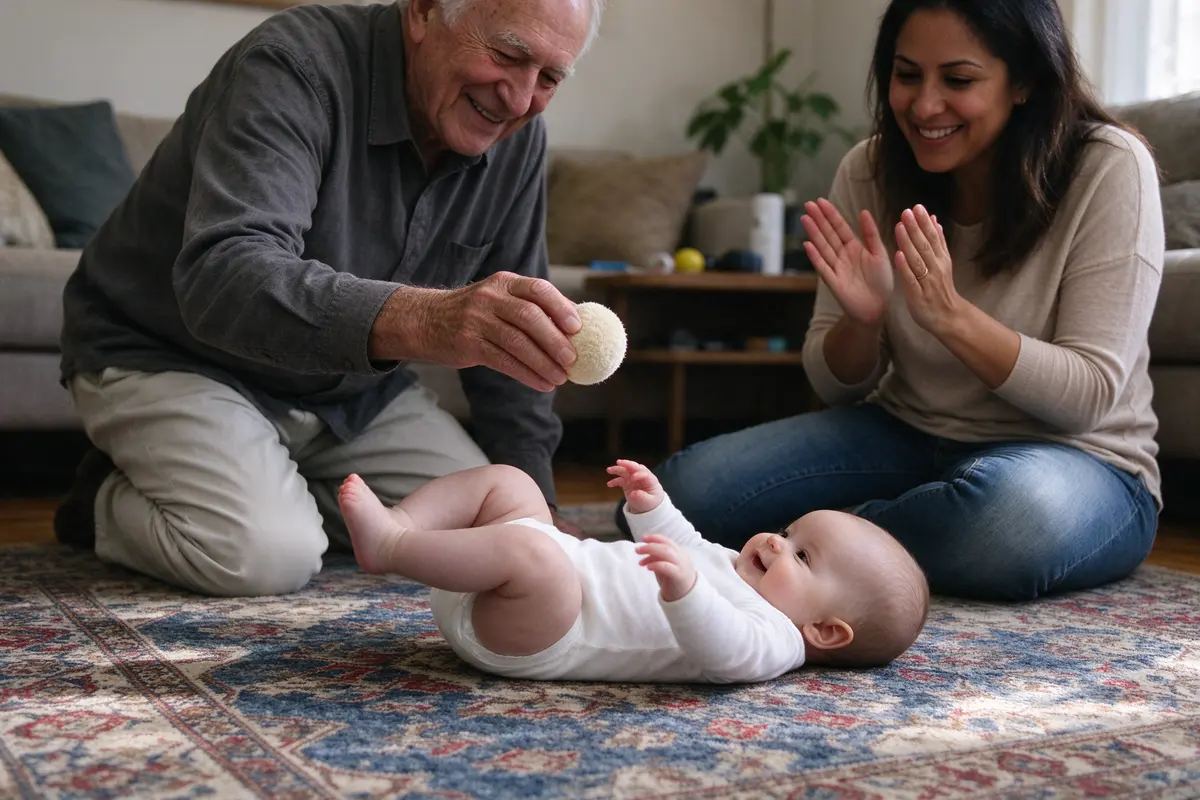
Roll to reach
Time: About 5 minutes, a few times a day · Roll to reach in the guide
Lay your baby on a blanket on the floor, on their back or tummy, after a look for anything small within rolling range (AAP).
Put a favorite toy just out of reach to one side, where they have to turn to see it (CDC).
Cheer the twist, the shoulder, the leg that comes over, and hand the toy over before frustration takes over.
Next round, the other side.
Make it work:If they only roll one way for now, set the toy on the side that works and let the other direction come; most babies roll tummy to back first (AAP).
Watch for
Normal
rolling one way only, for weeks (AAP).
Call your pediatrician
if your baby doesn't roll in either direction by 7 months (AAP).
Normal
a baby who flips to their tummy in the crib and stays there, placed on their back in a bare crib (AAP).
Call 911
if your baby is struggling for each breath, has stopped breathing, or has bluish lips or face (AAP).
Normal
a roll that ends under the coffee table with a surprised face.
Call Poison Help at 1-800-222-1222
if you think your baby swallowed something poisonous (AAP).
For you
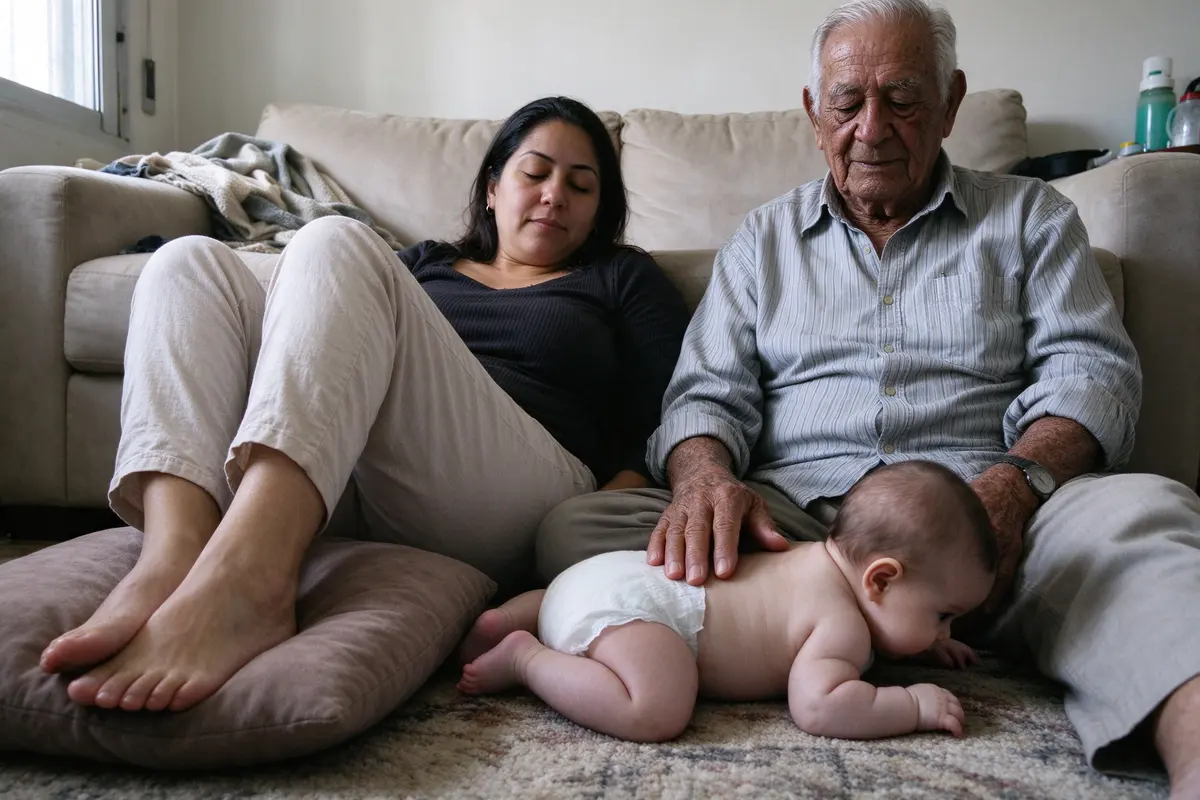
The floor is still the safest place in the house, and the cheapest. A blanket, a rug, a toy from the basket: that's the whole budget. The walker is still a no, however it arrived, and the AAP's reason is the stairs (AAP). If a stationary activity center buys you a shower, use it for the shower and then back to the rug; an hour strapped in is the WHO's line (WHO).
Lie down on the floor yourself while they roll. It's the one piece of baby equipment that also rests your back.
If you're the partner: if a walker was a gift, you're the one who returns it, and you say why.
Sources
- American Academy of Pediatrics. "Movement Milestones: Babies 4 to 7 Months." HealthyChildren.org, updated 2021. https://www.healthychildren.org/English/ages-stages/baby/Pages/Movement-4-to-7-Months.aspx
- Centers for Disease Control and Prevention. "Milestones by 6 Months." Learn the Signs. Act Early. program, updated 2026. https://www.cdc.gov/act-early/milestones/6-months.html
- World Health Organization. "To grow up healthy, children need to sit less and play more." 2019. https://www.who.int/news/item/24-04-2019-to-grow-up-healthy-children-need-to-sit-less-and-play-more
- American Academy of Pediatrics. "Baby Walkers: A Dangerous Choice." HealthyChildren.org, updated 2022. https://www.healthychildren.org/English/safety-prevention/at-home/Pages/Baby-Walkers-A-Dangerous-Choice.aspx
- Moon RY. "How to Keep Your Sleeping Baby Safe: AAP Policy Explained." HealthyChildren.org, updated 2026. https://www.healthychildren.org/English/ages-stages/baby/sleep/Pages/a-parents-guide-to-safe-sleep.aspx
- American Academy of Pediatrics. "Home Safety: Tips for Families With Young Children." HealthyChildren.org, updated 2022. https://www.healthychildren.org/English/safety-prevention/at-home/Pages/Home-Safety-Heres-How.aspx
- American Academy of Pediatrics. "Developmental Milestones: 7 Months." HealthyChildren.org, updated 2009. https://www.healthychildren.org/English/ages-stages/baby/Pages/Developmental-Milestones-7-Months.aspx
- American Academy of Pediatrics. "Breathing Trouble" (symptom checker). HealthyChildren.org, accessed 2026. https://www.healthychildren.org/English/tips-tools/symptom-checker/Pages/symptomviewer.aspx?symptom=Breathing+Trouble
This guide is general education that summarizes published research and guidance from groups like the American Academy of Pediatrics, the CDC, and the WHO. It isn’t medical advice, and every child develops on their own timeline. Your pediatrician knows your child; if something feels wrong, call them. In an emergency, call 911.
Get each day’s note the morning it applies
Add your baby to a free Chorevia household with their date of birth, and every morning for 300 days the day’s note arrives in the app and by email: what’s developing, one thing to try, what to watch for, and a word for you.
Create your household