Day 193 of 300 · Week 26
Sitting, in steps
Last reviewed · 3 min read · 11 sources · Plain-text version
Tripod first, then upright once you set them there, then sitting alone around 9 months. The WHO's wide window, and the crib mattress that goes down tonight.

The sit is this month's big change of view. Your baby can see the room, the table, and you, from the floor, without being held.
Heart
Sitting comes in steps. First your baby "tripods," leaning forward on their arms. By 6 to 8 months, many can stay upright without leaning on their hands once you sit them up, though getting into a sit alone comes later (AAP). Leaning on their hands to hold themselves up is on the 6-month list (CDC); sitting without support is on the 9-month list (CDC). The window is wide. In a WHO study of 816 children in five countries, healthy babies first sat alone anywhere from 3.8 to 9.2 months (WHO Multicentre Growth Reference Study Group, 2006). A wobbly tripod at twenty-six weeks is on schedule.
Head
What practice is for: balance, trunk strength, and a new angle on everything. CDC and the AAP suggest supported sitting with toys to look at while babies learn to balance (CDC; AAP). It hasn't been tested as a way to make sitting come sooner, and that isn't the point. The point is the floor: the WHO advises against keeping babies strapped into strollers, high chairs, or carriers for more than an hour at a time, and recommends interactive floor play several times a day (WHO). A propped seat holds a baby up; the rug teaches them to do it.
Body
A sitting baby changes the crib. Lower the mattress before your baby can sit up, move it to the lowest position before they can stand, and take down any mobile once your baby is 5 months old or gets up on hands and knees (AAP). Back to sleep still; if they roll both ways comfortably, you don't need to flip them back, as long as the crib is bare (AAP). Read safe sleep, now that your baby rolls once more tonight.
Try today
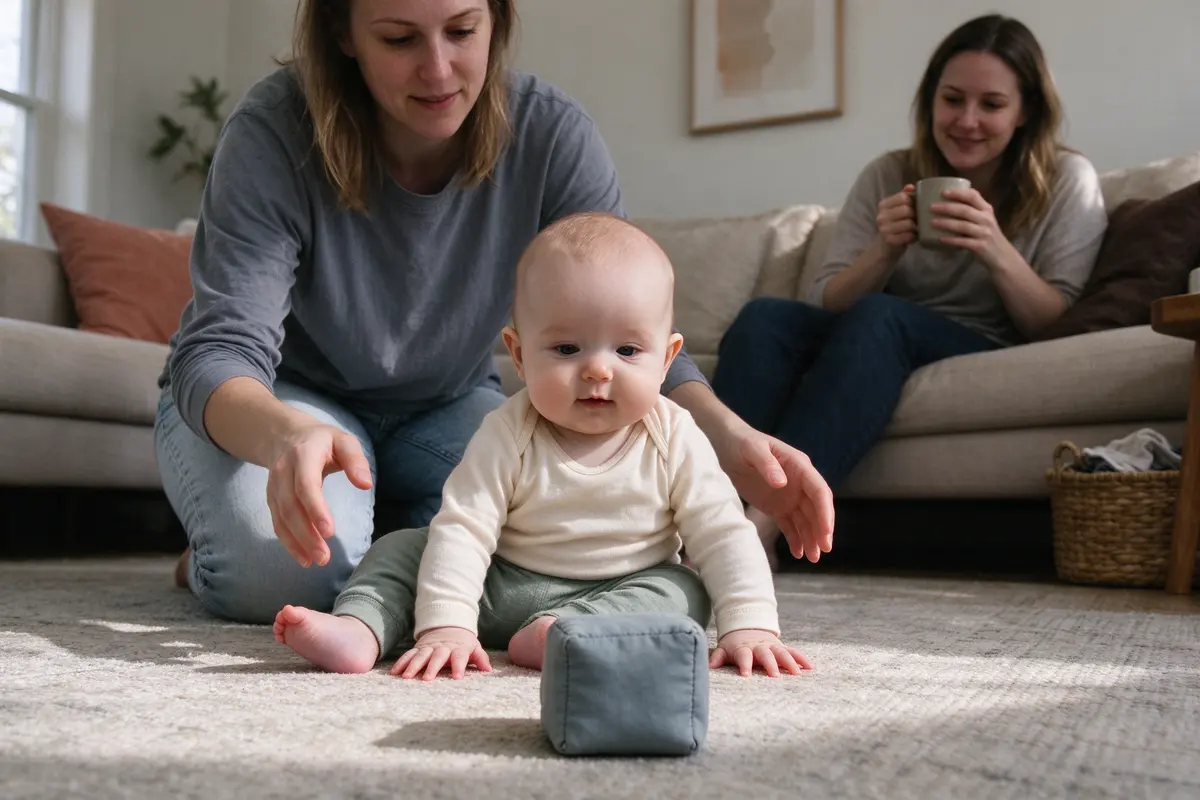
Sitting practice
Time: A few minutes, several times a day · Sitting practice in the guide
Sit your baby on a rug between your legs, or with pillows around them, hands on the floor in front (CDC).
Put a toy a hand's width ahead so they lean forward onto their hands (AAP).
Slide it a little to one side and watch the lean; stay within arm's reach for the topple.
When they slump or fuss, lay them down for free floor play instead (WHO).
Make it work:Floor time beats baby seats. The WHO's limit is an hour at a time strapped into a stroller, high chair, or carrier (WHO).
Watch for
Normal
a sit that ends sideways into a cushion; getting into a sit alone comes later (AAP).
Call your pediatrician
if your baby can't sit with help by 6 months, or seems very stiff or very floppy (AAP).
Normal
a topple onto the rug, a startled face, then back up (CDC).
Call your pediatrician right away
for any head injury in a baby under 1, and call 911 for a seizure, or if they were knocked out for more than a minute (AAP).
Normal
a baby who rolls to their tummy in the crib and sleeps that way, in a bare crib, placed on their back (AAP).
Go to the ER now
if your baby is hard to wake or not alert when awake (AAP).
For you

Lower the mattress tonight. The rule is before your baby can sit up, not after the first time they do (AAP), and tripod sitting counts as the warning. It's ten minutes with a screwdriver and two adults, one on the frame and one on the baby.
Your own back is in this too. If you had a C-section, the lifting limit was the first 6 to 8 weeks (MedlinePlus); you're long past it, but a lower mattress means a deeper reach at every pickup. Bend your knees, bring the baby close, then stand.
If you're the partner: the screwdriver is yours. Tonight, not the weekend.
Sources
- American Academy of Pediatrics. "Movement Milestones: Babies 4 to 7 Months." HealthyChildren.org, updated 2021. https://www.healthychildren.org/English/ages-stages/baby/Pages/Movement-4-to-7-Months.aspx
- Centers for Disease Control and Prevention. "Milestones by 6 Months." Learn the Signs. Act Early. program, updated 2026. https://www.cdc.gov/act-early/milestones/6-months.html
- Centers for Disease Control and Prevention. "Milestones by 9 Months." Learn the Signs. Act Early. program, updated 2026. https://www.cdc.gov/act-early/milestones/9-months.html
- WHO Multicentre Growth Reference Study Group. "WHO Motor Development Study: windows of achievement for six gross motor development milestones." Acta Paediatrica Supplement, 2006. https://pubmed.ncbi.nlm.nih.gov/16817682/
- World Health Organization. "To grow up healthy, children need to sit less and play more." 2019. https://www.who.int/news/item/24-04-2019-to-grow-up-healthy-children-need-to-sit-less-and-play-more
- American Academy of Pediatrics. "Make Baby's Room Safe: Parent Checklist." HealthyChildren.org, updated 2020. https://www.healthychildren.org/English/safety-prevention/at-home/Pages/Make-Babys-Room-Safe.aspx
- Moon RY. "How to Keep Your Sleeping Baby Safe: AAP Policy Explained." HealthyChildren.org, updated 2026. https://www.healthychildren.org/English/ages-stages/baby/sleep/Pages/a-parents-guide-to-safe-sleep.aspx
- American Academy of Pediatrics. "Developmental Milestones: 7 Months." HealthyChildren.org, updated 2009. https://www.healthychildren.org/English/ages-stages/baby/Pages/Developmental-Milestones-7-Months.aspx
- American Academy of Pediatrics. "Head Injury" (symptom checker). HealthyChildren.org, accessed 2026. https://www.healthychildren.org/English/tips-tools/symptom-checker/Pages/symptomviewer.aspx?symptom=Head+Injury
- American Academy of Pediatrics. "Fever" (symptom checker). HealthyChildren.org, accessed 2026. https://www.healthychildren.org/English/tips-tools/symptom-checker/Pages/symptomviewer.aspx?symptom=Fever
- MedlinePlus. "Going home after a C-section." National Library of Medicine, 2024. https://medlineplus.gov/ency/patientinstructions/000624.htm
This guide is general education that summarizes published research and guidance from groups like the American Academy of Pediatrics, the CDC, and the WHO. It isn’t medical advice, and every child develops on their own timeline. Your pediatrician knows your child; if something feels wrong, call them. In an emergency, call 911.
Get each day’s note the morning it applies
Add your baby to a free Chorevia household with their date of birth, and every morning for 300 days the day’s note arrives in the app and by email: what’s developing, one thing to try, what to watch for, and a word for you.
Create your household