Day 206 of 300 · Week 28
Shy, clingy, new people
Last reviewed · 4 min read · 8 sources · Plain-text version
Stranger anxiety normally shows up between 7 and 12 months, and being shy or clingy is on the 9-month list. Watching from your arms, saying when you leave, and a goodbye ritual that holds.
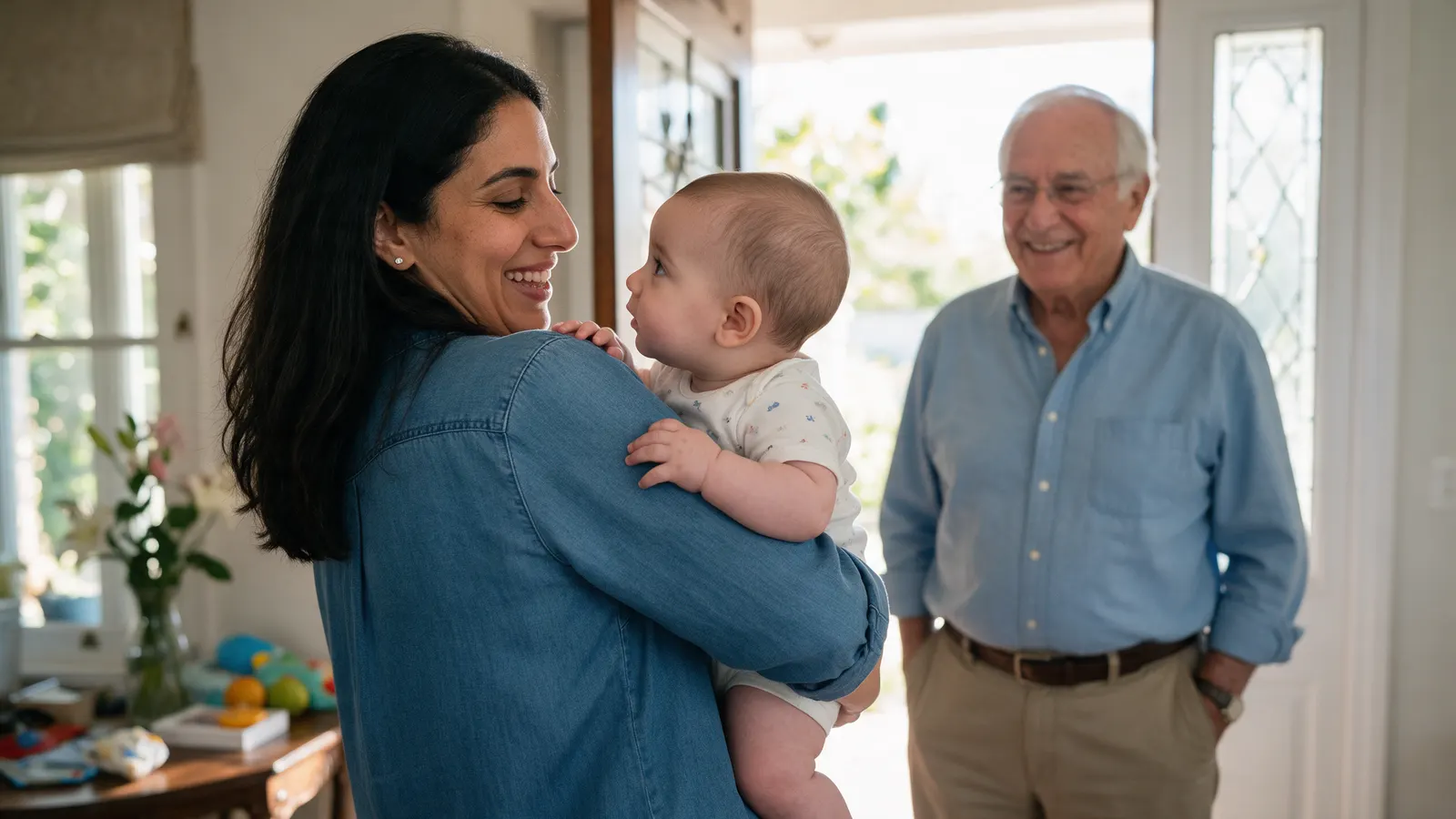
Around now the baby who beamed at everyone in the grocery line may go quiet and bury their face in your neck when a stranger leans in. Nothing has gone wrong. Something has gone right.
Heart
Stranger anxiety normally shows up between 7 and 12 months (AAP), and being shy, clingy, or fearful around strangers is on CDC's 9-month list of things most babies do (CDC). It isn't caused by "spoiling"; your baby can now tell familiar from unfamiliar (AAP). The clinging is the flip side of knowing exactly who you are.
Head
The AAP's advice for new faces is slow. Even favorite relatives can make a wary baby cry if they swoop in too fast (AAP), so let your baby watch new people from your arms first. Tell your baby matter-of-factly when you're leaving, even just for another room. A familiar sitter helps, and a new one should arrive early enough to get acquainted; then offer a distraction, say goodbye, and go (AAP). Never sneak away: a quick, cheerful goodbye, even if your baby cries (CDC), the same short ritual every time, and come back when you said you would (Swanson, AAP).
Body
This is also the reason the AAP suggests, if you can, not starting child care in the 7- to 12-month window, or easing into it with a short goodbye ritual you repeat every day (AAP). And it reaches into the night. Beginning in the second half of the first year, separation anxiety can disrupt sleep, with babies waking and crying for a parent; the AAP calls it a normal stage of emotional development (AAP). The ritual you build today in the kitchen is the same one you'll use at the crib.
Try today
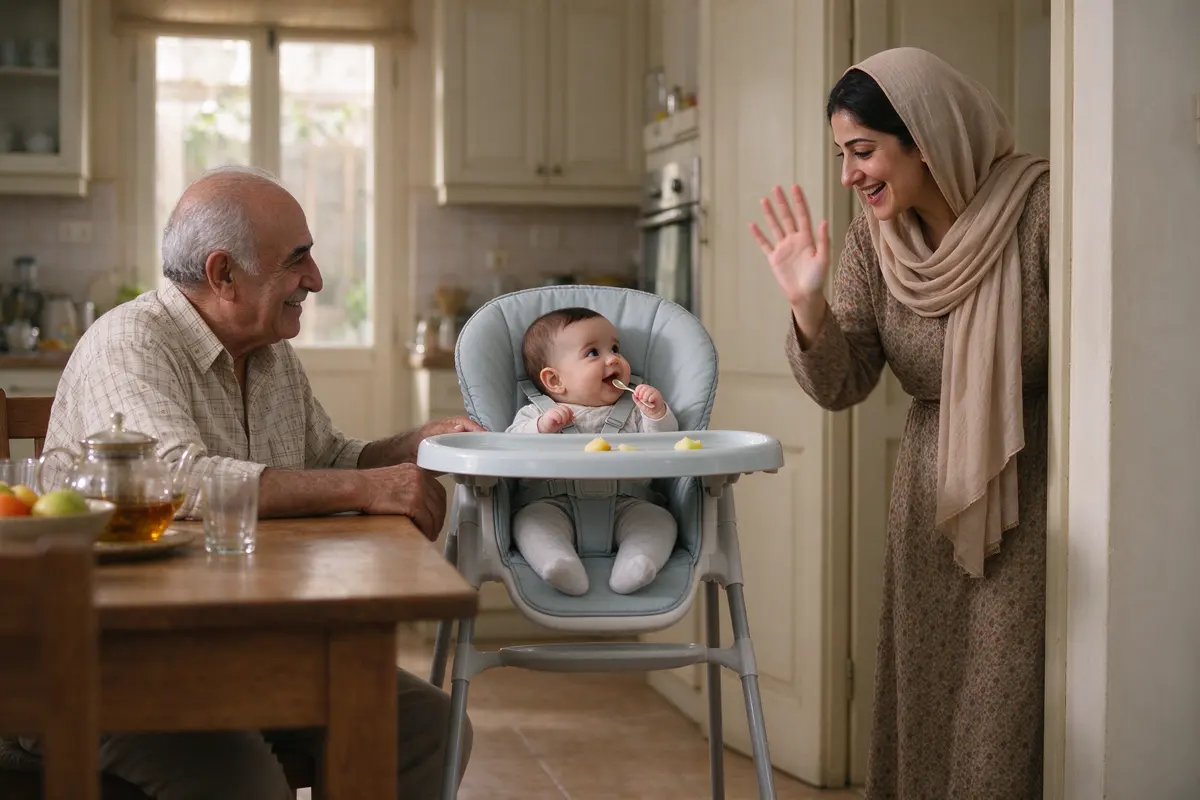
The goodbye ritual
Time: 5 seconds, every time you leave the room · Warming up to new people in the guide
Pick three words and a wave: "Bye-bye, back soon," and a hand up. Don't make it longer.
Use it every time you leave your baby's sight today, even for the laundry; the AAP says to tell your baby matter-of-factly when you're leaving, even just for another room (AAP).
Come back when you said you would, and say so: "I'm back" (Swanson, AAP).
With a visitor, use it in reverse: let your baby watch from your arms while the visitor talks to you first, and only then to the baby (AAP).
With a sitter: arrive early, hand over a distraction, say the three words, wave, go (AAP).
Make it work:Crying at the wave doesn't mean the ritual failed; sneaking out to avoid the crying is what fails (CDC).
Watch for
Normal
a long, serious stare at a new face and a turn into your shoulder; that's your baby telling familiar from unfamiliar (AAP).
Normal
crying the moment you step out of the room and stopping the moment you're back.
Call your pediatrician right away
if your baby cries nonstop, or cries when touched or moved (AAP).
Normal
waking at night and calling for you in a way they didn't last month (AAP).
Go to the ER now
if your baby has a seizure with a fever, a stiff neck, or a bulging soft spot (AAP).
For you

Your own leaving gets easier with a ritual too. The AAP's advice to ease into child care with a short goodbye you repeat every day (AAP) works on the parent too: three words and a wave give you something to do instead of standing in the doorway deciding. Say it, wave, walk. Tears at the door usually stop within minutes of your leaving (AAP); your part is to leave so they can.
If you're the partner: when a relative swoops, you're the one who says "give her a minute, she's just looking at you." It lands better from you than from the person holding the baby.
Sources
- American Academy of Pediatrics. "Making Baby Drop Off at Child Care Easier." HealthyChildren.org, updated 2022. https://www.healthychildren.org/English/family-life/work-and-child-care/Pages/making-baby-drop-off-at-child-care-easier.aspx
- Centers for Disease Control and Prevention. "Milestones by 9 Months." Learn the Signs. Act Early. program, updated 2026. https://www.cdc.gov/act-early/milestones/9-months.html
- American Academy of Pediatrics. "Emotional and Social Development: 8 to 12 Months." HealthyChildren.org, updated 2009. https://www.healthychildren.org/English/ages-stages/baby/Pages/Emotional-and-Social-Development-8-12-Months.aspx
- American Academy of Pediatrics. "Separation Anxiety & Sleeping Trouble in Young Children." HealthyChildren.org, updated 2022. https://www.healthychildren.org/English/healthy-living/sleep/Pages/separation-anxiety-and-sleeping.aspx
- Swanson WS. "How to Ease Your Child's Separation Anxiety." HealthyChildren.org, updated 2026. https://www.healthychildren.org/English/ages-stages/toddler/Pages/Soothing-Your-Childs-Separation-Anxiety.aspx
- Centers for Disease Control and Prevention. "Milestones by 6 Months." Learn the Signs. Act Early. program, updated 2026. https://www.cdc.gov/act-early/milestones/6-months.html
- Centers for Disease Control and Prevention. "Concerned About Your Child's Development?" 2026. https://www.cdc.gov/act-early/families/concerned.html
- American Academy of Pediatrics. "Fever" (symptom checker). HealthyChildren.org, accessed 2026. https://www.healthychildren.org/English/tips-tools/symptom-checker/Pages/symptomviewer.aspx?symptom=Fever
This guide is general education that summarizes published research and guidance from groups like the American Academy of Pediatrics, the CDC, and the WHO. It isn’t medical advice, and every child develops on their own timeline. Your pediatrician knows your child; if something feels wrong, call them. In an emergency, call 911.
Get each day’s note the morning it applies
Add your baby to a free Chorevia household with their date of birth, and every morning for 300 days the day’s note arrives in the app and by email: what’s developing, one thing to try, what to watch for, and a word for you.
Create your household