Day 190 of 300 · Week 26
The foods that wait
Last reviewed · 4 min read · 16 sources · Plain-text version
Hot dogs, whole grapes, nuts, popcorn, raw apple, and the rest of the choking list wait until after the first birthday, with honey, juice, and cow's milk. Today it goes on the fridge.

Today is the other list: the foods that wait, and where to put it so everyone who feeds your baby reads it.
Heart
Two-thirds of the children who die from choking are babies under 1 (AAP). Before age 1, avoid hot dogs and meat sticks, nuts and seeds, chunks of meat or cheese, whole grapes, popcorn, chunks of peanut butter, raw vegetables, raw fruit chunks like apple, and hard, gooey, or sticky candy (AAP). Most of that is ordinary food, which is why it needs writing down: the danger is a grape, not a strange ingredient.
Head
Skip added sugar, salty foods, caffeine, high-mercury fish like shark and swordfish, and unpasteurized milk, cheese, and juice (CDC). No honey before 12 months, not even on a pacifier, because it can cause botulism (CDC). No juice before 12 months (AAP), and no cow's milk as a drink, though plain yogurt and cheese are fine (CDC). None of it is forever; it's the first birthday.
Body
The list on the fridge matters most for the meals you're not at. Eating in a car seat or stroller or while lying down belongs on it too (CDC), and so does the setup every meal keeps: upright, buckled, soft, cut into strips rather than coins, an adult watching (AAP; CDC). Peanut stays on the yes side, in its thinned form, never as whole nuts or thick globs (AAP).
Try today
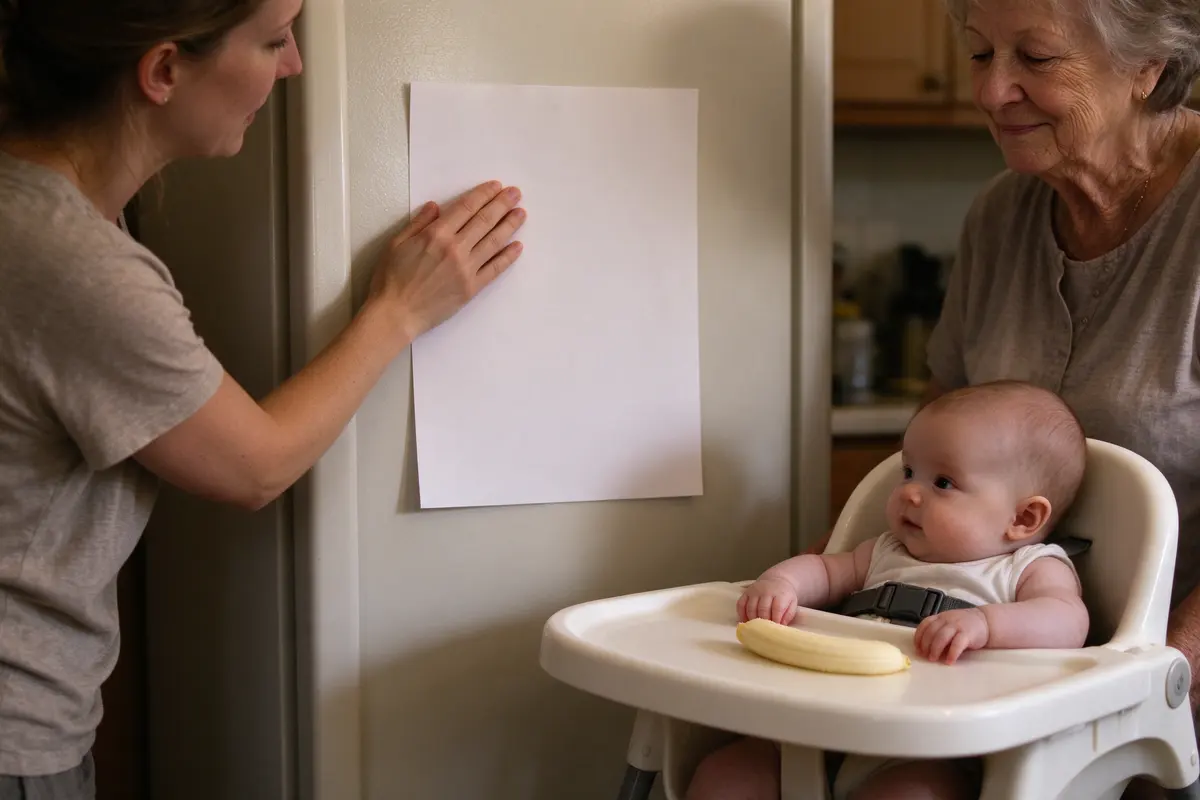
The not-yet list on the fridge
Time: 10 minutes, one sheet of paper
Write the choking list from the AAP: hot dogs and meat sticks, nuts and seeds, chunks of meat or cheese, whole grapes, popcorn, chunks of peanut butter, raw vegetables, raw apple chunks, hard or sticky candy (AAP).
Under it, the skip list from CDC: added sugar, salty foods, caffeine, shark and swordfish, anything unpasteurized, and honey (CDC).
Add the setup line: high chair, buckled, strips not coins, an adult watching (AAP).
Tape it at adult eye level, and point to it when anyone offers the baby a bite from their plate.
Make it work:Write "until 1" at the top, so it reads as a date, not a judgment.
Watch for
Normal
a baby who lunges for your plate; wanting your food is a readiness sign, not a reason to share it (AAP).
Call 911
if your baby is choking and can't cry, cough, or breathe, or has a weak cough, high-pitched sounds, or blue or pale skin (Red Cross).
Normal
everything on the floor going into the mouth; that's how babies explore (CDC).
Call Poison Help at 1-800-222-1222 right away
if you think your baby swallowed a button battery, which can do severe damage in the esophagus in 2 hours, or anything poisonous (Poison Control; AAP).
Normal
a food refused five times running; it may take 10 to 15 tries (AAP).
Normal
knowing this baby better than anyone alive.
Call anyway
if your baby just doesn't seem right to you. Trust your instincts; ten days of spoons have taught you their full face (Lurie Children's).
For you

Grandparents read fridges. The list isn't a verdict on anyone's parenting; it's that the advice changed, and the people who raised you on a honey-dipped pacifier didn't have the botulism line (CDC) or the two-thirds number (AAP). A sheet of paper lets you say "it's on the fridge" instead of having the argument at the table.
If you're the partner: the visiting parents are often yours. Walk them to the fridge before the baby is in the chair, and say the grape line yourself. And this is for you too: about 10% of fathers have depression around a birth, and studies reported higher rates, 25.6%, at 3 to 6 months after, though results varied widely (Paulson & Bazemore, 2010). If that's you, the hotline is yours as well: 1-833-TLC-MAMA (1-833-852-6262), call or text, or 988 (CDC).
Sources
- Bradin S. "Choking Prevention for Babies & Children: What Every Parent Needs to Know." HealthyChildren.org, updated 2026. https://www.healthychildren.org/English/health-issues/injuries-emergencies/Pages/Choking-Prevention.aspx
- American Academy of Pediatrics. "When Can Babies Start Solid Foods? Readiness & Feeding Tips." HealthyChildren.org, updated 2026. https://www.healthychildren.org/English/ages-stages/baby/feeding-nutrition/Pages/Starting-Solid-Foods.aspx
- Centers for Disease Control and Prevention. "Foods and Drinks to Avoid or Limit." 2026. https://www.cdc.gov/infant-toddler-nutrition/foods-and-drinks/foods-and-drinks-to-avoid-or-limit.html
- Centers for Disease Control and Prevention. "When, What, and How to Introduce Solid Foods." 2026. https://www.cdc.gov/infant-toddler-nutrition/foods-and-drinks/when-what-and-how-to-introduce-solid-foods.html
- Centers for Disease Control and Prevention. "Choking Hazards." 2026. https://www.cdc.gov/infant-toddler-nutrition/foods-and-drinks/choking-hazards.html
- Agbim IA, Hurtado CW. "Baby-Led Weaning: Is It Safe?" HealthyChildren.org, updated 2024. https://www.healthychildren.org/English/ages-stages/baby/feeding-nutrition/Pages/baby-led-weaning-is-it-safe.aspx
- Cox A, Pistiner M. "When to Introduce Egg, Peanut Butter & Other Common Food Allergens to a Baby." HealthyChildren.org, updated 2025. https://www.healthychildren.org/English/healthy-living/nutrition/Pages/when-to-introduce-egg-peanut-butter-and-other-common-food-allergens-to-your-baby-food-allergy-prevention-tips.aspx
- American Red Cross. "Infant Choking: How To Help." Accessed 2026. https://www.redcross.org/take-a-class/resources/learn-first-aid/infant-choking
- Centers for Disease Control and Prevention. "Milestones by 6 Months." Learn the Signs. Act Early. program, updated 2026. https://www.cdc.gov/act-early/milestones/6-months.html
- National Capital Poison Center. "Swallowed a button battery? Battery in the nose or ear?" Poison Control, accessed 2026. https://www.poison.org/battery
- American Academy of Pediatrics. "Home Safety: Tips for Families With Young Children." HealthyChildren.org, updated 2022. https://www.healthychildren.org/English/safety-prevention/at-home/Pages/Home-Safety-Heres-How.aspx
- American Academy of Pediatrics. "Checkup Checklist: 6 Months Old." HealthyChildren.org, updated 2023. https://www.healthychildren.org/English/ages-stages/Your-Childs-Checkups/Pages/Your-Checkup-Checklist-6-Months-Old.aspx
- National Institute of Allergy and Infectious Diseases. "Instructions for Home Feeding of Peanut Protein for Infants at Low Risk of an Allergic Reaction to Peanut" (Appendix D). 2017. https://www.niaid.nih.gov/sites/default/files/addendum_guidelines_peanut_appx_d.pdf
- Lurie Children's Hospital of Chicago. "When to Call the Pediatrician for Your Newborn." 2024. https://www.luriechildrens.org/en/blog/when-to-call-the-pediatrician-for-your-newborn/
- Paulson JF, Bazemore SD. "Prenatal and postpartum depression in fathers and its association with maternal depression: a meta-analysis." JAMA, 2010. https://pubmed.ncbi.nlm.nih.gov/20483973/
- Centers for Disease Control and Prevention. "Symptoms of Depression Among Women." 2024. https://www.cdc.gov/reproductive-health/depression/index.html
This guide is general education that summarizes published research and guidance from groups like the American Academy of Pediatrics, the CDC, and the WHO. It isn’t medical advice, and every child develops on their own timeline. Your pediatrician knows your child; if something feels wrong, call them. In an emergency, call 911.
Get each day’s note the morning it applies
Add your baby to a free Chorevia household with their date of birth, and every morning for 300 days the day’s note arrives in the app and by email: what’s developing, one thing to try, what to watch for, and a word for you.
Create your household