Day 205 of 300 · Week 28
If you decide to sleep train
Last reviewed · 4 min read · 10 sources · Plain-text version
Sleep training is a choice, not a requirement. Two trials found no harm to attachment a year later and no lasting harms or benefits at age 6. How two adults decide, together, or decide not to.
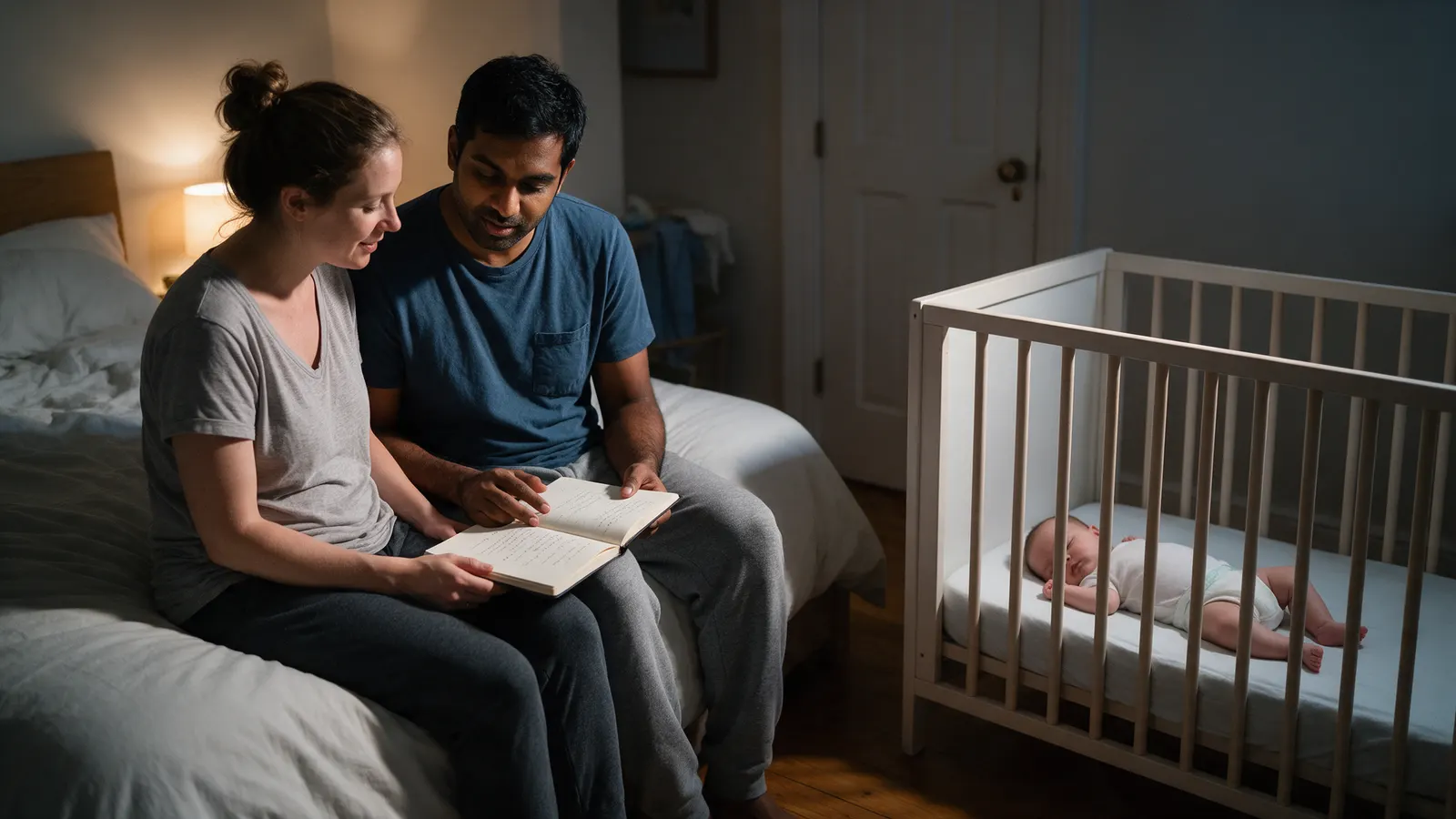
Yesterday was the routine. Today is the question under it, which some families never need to ask and some ask every night: should we sleep train? Here's what the trials found, and a way to decide that both adults can live with.
Heart
Sleep training is a choice, not a requirement. The AAP's own advice for this age stops at drowsy-but-awake and a few minutes to resettle, with feeding, changing, and comforting still allowed whenever they're needed (AAP). Night waking at six months is normal, and a baby who wakes isn't broken (Pennestri et al., 2018). If the nights are working for you, you can stop reading here.
Head
The trials are small, and they point the same way. In 43 babies 6 to 16 months old, graduated extinction and bedtime fading improved sleep with no effect on attachment a year later (Gradisar et al., 2016). A larger trial followed 326 children who had sleep problems at 7 months and found no lasting harms, and no lasting benefits either, when the children were 6 (Price et al., 2012). Whichever way you go, you aren't choosing between a secure baby and an insecure one.
Body
Two things sit outside the choice. Room-sharing: one US study linked sharing a room at 9 months with about 40 minutes less night sleep and more bed-sharing (Paul et al., 2017), but the AAP still recommends room-sharing without bed-sharing for at least the first 6 months because it lowers SIDS risk (AAP); if you move the crib out, the crib stays bare and the back stays down. And setbacks: when separation anxiety brings new night waking later this year, the AAP's advice is to reassure calmly and consistently (AAP).
Try today
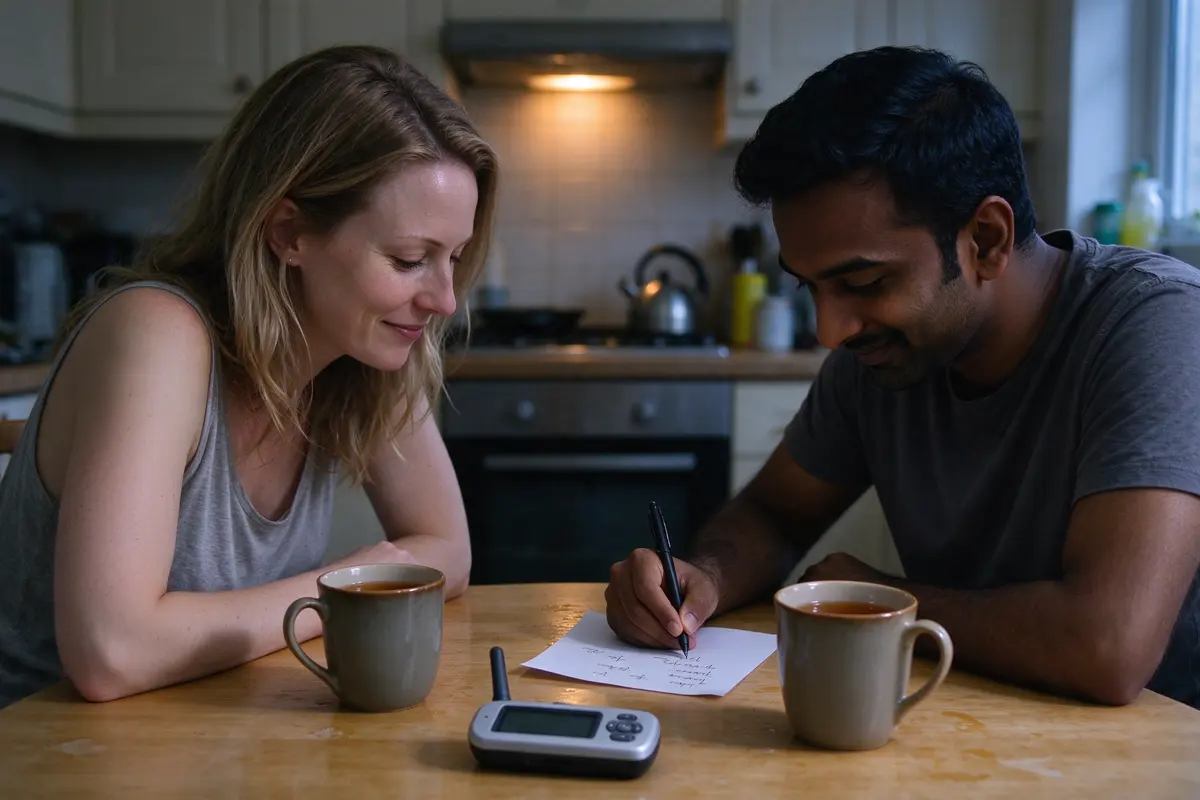
The method talk
Time: 15 minutes, both adults, baby asleep · Sleep: routine first, then decide in the guide
Start with the question, not a method: are the nights working for us? If both say yes, write "not now" and a date to ask again.
If not, read the two findings out loud: no effect on attachment a year later in 43 babies (Gradisar et al., 2016); no lasting harms or benefits at age 6 in 326 children (Price et al., 2012).
Pick one approach you can both do the same way every night; consistency went with better sleep (Mindell et al., 2015). Write who does which night.
Set a date two weeks out to look at it again.
Make it work:If night waking is wearing your family down, ask your pediatrician about the options, including sleep training, before you start (Price et al., 2012).
Watch for
Normal
a baby who protests a new bedtime for a few nights and then settles faster than before.
Call your pediatrician right away
if your baby cries nonstop, or cries when touched or moved, which isn't protest (AAP).
Normal
a night feed that stays in the plan; 27.9% to 57.0% of 6- and 12-month-olds didn't sleep 6 or 8 hours straight (Pennestri et al., 2018).
Call 911
if your baby is struggling for each breath or has bluish lips or face (AAP).
Normal
a run of good nights, then a bad week; separation anxiety can bring waking back (AAP).
Call your pediatrician right away
if your baby has a fever higher than 104°F (40°C), or looks or acts very sick (AAP).
For you
Whichever you choose, you are not harming your baby. That sentence has a year of follow-up behind it (Gradisar et al., 2016) and five years behind it (Price et al., 2012), and it applies to the family that trains and the family that doesn't. What the evidence can't tell you is which one you can keep doing at 3 a.m. in week three, and that's the only question that matters.
If you're the partner: if she's the one who hears every wake, your name goes on half the nights before any method goes on the page.
Sources
- American Academy of Pediatrics. "Getting Your Baby to Sleep." HealthyChildren.org, updated 2024. https://www.healthychildren.org/English/ages-stages/baby/sleep/Pages/getting-your-baby-to-sleep.aspx
- Pennestri MH, Laganière C, Bouvette-Turcot AA, et al. "Uninterrupted Infant Sleep, Development, and Maternal Mood." Pediatrics, 2018. https://pubmed.ncbi.nlm.nih.gov/30420470/
- Gradisar M, Jackson K, Spurrier NJ, et al. "Behavioral Interventions for Infant Sleep Problems: A Randomized Controlled Trial." Pediatrics, 2016. https://pubmed.ncbi.nlm.nih.gov/27221288/
- Price AMH, Wake M, Ukoumunne OC, Hiscock H. "Five-year follow-up of harms and benefits of behavioral infant sleep intervention: randomized trial." Pediatrics, 2012. https://pubmed.ncbi.nlm.nih.gov/22966034/
- Paul IM, Hohman EE, Loken E, et al. "Mother-Infant Room-Sharing and Sleep Outcomes in the INSIGHT Study." Pediatrics, 2017. https://pubmed.ncbi.nlm.nih.gov/28759407/
- Moon RY. "How to Keep Your Sleeping Baby Safe: AAP Policy Explained." HealthyChildren.org, updated 2026. https://www.healthychildren.org/English/ages-stages/baby/sleep/Pages/a-parents-guide-to-safe-sleep.aspx
- American Academy of Pediatrics. "Separation Anxiety & Sleeping Trouble in Young Children." HealthyChildren.org, updated 2022. https://www.healthychildren.org/English/healthy-living/sleep/Pages/separation-anxiety-and-sleeping.aspx
- Mindell JA, Li AM, Sadeh A, et al. "Bedtime routines for young children: a dose-dependent association with sleep outcomes." Sleep, 2015. https://pubmed.ncbi.nlm.nih.gov/25325483/
- American Academy of Pediatrics. "Fever" (symptom checker). HealthyChildren.org, accessed 2026. https://www.healthychildren.org/English/tips-tools/symptom-checker/Pages/symptomviewer.aspx?symptom=Fever
- American Academy of Pediatrics. "Breathing Trouble" (symptom checker). HealthyChildren.org, accessed 2026. https://www.healthychildren.org/English/tips-tools/symptom-checker/Pages/symptomviewer.aspx?symptom=Breathing+Trouble
This guide is general education that summarizes published research and guidance from groups like the American Academy of Pediatrics, the CDC, and the WHO. It isn’t medical advice, and every child develops on their own timeline. Your pediatrician knows your child; if something feels wrong, call them. In an emergency, call 911.
Get each day’s note the morning it applies
Add your baby to a free Chorevia household with their date of birth, and every morning for 300 days the day’s note arrives in the app and by email: what’s developing, one thing to try, what to watch for, and a word for you.
Create your household