Day 64 of 120 · Week 9
Who gets the big smile
Last reviewed · 3 min read · 10 sources · Plain-text version
Your baby is sorting out who's who: the big smile for you, a hesitant one for the sitter, a stare for strangers. Looking away is control, not rejection. Plus a chuckle hunt.
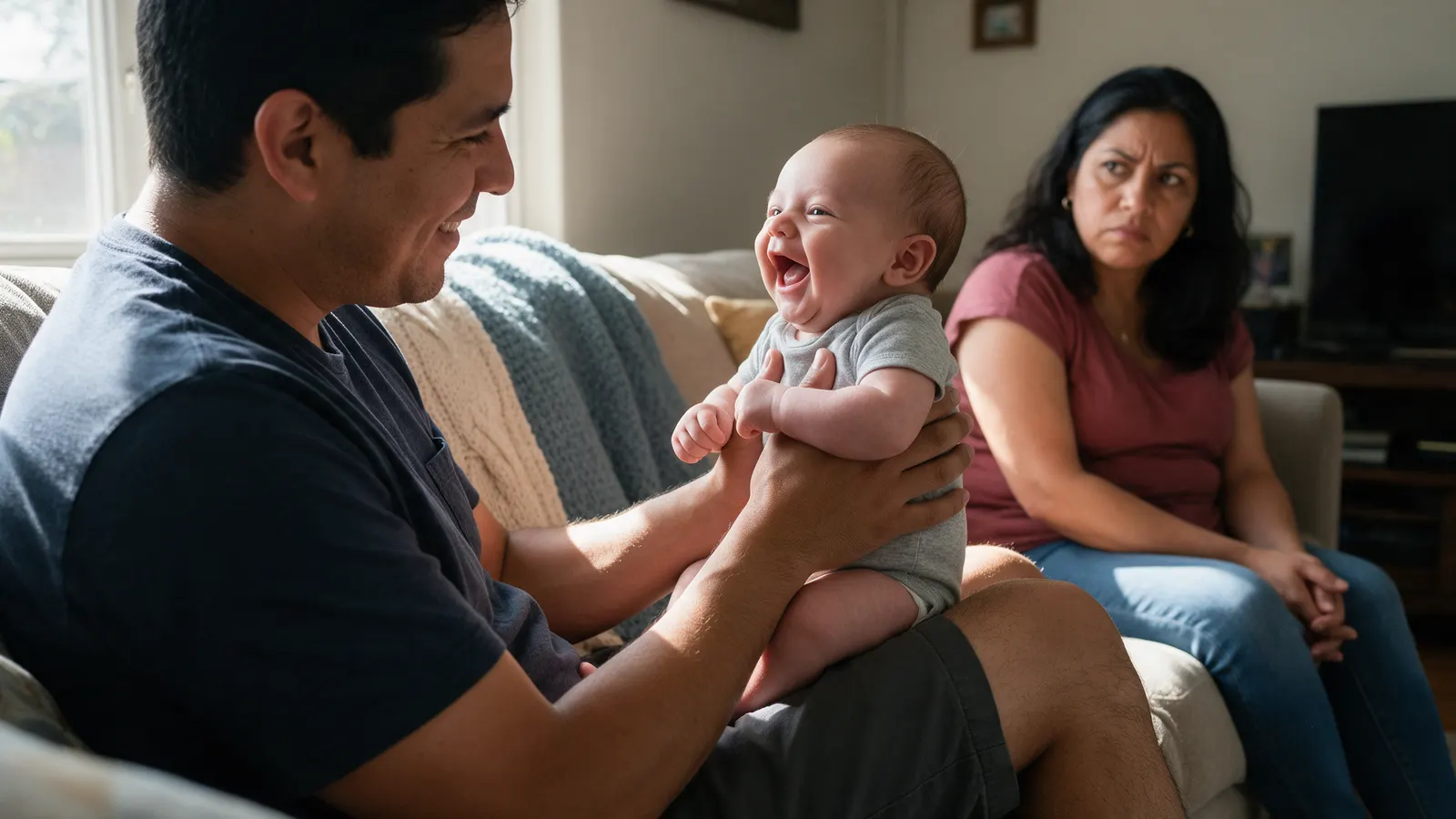
The smile you get is not the smile the neighbor gets. Your baby is starting to tell people apart, and it shows in their face.
Heart
Familiar people get the big smiles, sitters may get a hesitant one, and strangers a curious stare (AAP). That sorting is new, and it's aimed at you. And looking away mid-chat is normal; it gives your baby some control and keeps them from getting overwhelmed (AAP). A turned head is a pause, not a verdict.
Head
By the second or third month, many babies "talk" back with coos and gurgles and smile when they see or hear you (AAP). The next steps have a wide window: chuckling when you try to make them laugh is a 4-month milestone, and a full laugh is a 6-month one (CDC; CDC). Around 3 or 4 months, babies also become fascinated by other children (AAP), so a sibling may soon get a bigger reaction than any adult.
Body
Try today
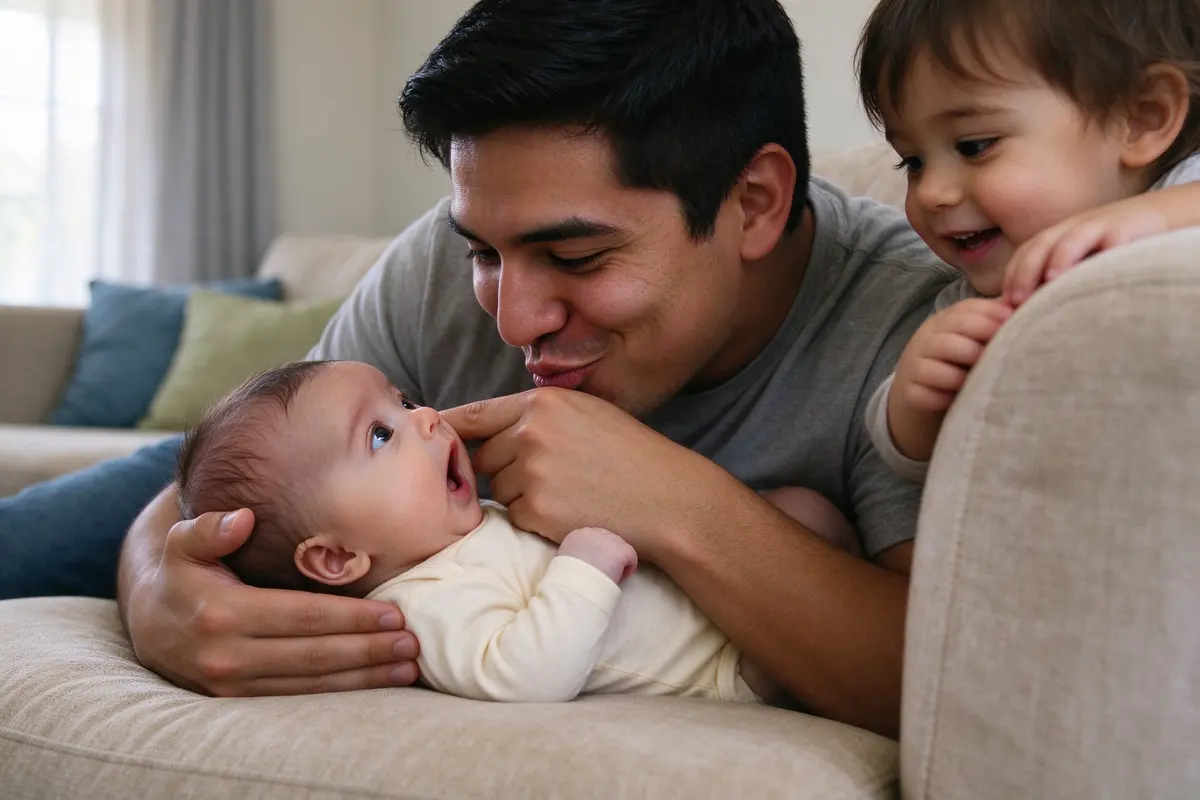
Chuckle hunt
Time: A few minutes, when your baby is happy and alert · Chuckle hunt in the guide
Try one silly thing at a time: a gentle "boo," a funny sound, or a raspberry on your own hand.
Watch your baby's face and repeat whatever gets a smile.
Let everyone at home take a turn, and notice who gets the biggest reaction.
Stop while it's still fun.
Watch for
Normal
a hesitant smile for a visitor and a long stare for a stranger (AAP).
Normal
looking away in the middle of a good chat.
Call your pediatrician right away
if your baby seems especially floppy, or has shaking of the whole body (AAP).
Normal
a big smile for the ceiling fan too.
Call your pediatrician within a day
if your baby isn't gaining weight or always seems hungry (AAP).
For you
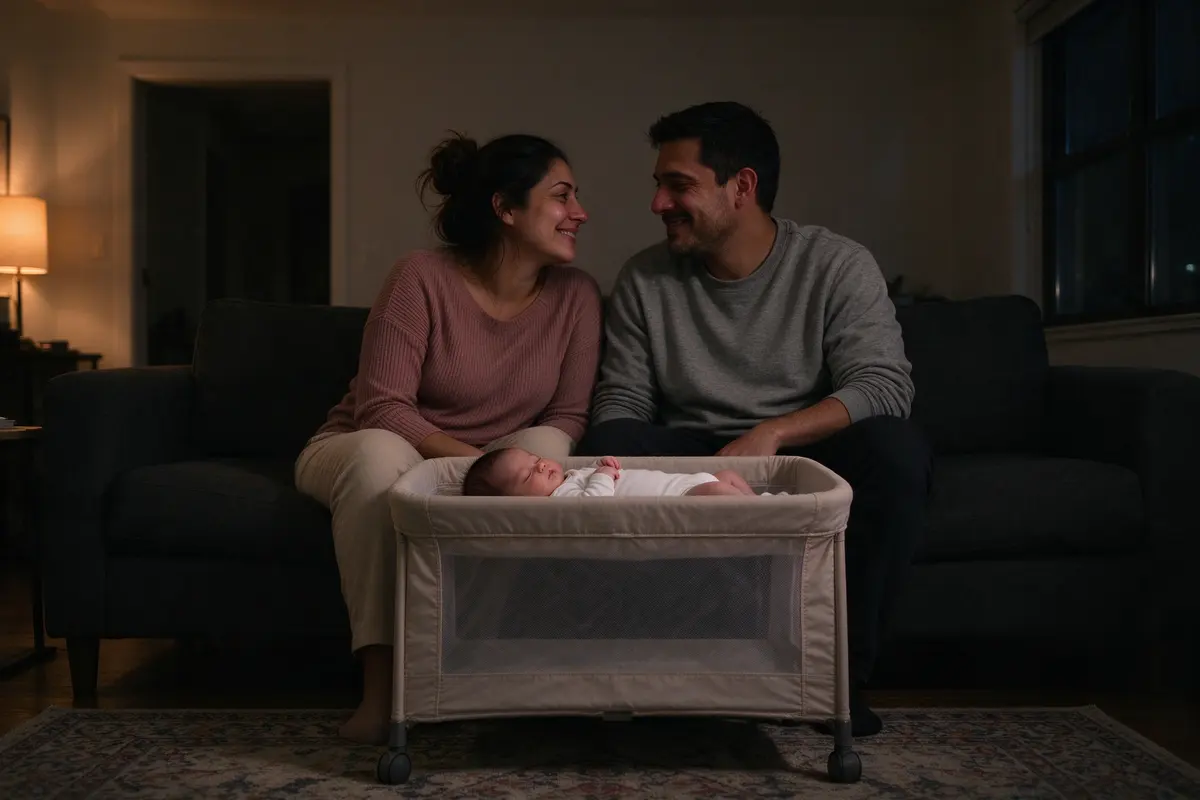
The big smile is for both of you, so look at the other adult's face today too. A meta-analysis of 43 studies found depression in about 10% of fathers around a birth, rising to about 26% at 3 to 6 months after birth (Paulson & Bazemore, 2010); a larger, later one of 74 studies found about 8% and no effect of timing (Cameron et al., 2016). Depression in one parent was moderately linked to depression in the other (Paulson & Bazemore, 2010), so check on each other.
Anyone at home can call or text 988 (NIMH).
If you're the partner: when did she last get the big smile from you? If you can't remember, say something tonight.
Sources
- American Academy of Pediatrics. "Emotional & Social Development: Birth Through 3 Months." HealthyChildren.org, 2026. https://www.healthychildren.org/English/ages-stages/baby/Pages/Emotional-and-Social-Development-Birth-to-3-Months.aspx
- American Academy of Pediatrics. "Developmental Milestones: 1-4 Months Old." HealthyChildren.org, 2026. https://www.healthychildren.org/English/ages-stages/baby/Pages/Developmental-Milestones-3-Months.aspx
- Centers for Disease Control and Prevention. "Milestones by 4 Months." Learn the Signs. Act Early., 2026. https://www.cdc.gov/act-early/milestones/4-months.html
- Centers for Disease Control and Prevention. "Milestones by 6 Months." Learn the Signs. Act Early., 2026. https://www.cdc.gov/act-early/milestones/6-months.html
- Centers for Disease Control and Prevention. "Milestones by 2 Months." Learn the Signs. Act Early., 2026. https://www.cdc.gov/act-early/milestones/2-months.html
- Wusthoff CJ. "Movement Milestones: Birth to 3 Months." HealthyChildren.org, 2020. https://www.healthychildren.org/English/ages-stages/baby/Pages/Movement-Birth-to-Three-Months.aspx
- American Academy of Pediatrics. "Crying Baby - Before 3 Months Old" (symptom checker). HealthyChildren.org, 2026. https://www.healthychildren.org/English/tips-tools/symptom-checker/Pages/symptomviewer.aspx?symptom=Crying+Baby+-+Before+3+Months+Old
- Paulson JF, Bazemore SD. "Prenatal and postpartum depression in fathers and its association with maternal depression: a meta-analysis." JAMA, 2010. https://pubmed.ncbi.nlm.nih.gov/20483973/
- Cameron EE, Sedov ID, Tomfohr-Madsen LM. "Prevalence of paternal depression in pregnancy and the postpartum: An updated meta-analysis." Journal of Affective Disorders, 2016. https://pubmed.ncbi.nlm.nih.gov/27475890/
- National Institute of Mental Health. "Perinatal Depression." 2026. https://www.nimh.nih.gov/health/publications/perinatal-depression
This guide is general education that summarizes published research and guidance from groups like the American Academy of Pediatrics, the CDC, and the WHO. It isn’t medical advice, and every child develops on their own timeline. Your pediatrician knows your child; if something feels wrong, call them. In an emergency, call 911.
Get each day’s note the morning it applies
Add your baby to a free Chorevia household with their date of birth, and every morning for 120 days the day’s note arrives in the app and by email: what’s developing, one thing to try, what to watch for, and a word for you.
Create your household