Day 88 of 120 · Week 12
What's coming
Last reviewed · 4 min read · 16 sources · Plain-text version
Regular sleep cycles arrive around 4 months, and sleep training is next month's question at the earliest. What that means for tonight, and one daytime nap in the crib.

You'll hear a lot about four months soon. Here's what actually changes then, and what doesn't have to.
Heart
Regular sleep cycles don't arrive until about 4 months (AAP), but this is when many babies start stringing together longer night stretches. In a New Zealand study of 75 babies, the biggest gains in self-settled night sleep came between 1 and 4 months, and half were sleeping from midnight to 5 a.m. without needing a parent by about 3 months, yet 11 still weren't at 12 months (Henderson et al., 2010). Long stretches come when they come.
Head
Sleep training is next month's question, at the earliest. The AAP's tips on putting babies down drowsy and not rushing in are for babies 4 months and older (AAP); one children's hospital says pediatricians generally give the okay at 3 or 4 months (Lurie Children's). A well-known trial taught sleep techniques at 8 to 10 months and found no lasting harms or benefits by age 6 (Price et al., 2012). Nothing to decide today; the 3-month guide picks it up.
Body
What doesn't change is safe sleep, and this is the window that matters most: 72% of SIDS deaths happen in months 1 to 4, and more than 90% before 6 months (NICHD). On the back for every sleep, on a firm, flat surface with nothing else in the crib, in your room but not your bed for at least the first 6 months, and sleeping babies moved out of seats, swings, and carriers as soon as you can (Moon, AAP). Keep nights calm and days lively (AAP).
Try today
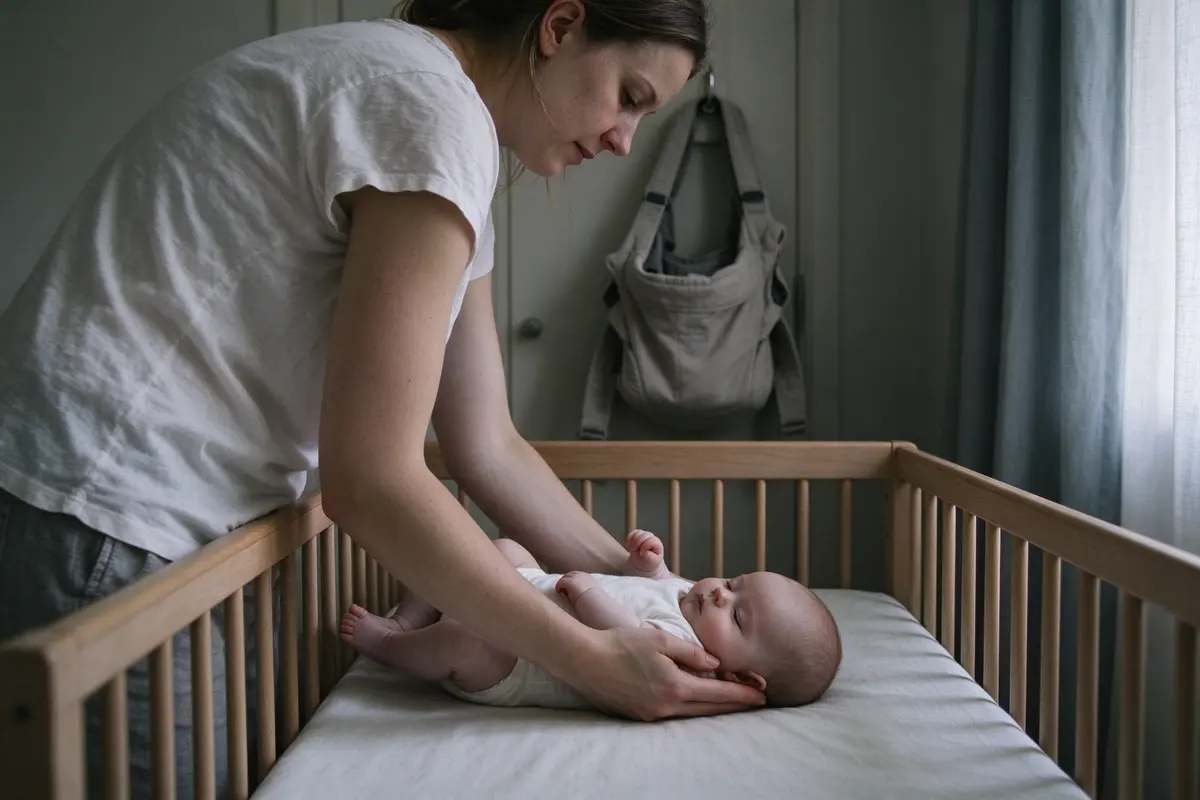
One nap in the crib
Time: One daytime nap · Safety and when to call your pediatrician in the guide
Pick the nap that usually happens in the carrier or your arms, and watch for tired signs: yawning, droopy eyelids, staring into the distance, fussiness (Cleveland Clinic).
Check the crib: a fitted sheet only, no blanket, pillow, toy, or weighted product (Moon, AAP).
Lay your baby on their back, in a sleep sack that doesn't swaddle if you use one (Moon & Glassy, AAP), and step out.
If they cry, go back and settle them the usual way. A nap that ends early in the crib still counts.
Make it work:This isn't a first step toward training; it's practice at a place. The drowsy-but-awake advice is for 4 months and older (AAP).
Watch for
Normal
waking at night and settling again; a good sleeper at this age is one who wakes often but can get back to sleep (AAP).
Call 911
if your baby can't be woken up (AAP).
Normal
fewer middle-of-the-night feeds for formula-fed babies between 2 and 4 months, or once they weigh more than 12 pounds, though this varies a lot (AAP).
Call your pediatrician right away
if your baby drinks very little or nothing for more than 8 hours (AAP).
Normal
a nap that starts in the carrier on a walk; move your baby to a firm, flat surface on their back as soon as you can (Moon, AAP).
Call 911
if breathing becomes a struggle, or you hear new grunting, wheezing, or whistling (Nationwide Children's).
For you

The first evening out, if you want one. Not everyone does yet, and that's fine. If you do: a bottle goes better from someone else; if your baby refuses, another adult may have better luck (CDC), and babies 1 to 6 months old take about 2 to 3 ounces of breast milk per feeding (Office on Women's Health).
Write the sleep rules down for the sitter: on the back, bare crib, no swaddle; babies swaddled for the first time at an older age may have a harder time waking (Moon & Glassy, AAP). Add what calms your baby (AAP). Then go. Two hours is an evening.
If you're the partner: the evening might be for both of you, or for her alone with a friend. Ask which, and make the other one happen next week.
Sources
- American Academy of Pediatrics. "Getting Your Baby to Sleep." HealthyChildren.org, 2024. https://www.healthychildren.org/English/ages-stages/baby/sleep/Pages/getting-your-baby-to-sleep.aspx
- Henderson JM, France KG, Owens JL, Blampied NM. "Sleeping through the night: the consolidation of self-regulated sleep across the first year of life." Pediatrics, 2010. https://pubmed.ncbi.nlm.nih.gov/20974775/
- Freeman I. "How to Sleep Train Your Baby." Lurie Children's Hospital of Chicago, 2022. https://www.luriechildrens.org/en/blog/sleep-training-for-babies/
- Price AMH, Wake M, Ukoumunne OC, Hiscock H. "Five-year follow-up of harms and benefits of behavioral infant sleep intervention: randomized trial." Pediatrics, 2012. https://pubmed.ncbi.nlm.nih.gov/22966034/
- Eunice Kennedy Shriver National Institute of Child Health and Human Development. "Infographic: SIDS by Baby's Age (Text Alternative)." Safe to Sleep, 2026. https://safetosleep.nichd.nih.gov/resources/social-digital/sids-by-babys-age-infographic-text-alternative
- Moon RY. "How to Keep Your Sleeping Baby Safe: AAP Policy Explained." HealthyChildren.org, 2026. https://www.healthychildren.org/English/ages-stages/baby/sleep/Pages/a-parents-guide-to-safe-sleep.aspx
- Cleveland Clinic. "How Can I Tell When My Baby Is Tired?" 2024. https://health.clevelandclinic.org/how-can-i-tell-when-my-baby-is-tired
- Moon RY, Glassy D. "Swaddling: Is it Safe for Your Baby?" HealthyChildren.org, 2022. https://www.healthychildren.org/English/ages-stages/baby/diapers-clothing/Pages/Swaddling-Is-it-Safe.aspx
- American Academy of Pediatrics. "Sleeping Through the Night." HealthyChildren.org, 2013. https://www.healthychildren.org/English/ages-stages/baby/sleep/Pages/Sleeping-Through-the-Night.aspx
- American Academy of Pediatrics. "Immunization Reactions" (symptom checker). HealthyChildren.org, 2026. https://www.healthychildren.org/English/tips-tools/symptom-checker/Pages/symptomviewer.aspx?symptom=Immunization+Reactions
- American Academy of Pediatrics. "Amount and Schedule of Baby Formula Feedings." HealthyChildren.org, 2022. https://www.healthychildren.org/English/ages-stages/baby/formula-feeding/Pages/amount-and-schedule-of-formula-feedings.aspx
- American Academy of Pediatrics. "Crying Baby - Before 3 Months Old" (symptom checker). HealthyChildren.org, 2026. https://www.healthychildren.org/English/tips-tools/symptom-checker/Pages/symptomviewer.aspx?symptom=Crying+Baby+-+Before+3+Months+Old
- Nationwide Children's Hospital. "Newborn Warning Signs." 2023. https://www.nationwidechildrens.org/conditions/health-library/newborn-warning-signs
- Centers for Disease Control and Prevention. "Breastfeeding and Returning to Your Workplace." 2026. https://www.cdc.gov/infant-toddler-nutrition/breastfeeding/returning-to-your-workplace.html
- Office on Women's Health. "Breastfeeding and Going Back to Work." US Department of Health and Human Services, 2025. https://www.womenshealth.gov/breastfeeding/breastfeeding-home-work-and-public/breastfeeding-and-going-back-work
- American Academy of Pediatrics. "Emotional & Social Development: Birth Through 3 Months." HealthyChildren.org, 2026. https://www.healthychildren.org/English/ages-stages/baby/Pages/Emotional-and-Social-Development-Birth-to-3-Months.aspx
This guide is general education that summarizes published research and guidance from groups like the American Academy of Pediatrics, the CDC, and the WHO. It isn’t medical advice, and every child develops on their own timeline. Your pediatrician knows your child; if something feels wrong, call them. In an emergency, call 911.
Get each day’s note the morning it applies
Add your baby to a free Chorevia household with their date of birth, and every morning for 120 days the day’s note arrives in the app and by email: what’s developing, one thing to try, what to watch for, and a word for you.
Create your household