Day 85 of 120 · Week 12
Hot, sharp, and buckled
Last reviewed · 3 min read · 13 sources · Plain-text version
A baby who reaches and grabs changes the kitchen and the car. Hot drinks, bath water, bouncer seats on the floor, and a car-seat harness rechecked against a bigger baby.

Three things that didn't matter much while your baby lay still, and matter now that they reach, grab, and grow.
Heart
Hot first. Scalds are the most common burns in young children (Seattle Children's). Don't hold your baby while you're holding something hot, and keep hot drinks away from table and counter edges (Seattle Children's). Set your water heater so the hottest water at the faucet is no more than 120°F (48.9°C) (AAP). Bath water stays about 2 inches deep and warm, not hot, tested with your wrist or elbow, with one hand on your baby the whole time (AAP).
Head
Sharp, and seats. Now that hands reach the mouth, keep small, sharp, or hot things away (CDC). Use bouncer seats only on the floor, never on a counter, table, bed, or sofa, and always buckle the straps (CPSC). Keep the sitting short: the AAP advises against leaving babies in bouncer seats, where they get less chance to practice using their muscles (AAP), and WHO advises not keeping babies strapped in a seat, stroller, or carrier for more than 1 hour at a time (WHO).
Body
Buckled. Ride rear-facing in the back seat. For rear-facing seats, harness straps go in slots at or below your baby's shoulders, so recheck as your baby grows. The harness should be snug enough that you can't pinch any slack, with the chest clip at armpit level. As the weather cools, skip bulky coats and snowsuits under the straps; tuck a blanket over the buckled harness instead (AAP). From 1 to 4 months, babies typically gain 1.5 to 2 pounds and grow 1 to 1.5 inches a month (AAP), so the slots that fit on the first ride home may not fit now.
Try today
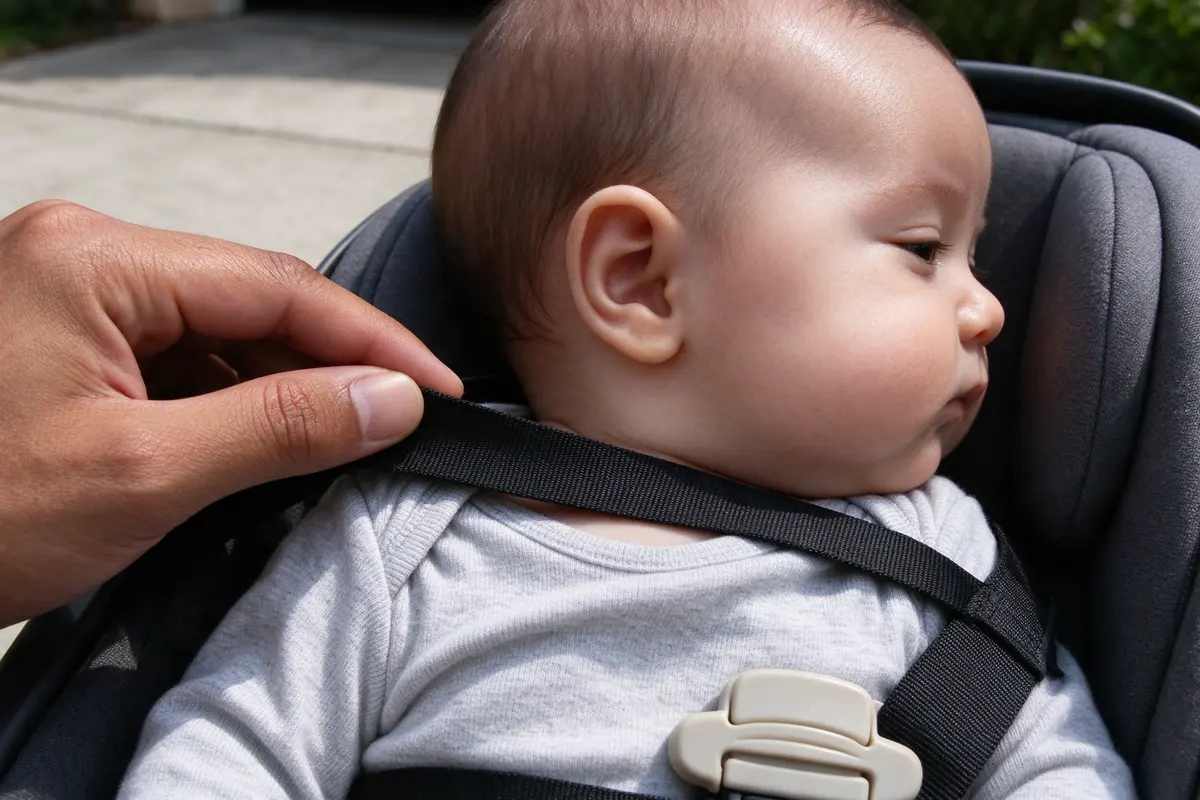
The car-seat fit check
Time: 5 minutes, parked, with the baby in the seat · Safety and when to call your pediatrician in the guide
Buckle your baby in at home: back seat, rear-facing, indoor clothes, no coat (AAP).
Look at the strap slots: for a rear-facing seat they belong at or below the shoulders, so move them if your baby has grown past them (AAP).
Tighten until you can't pinch any slack at the collarbone, and slide the chest clip to armpit level (AAP).
Unbuckle and lift your baby out: car seats are for travel, not for sleeping at home (AAP).
Make it work:On a cold day, buckle first, then tuck a blanket over the harness (AAP).
Watch for
Normal
dozing in the seat during a drive; once home, move your baby to a firm, flat surface on their back (Moon, AAP).
Call 911
for bluish lips or face, or a baby struggling for each breath (AAP).
Normal
a swipe at whatever's on the table; swinging an arm at toys is a 4-month skill on its way (CDC).
Call your pediatrician right away
if your baby looks or acts very sick, or you think they need to be seen urgently (AAP).
Normal
crying through a long drive in the seat.
Call your pediatrician right away
if your baby cries nonstop for more than 2 hours and can't be consoled (AAP).
For you
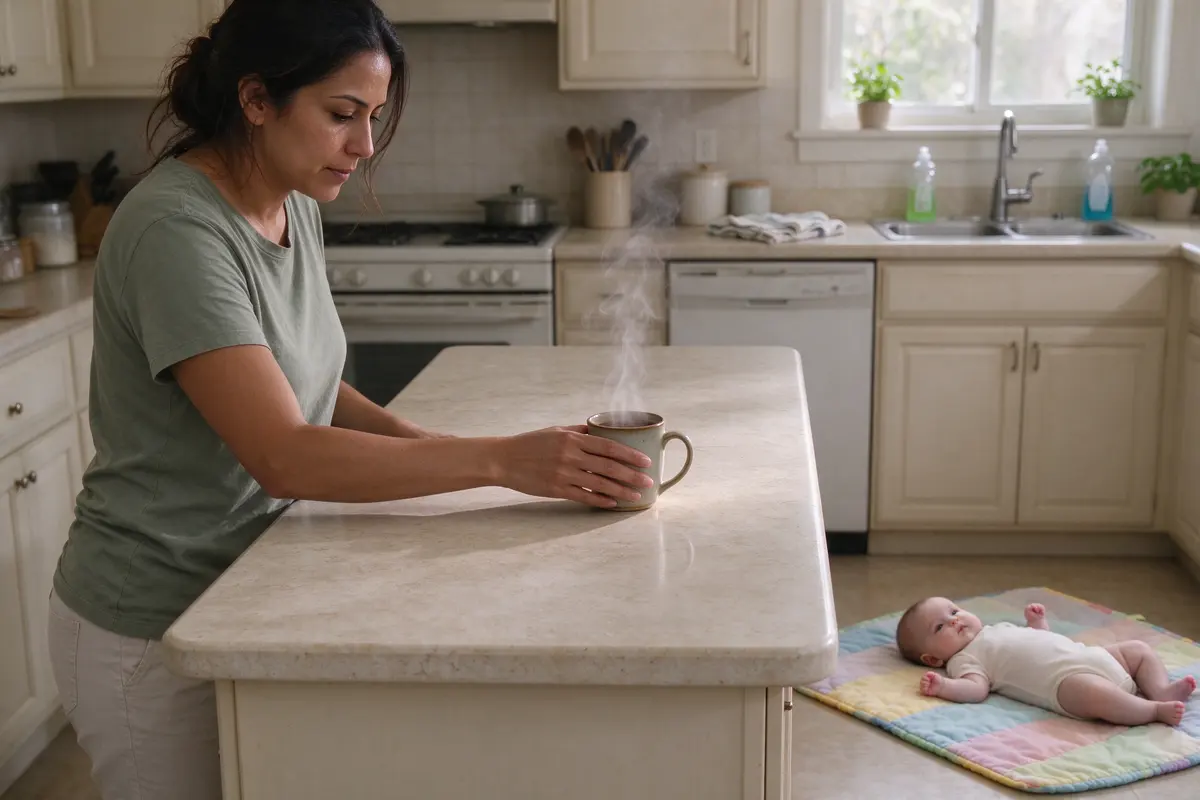
Coffee goes on the far side of the counter. Not because you're careless, but because you're tired, and a hot drink near an edge is how scalds happen (Seattle Children's). Push the mug to the back wall, and drink it sitting down with the baby on the floor, not in your lap.
The tiredness itself deserves a sentence. Overwhelming tiredness is on the CDC's list of urgent maternal warning signs, the kind to tell a provider about, not push through (CDC). If it feels like more than a new parent's tired, say so.
If you're the partner: the car seat is yours today, and the water heater is yours this week.
Sources
- Seattle Children's Hospital. "Preventing Scald Burns." 2026. https://www.seattlechildrens.org/health-safety/injury-prevention/preventing-scald-burns/
- American Academy of Pediatrics. "Checkup Checklist: 2 Months Old." HealthyChildren.org, 2021. https://www.healthychildren.org/English/ages-stages/Your-Childs-Checkups/Pages/Your-Checkup-Checklist-2-Months-Old.aspx
- Navsaria D. "Bathing Your Baby." HealthyChildren.org, 2025. https://www.healthychildren.org/English/ages-stages/baby/bathing-skin-care/Pages/Bathing-Your-Newborn.aspx
- Centers for Disease Control and Prevention. "Milestones by 4 Months." Learn the Signs. Act Early., 2026. https://www.cdc.gov/act-early/milestones/4-months.html
- US Consumer Product Safety Commission. "New Federal Standard to Improve Safety of Infant Bouncer Seats Takes Effect." 2018. https://www.cpsc.gov/Newsroom/News-Releases/2018/New-Federal-Standard-to-Improve-Safety-of-Infant-Bouncer-Seats-Takes-Effect
- Wusthoff CJ. "Movement Milestones: Birth to 3 Months." HealthyChildren.org, 2020. https://www.healthychildren.org/English/ages-stages/baby/Pages/Movement-Birth-to-Three-Months.aspx
- World Health Organization. "To grow up healthy, children need to sit less and play more." 2019. https://www.who.int/news/item/24-04-2019-to-grow-up-healthy-children-need-to-sit-less-and-play-more
- American Academy of Pediatrics. "Car Seats: Information for Families." HealthyChildren.org, 2026. https://www.healthychildren.org/English/safety-prevention/on-the-go/Pages/Car-Safety-Seats-Information-for-Families.aspx
- American Academy of Pediatrics. "Your Baby's Growth & Physical Development: 1 to 4 Months Old." HealthyChildren.org, 2026. https://www.healthychildren.org/English/ages-stages/baby/Pages/Physical-Appearance-and-Growth-1-To-3-Months.aspx
- Moon RY. "How to Keep Your Sleeping Baby Safe: AAP Policy Explained." HealthyChildren.org, 2026. https://www.healthychildren.org/English/ages-stages/baby/sleep/Pages/a-parents-guide-to-safe-sleep.aspx
- American Academy of Pediatrics. "Breathing Trouble" (symptom checker). HealthyChildren.org, 2026. https://www.healthychildren.org/English/tips-tools/symptom-checker/Pages/symptomviewer.aspx?symptom=Breathing+Trouble
- American Academy of Pediatrics. "Crying Baby - Before 3 Months Old" (symptom checker). HealthyChildren.org, 2026. https://www.healthychildren.org/English/tips-tools/symptom-checker/Pages/symptomviewer.aspx?symptom=Crying+Baby+-+Before+3+Months+Old
- Centers for Disease Control and Prevention. "Urgent Maternal Warning Signs and Symptoms." HEAR HER. https://www.cdc.gov/hearher/maternal-warning-signs/index.html
This guide is general education that summarizes published research and guidance from groups like the American Academy of Pediatrics, the CDC, and the WHO. It isn’t medical advice, and every child develops on their own timeline. Your pediatrician knows your child; if something feels wrong, call them. In an emergency, call 911.
Get each day’s note the morning it applies
Add your baby to a free Chorevia household with their date of birth, and every morning for 120 days the day’s note arrives in the app and by email: what’s developing, one thing to try, what to watch for, and a word for you.
Create your household