Day 79 of 120 · Week 11
Floor over seats
Last reviewed · 3 min read · 13 sources · Plain-text version
Why the floor beats the bouncer this month, the one-hour limit on strapped-in time, what a big review found about tummy time, and a circle of toys to lie down inside.
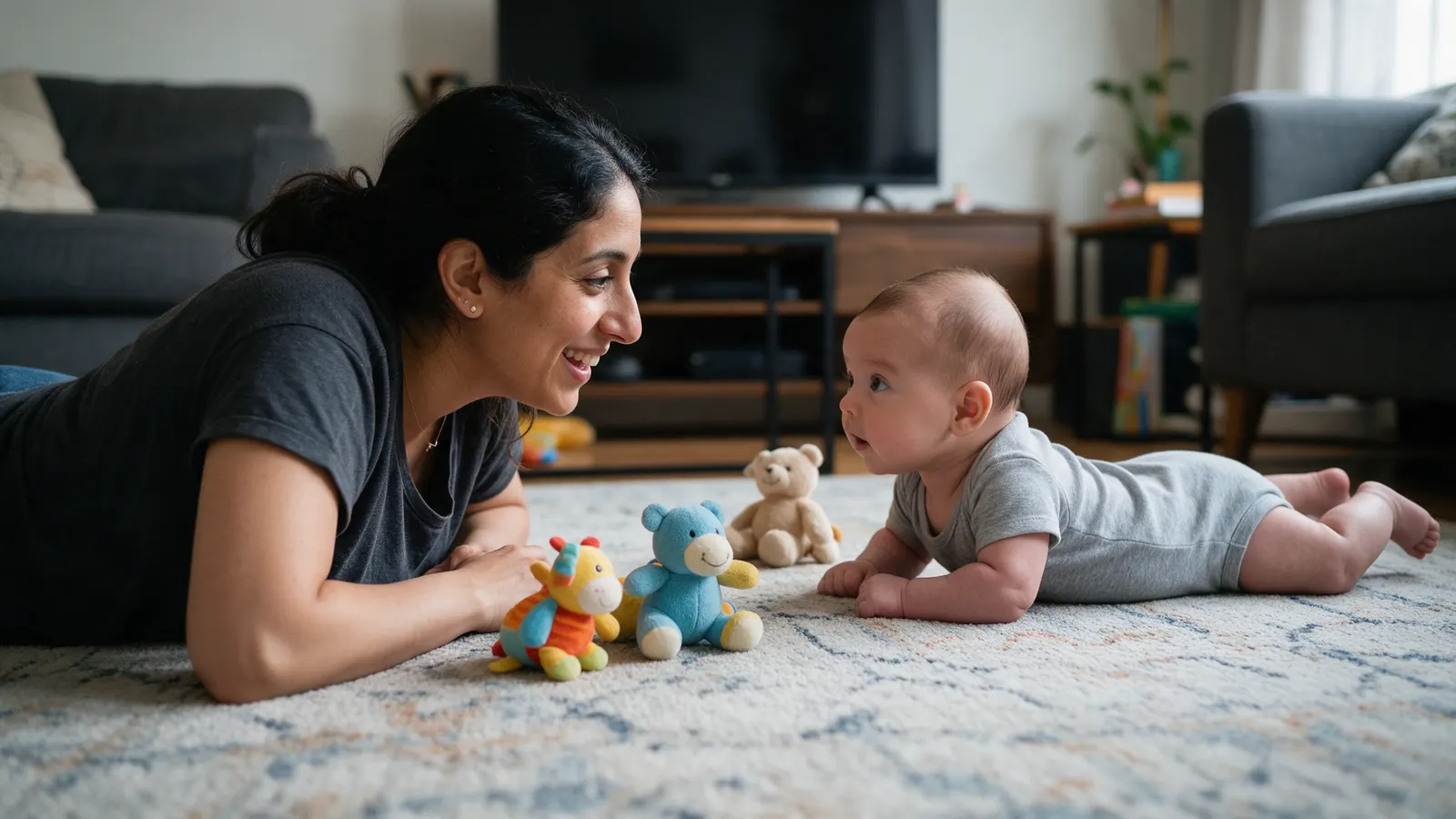
Seats, swings, and bouncers all have a job. The job is short, and the floor does the rest.
Heart
WHO advises interactive floor play several times a day, and not keeping babies strapped in a stroller, seat, or carrier for more than 1 hour at a time (WHO). The AAP advises against leaving babies in bouncer seats, where they get less chance to practice using their muscles (AAP). At this age, the floor is where the pushing up, the swiping, and the first rolling attempts happen, and none of them can happen in a seat.
Head
The evidence for the floor. A systematic review of 16 mostly observational studies, 4,237 babies, linked tummy time to better gross motor development and less flattening across the back of the head (Hewitt et al., 2020). Flattening most often develops in the first 4 to 12 weeks, which is why the AAP says to limit time in car seats, bouncers, and swings (AAP). And reaching: in small studies, a couple of weeks of daily reaching practice helped young babies make more contact with toys (Williams et al., 2015). Repeated chances at real toys seem to matter more than any gadget.
Body
The AAP's tummy time tips: time it right after a diaper change or nap, with your face or toys in a circle around your baby to reach toward (AAP). If your baby protests, try your chest, your lap, or side-lying with a rolled towel behind their back, and change positions every 10 to 15 minutes (AAP). WHO's target is at least 30 minutes a day, spread out, while awake (WHO). When a seat is in use, it's on the floor, never a counter, table, bed, or sofa, with the straps buckled (CPSC).
Try today
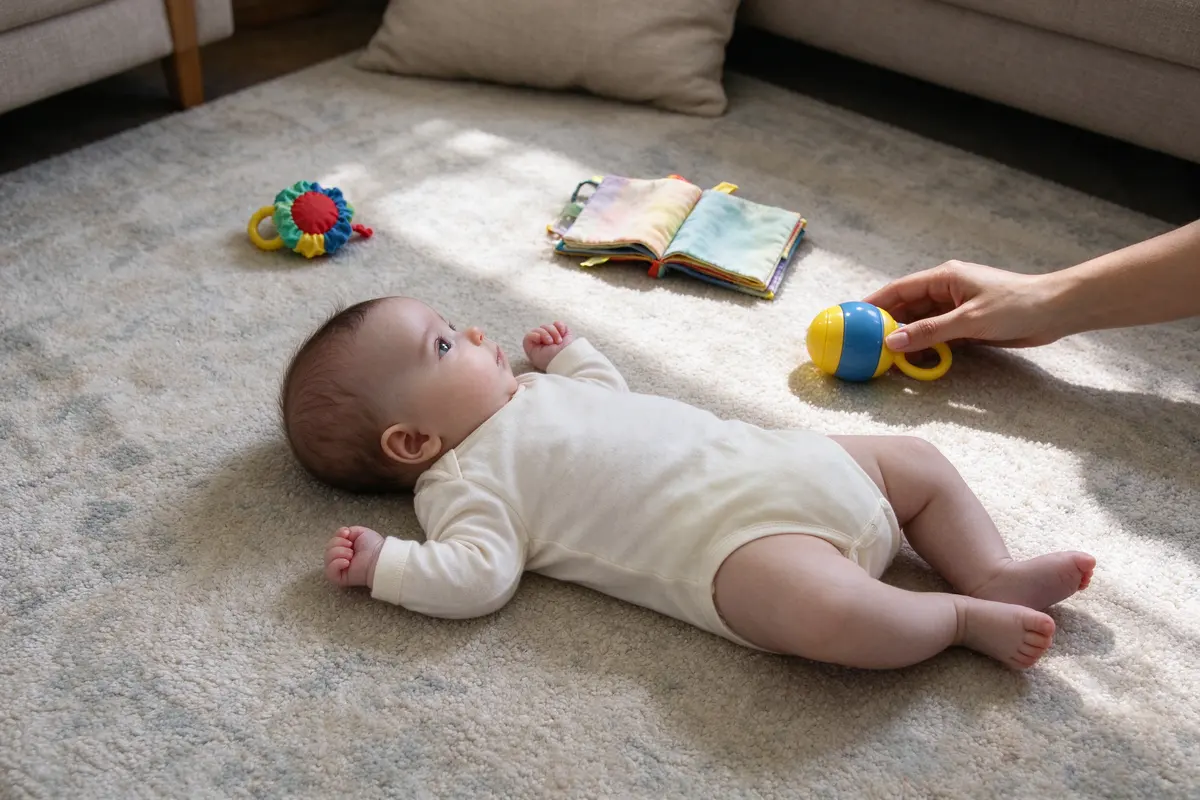
The toy circle
Time: 5 to 10 minutes, after a diaper change · Tummy time at 2 to 3 months in the guide
Lay your baby tummy-down on a blanket on the floor, elbows tucked under their shoulders.
Set three or four safe toys in a half circle just beyond their hands, at eye level, so there's something to reach toward (AAP).
Lie down inside the circle yourself, face to face.
Nudge whichever toy they're staring at a little to one side, then the other, so the head turns both ways.
Make it work:Stay with your baby the whole time, and if they fall asleep, move them to their back in their own sleep space (AAP).
Watch for
Normal
protests a few minutes in; switch to your chest or lap and the time still counts (AAP).
Bring it up with your pediatrician, don't wait,
if your baby can't hold their head up on their tummy (CDC).
Normal
a doze that starts in the bouncer; move them to their back on a firm, flat surface as soon as you can (Moon, AAP).
Call 911
if your baby is struggling for each breath or has bluish lips or face (AAP).
Normal
a mild flat patch you're working on with floor time (AAP).
Bring it up
if your baby always tilts their head one way (AAP).
For you

The swing is for your shower, not the afternoon. Ten minutes of awake, buckled, on-the-floor bouncer time while you wash your hair is exactly what it's for; the one-hour limit is WHO's, and it's generous (WHO). What it isn't for is sleep: if your baby dozes off in it, the nap finishes on their back on a firm, flat surface (Moon, AAP).
The floor is yours too. Lying beside the baby is rest with your eyes open, and getting down and up by bending at the knees rather than the waist is the AAP's rule for carrying (AAP); it works for the floor as well.
If you're the partner: floor sessions in the evening are yours. Your face in the circle works as well as hers.
Sources
- World Health Organization. "To grow up healthy, children need to sit less and play more." 2019. https://www.who.int/news/item/24-04-2019-to-grow-up-healthy-children-need-to-sit-less-and-play-more
- Wusthoff CJ. "Movement Milestones: Birth to 3 Months." HealthyChildren.org, updated 2020. https://www.healthychildren.org/English/ages-stages/baby/Pages/Movement-Birth-to-Three-Months.aspx
- Hewitt L, Kerr E, Stanley RM, Okely AD. "Tummy Time and Infant Health Outcomes: A Systematic Review." Pediatrics, 2020. https://pubmed.ncbi.nlm.nih.gov/32371428/
- American Academy of Pediatrics. "When a Baby's Head is Misshapen: Positional Skull Deformities." HealthyChildren.org, updated 2022. https://www.healthychildren.org/English/health-issues/conditions/Cleft-Craniofacial/Pages/Positional-Skull-Deformities-and-Torticollis.aspx
- Williams JL, Corbetta D, Guan Y. "Learning to reach with 'sticky' or 'non-sticky' mittens: a tale of developmental trajectories." Infant Behavior and Development, 2015. https://pubmed.ncbi.nlm.nih.gov/25636028/
- American Academy of Pediatrics. "Back to Sleep, Tummy to Play: Give Your Baby a Safe, Strong Start." HealthyChildren.org, updated 2026. https://www.healthychildren.org/English/ages-stages/baby/sleep/Pages/back-to-sleep-tummy-to-play.aspx
- American Academy of Pediatrics. "3 Tummy Time Activities to Try With Your Baby." HealthyChildren.org, updated 2023. https://www.healthychildren.org/English/ages-stages/baby/sleep/Pages/The-Importance-of-Tummy-Time.aspx
- US Consumer Product Safety Commission. "New Federal Standard to Improve Safety of Infant Bouncer Seats Takes Effect." 2018. https://www.cpsc.gov/Newsroom/News-Releases/2018/New-Federal-Standard-to-Improve-Safety-of-Infant-Bouncer-Seats-Takes-Effect
- Centers for Disease Control and Prevention. "Milestones by 2 Months." Learn the Signs. Act Early., updated 2026. https://www.cdc.gov/act-early/milestones/2-months.html
- Moon RY. "How to Keep Your Sleeping Baby Safe: AAP Policy Explained." HealthyChildren.org, updated 2026. https://www.healthychildren.org/English/ages-stages/baby/sleep/Pages/a-parents-guide-to-safe-sleep.aspx
- American Academy of Pediatrics. "Breathing Trouble" (symptom checker). HealthyChildren.org, accessed 2026. https://www.healthychildren.org/English/tips-tools/symptom-checker/Pages/symptomviewer.aspx?symptom=Breathing+Trouble
- American Academy of Pediatrics. "Head Tilt (Torticollis)." HealthyChildren.org, updated 2020. https://www.healthychildren.org/English/health-issues/conditions/Cleft-Craniofacial/Pages/Head-Tilt.aspx
- American Academy of Pediatrics. "Baby Carriers: Backpacks, Front Packs, and Slings." HealthyChildren.org. https://www.healthychildren.org/English/safety-prevention/on-the-go/Pages/Baby-Carriers.aspx
This guide is general education that summarizes published research and guidance from groups like the American Academy of Pediatrics, the CDC, and the WHO. It isn’t medical advice, and every child develops on their own timeline. Your pediatrician knows your child; if something feels wrong, call them. In an emergency, call 911.
Get each day’s note the morning it applies
Add your baby to a free Chorevia household with their date of birth, and every morning for 120 days the day’s note arrives in the app and by email: what’s developing, one thing to try, what to watch for, and a word for you.
Create your household