Day 61 of 120 · Week 9
Month three
Last reviewed · 3 min read · 10 sources · Plain-text version
The 4-month list is the road ahead, not today's test. Which newborn reflexes fade when, the first hints of personality, and forearm push-ups on the floor.

The shots are behind you. Month three begins with a baby who is starting to act on purpose, and a list that describes the months ahead rather than today.
Heart
Something new is showing up: a preference, a mood, a way of looking at you that is all this baby's. The AAP describes this stretch as one where newborn reflexes fade, babies stare at their hands, and personality starts to show (AAP).
Head
The next milestone list is the 4-month one. It names skills at least 75% of babies show by that age, so it describes the road ahead, not what your baby must do today (Zubler et al., 2022). By 4 months, most babies smile on their own to get your attention, coo, hold their head steady, and push up onto forearms on their tummy (CDC). Born early? Use corrected age for milestones during the first 2 years (AAP).
Body
The reflexes you watched in the first weeks are on their way out, each on its own schedule. The startle (Moro) and stepping reflexes usually fade around 2 months, rooting around 4 months, the palm grasp at 5 to 6 months, and the "fencing" tonic neck reflex at 5 to 7 months (AAP).
Try today

Forearm push-up tummy time
Time: 3 to 10 minutes, several times a day · Forearm push-up tummy time in the guide
Lay your baby tummy-down on a firm, flat surface with elbows tucked under their shoulders.
Get down at eye level and talk, or set a toy just in front of them.
Slowly move the toy up a little so they lift their chest to follow it.
Watch for
Normal
a startle that's weaker than it was a month ago.
Tell your pediatrician
if a reflex seems different on one side, or if your baby moves one side of the body better than the other (AAP).
Normal
fussiness and a sore leg in the day or two after the shots.
Call your pediatrician right away
for any fever before 12 weeks, even after vaccines, and don't give fever medicine before your baby is seen (AAP).
Normal
a baby who hasn't started on the 4-month list.
For you
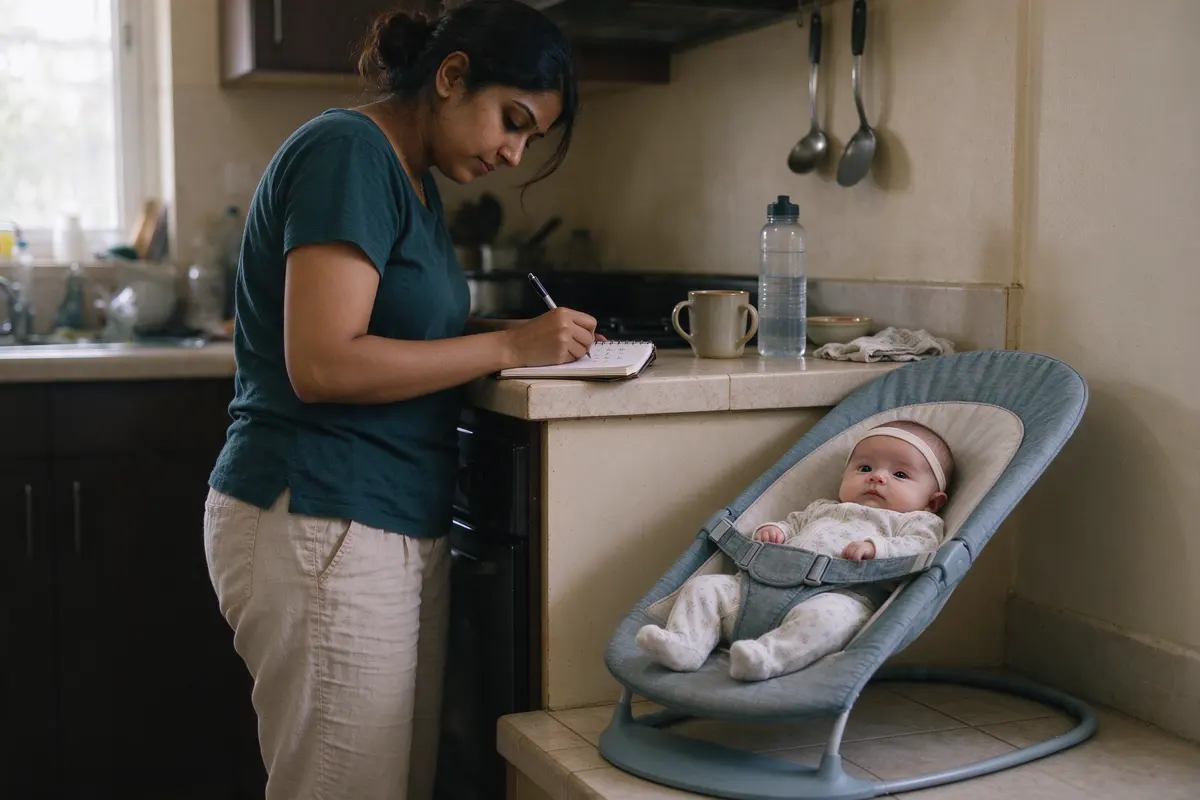
A new month, the same rules for your own body. The CDC's urgent maternal warning signs still apply: a headache that won't go away or gets worse, changes in vision, a fever of 100.4°F or higher, chest pain or a fast-beating heart, trouble breathing, heavy bleeding, extreme swelling of your hands or face, thoughts about harming yourself or your baby, and overwhelming tiredness. Seek care immediately for any of them, and tell any provider that you were pregnant within the last year (CDC).
Their own line says the rest: "If you feel like something just isn't right, or you aren't sure if it's serious, talk to your health care provider" (CDC).
If you're the partner: read that list once, today.
Sources
- American Academy of Pediatrics. "Developmental Milestones: 1-4 Months Old." HealthyChildren.org, 2026. https://www.healthychildren.org/English/ages-stages/baby/Pages/Developmental-Milestones-3-Months.aspx
- Zubler JM, Wiggins LD, Macias MM, et al. "Evidence-Informed Milestones for Developmental Surveillance Tools." Pediatrics, 2022. https://pubmed.ncbi.nlm.nih.gov/35132439/
- Centers for Disease Control and Prevention. "Milestones by 4 Months." Learn the Signs. Act Early., 2026. https://www.cdc.gov/act-early/milestones/4-months.html
- American Academy of Pediatrics. "Corrected Age For Preemies." HealthyChildren.org, 2026. https://www.healthychildren.org/English/ages-stages/baby/preemie/Pages/Corrected-Age-For-Preemies.aspx
- American Academy of Pediatrics. "Newborn Reflexes." HealthyChildren.org, 2022. https://www.healthychildren.org/English/ages-stages/baby/Pages/newborn-reflexes.aspx
- World Health Organization. "To grow up healthy, children need to sit less and play more." 2019. https://www.who.int/news/item/24-04-2019-to-grow-up-healthy-children-need-to-sit-less-and-play-more
- American Academy of Pediatrics. "Immunization Reactions" (symptom checker). HealthyChildren.org, 2026. https://www.healthychildren.org/English/tips-tools/symptom-checker/Pages/symptomviewer.aspx?symptom=Immunization+Reactions
- Centers for Disease Control and Prevention. "Milestones by 2 Months." Learn the Signs. Act Early., 2026. https://www.cdc.gov/act-early/milestones/2-months.html
- Centers for Disease Control and Prevention. "Concerned About Your Child's Development?" 2026. https://www.cdc.gov/act-early/families/concerned.html
- Centers for Disease Control and Prevention. "Urgent Maternal Warning Signs and Symptoms." HEAR HER. https://www.cdc.gov/hearher/maternal-warning-signs/index.html
This guide is general education that summarizes published research and guidance from groups like the American Academy of Pediatrics, the CDC, and the WHO. It isn’t medical advice, and every child develops on their own timeline. Your pediatrician knows your child; if something feels wrong, call them. In an emergency, call 911.
Get each day’s note the morning it applies
Add your baby to a free Chorevia household with their date of birth, and every morning for 120 days the day’s note arrives in the app and by email: what’s developing, one thing to try, what to watch for, and a word for you.
Create your household