Day 67 of 120 · Week 9
Nine weeks
Last reviewed · 3 min read · 11 sources · Plain-text version
What a good sleeper is at nine weeks, how wide the normal range for sleeping through is, why night feeds shift rather than vanish, and the whispered night feed.

Nine weeks. Someone has probably asked whether the baby is "a good sleeper" yet. Today redefines the term.
Heart
At this age, a good sleeper is a baby who wakes often but can get back to sleep, not one who sleeps 10 hours straight (AAP). By that measure, the baby who stirs at 2 a.m., feeds, and drifts off again is doing well. Regular sleep cycles don't arrive until about 4 months (AAP); nobody's baby is behind.
Head
In a New Zealand study of 75 babies, half were sleeping from midnight to 5 a.m., or 8 hours, without needing a parent by about 3 months, yet 11 still weren't at 12 months; the biggest gains in self-settled night sleep came between 1 and 4 months (Henderson et al., 2010). So the longer stretch may be arriving, or not yet, and either way the baby is fine.
Body
Night feeds shift; they don't vanish. Most formula-fed babies stop needing a middle-of-the-night feed between 2 and 4 months, though this varies a lot (AAP). For breastfed babies, night feeds are common and an important share of the day's milk (Kent et al., 2006). Two rules: never put your baby to bed with a bottle (AAP), and offer a pacifier for sleep if your baby takes one; it lowers SIDS risk (Moon, AAP).
Try today
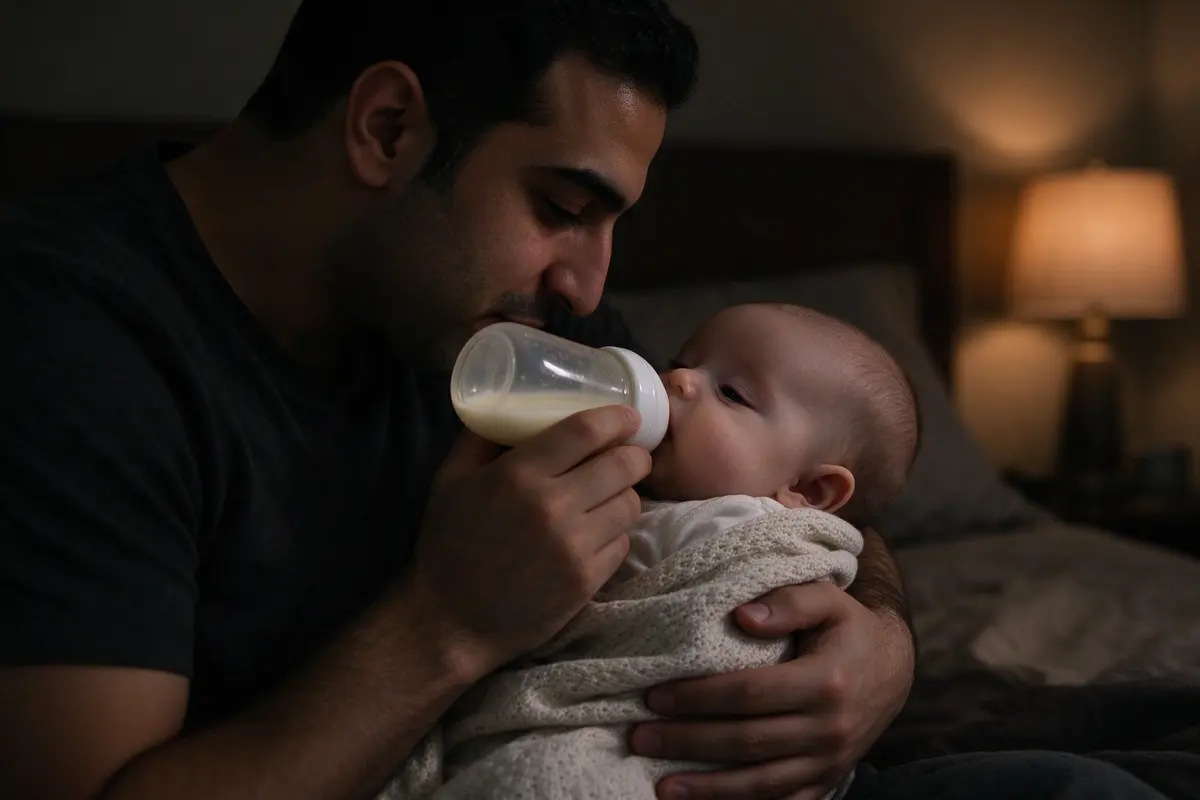
The whispered night feed
Time: The next night feed · Nights: what's realistic in the guide
Keep the light low and voices lower: quiet feeds and changes at night, play by day (AAP).
Feed, change only if needed, nothing beyond a murmur.
Back down on their back in the bare crib, pacifier if they take one (Moon, AAP).
Leave. A stir isn't a wake.
Make it work:This isn't sleep training; the AAP's drowsy-but-awake and don't-rush-in tips are for babies 4 months and older (AAP).
Watch for
- Normal: two or three wakings a night at nine weeks (Henderson et al., 2010). Call 911 if you can't wake your baby enough to feed (Nationwide Children's).
- Normal: one long stretch, then short ones again the next night. Call your pediatrician right away if your baby has had no wet diaper in more than 8 hours (AAP).
- Normal: a warm head after a feed. Sweating, a hot chest, or flushed skin means too warm; one more layer than you're wearing (Moon, AAP). This is the highest-risk window: 72% of SIDS deaths happen in months 1 to 4 (NICHD), so every sleep stays on the back in the bare crib (Moon, AAP).
For you
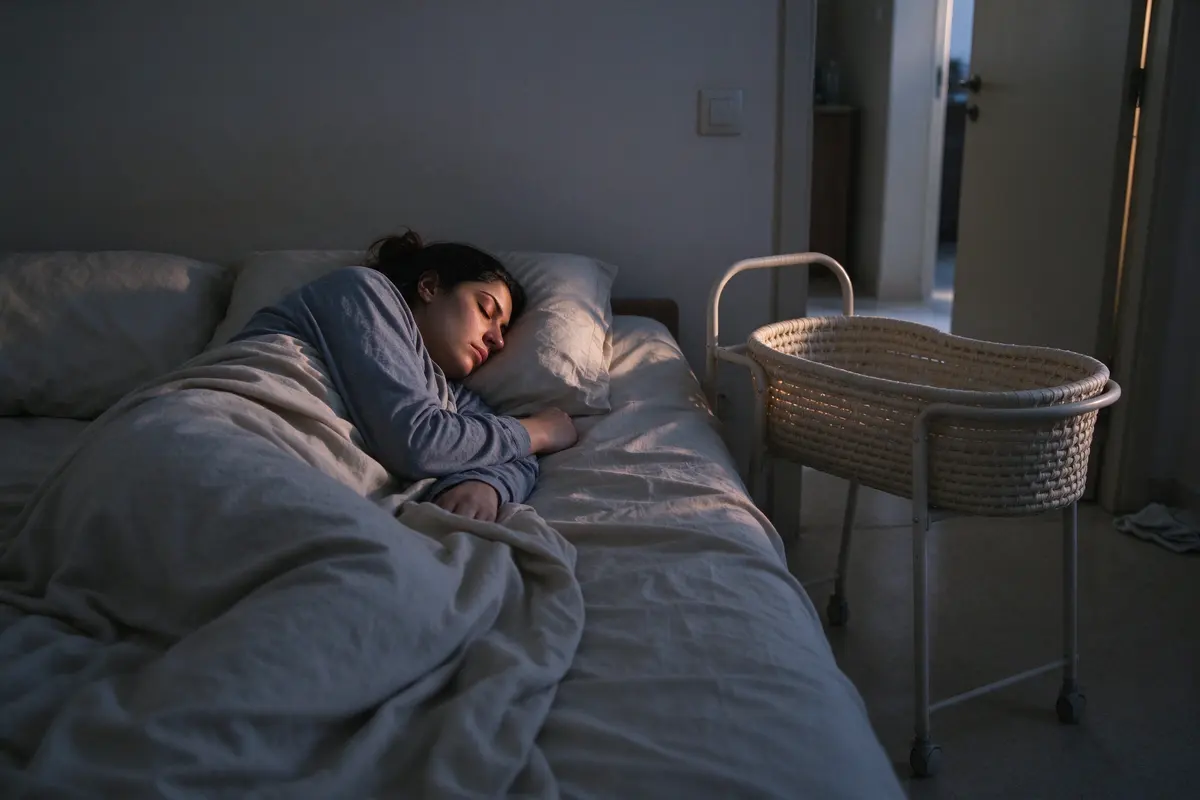
The protected stretch, month three version. If the baby gives you a longer run of sleep, take it as yours, not as time to catch up on the house. Split the night so one adult is on and the other off; if the night feed is a bottle, the other adult can whisper it. Avoid feeding on a couch or armchair, and if you doze off while feeding, put your baby on their back in their own space as soon as you wake (AAP).
Overwhelming tiredness is on the CDC's list of urgent maternal warning signs (CDC). Nine weeks of broken nights is tiring; something more than that is a call.
If you're the partner: the first half of tonight is yours. Whisper.
Sources
- American Academy of Pediatrics. "Sleeping Through the Night." HealthyChildren.org, 2013. https://www.healthychildren.org/English/ages-stages/baby/sleep/Pages/Sleeping-Through-the-Night.aspx
- American Academy of Pediatrics. "Getting Your Baby to Sleep." HealthyChildren.org, 2024. https://www.healthychildren.org/English/ages-stages/baby/sleep/Pages/getting-your-baby-to-sleep.aspx
- Henderson JM, France KG, Owens JL, Blampied NM. "Sleeping through the night: the consolidation of self-regulated sleep across the first year of life." Pediatrics, 2010. https://pubmed.ncbi.nlm.nih.gov/20974775/
- American Academy of Pediatrics. "Amount and Schedule of Baby Formula Feedings." HealthyChildren.org, 2022. https://www.healthychildren.org/English/ages-stages/baby/formula-feeding/Pages/amount-and-schedule-of-formula-feedings.aspx
- Kent JC, Mitoulas LR, Cregan MD, et al. "Volume and frequency of breastfeedings and fat content of breast milk throughout the day." Pediatrics, 2006. https://pubmed.ncbi.nlm.nih.gov/16510619/
- Moon RY. "How to Keep Your Sleeping Baby Safe: AAP Policy Explained." HealthyChildren.org, 2026. https://www.healthychildren.org/English/ages-stages/baby/sleep/Pages/a-parents-guide-to-safe-sleep.aspx
- Nationwide Children's Hospital. "Newborn Warning Signs." 2023. https://www.nationwidechildrens.org/conditions/health-library/newborn-warning-signs
- American Academy of Pediatrics. "Vomiting Without Diarrhea" (symptom checker). HealthyChildren.org, 2026. https://www.healthychildren.org/English/tips-tools/symptom-checker/Pages/symptomviewer.aspx?symptom=Vomiting+Without+Diarrhea
- Eunice Kennedy Shriver National Institute of Child Health and Human Development. "Infographic: SIDS by Baby's Age (Text Alternative)." Safe to Sleep, 2026. https://safetosleep.nichd.nih.gov/resources/social-digital/sids-by-babys-age-infographic-text-alternative
- Moon RY. "Safe Sleep Tips for Sleep-Deprived New Parents." HealthyChildren.org, 2026. https://www.healthychildren.org/English/ages-stages/baby/sleep/Pages/safe-sleep-tips-for-sleep-deprived-parents.aspx
- Centers for Disease Control and Prevention. "Urgent Maternal Warning Signs and Symptoms." HEAR HER. https://www.cdc.gov/hearher/maternal-warning-signs/index.html
This guide is general education that summarizes published research and guidance from groups like the American Academy of Pediatrics, the CDC, and the WHO. It isn’t medical advice, and every child develops on their own timeline. Your pediatrician knows your child; if something feels wrong, call them. In an emergency, call 911.
Get each day’s note the morning it applies
Add your baby to a free Chorevia household with their date of birth, and every morning for 120 days the day’s note arrives in the app and by email: what’s developing, one thing to try, what to watch for, and a word for you.
Create your household