Day 84 of 120 · Week 12
Both of you
Last reviewed · 3 min read · 14 sources · Plain-text version
Partners get postpartum depression too, and scary thoughts are common in new mothers. What's typical, what means help today, and one song you both sing.

Today's note is for whoever isn't the mother as much as it is for her. Read it together if you can.
Heart
Partners count. A meta-analysis of 43 studies found depression in about 10% of fathers around a birth, rising to about 26% at 3 to 6 months after birth (Paulson & Bazemore, 2010); a larger, later one of 74 studies found about 8% and no effect of timing (Cameron et al., 2016). Either way, it's common. Depression in one parent was moderately linked to depression in the other (Paulson & Bazemore, 2010), so check on each other, out loud, today.
Head
Scary thoughts are common too. In a study of 100 new mothers, all reported unwanted thoughts of their baby being accidentally harmed, and nearly half had unwanted thoughts of harming the baby on purpose, more often with high stress and little support. The study found little link between these thoughts and aggressive parenting (Fairbrother & Woody, 2008). A thought that horrifies you is not a plan. If such thoughts feel like urges, or you're afraid you might act on them, get help today. Seeing or hearing things that aren't there, or feeling confused or out of touch with reality, can signal postpartum psychosis, an emergency: call 911 (NIMH).
Body
Treatment works, for either of you. Postpartum depression usually doesn't improve without treatment but does respond to therapy, medication, or both; zuranolone is the first FDA-approved pill specifically for it (NIMH). Your pediatrician should ask how you're doing at the 4-month visit (Earls et al., 2019), and the partner can answer too. Help now: call or text the National Maternal Mental Health Hotline at 1-833-TLC-MAMA (1-833-852-6262), or call or text 988 (CDC).
Try today
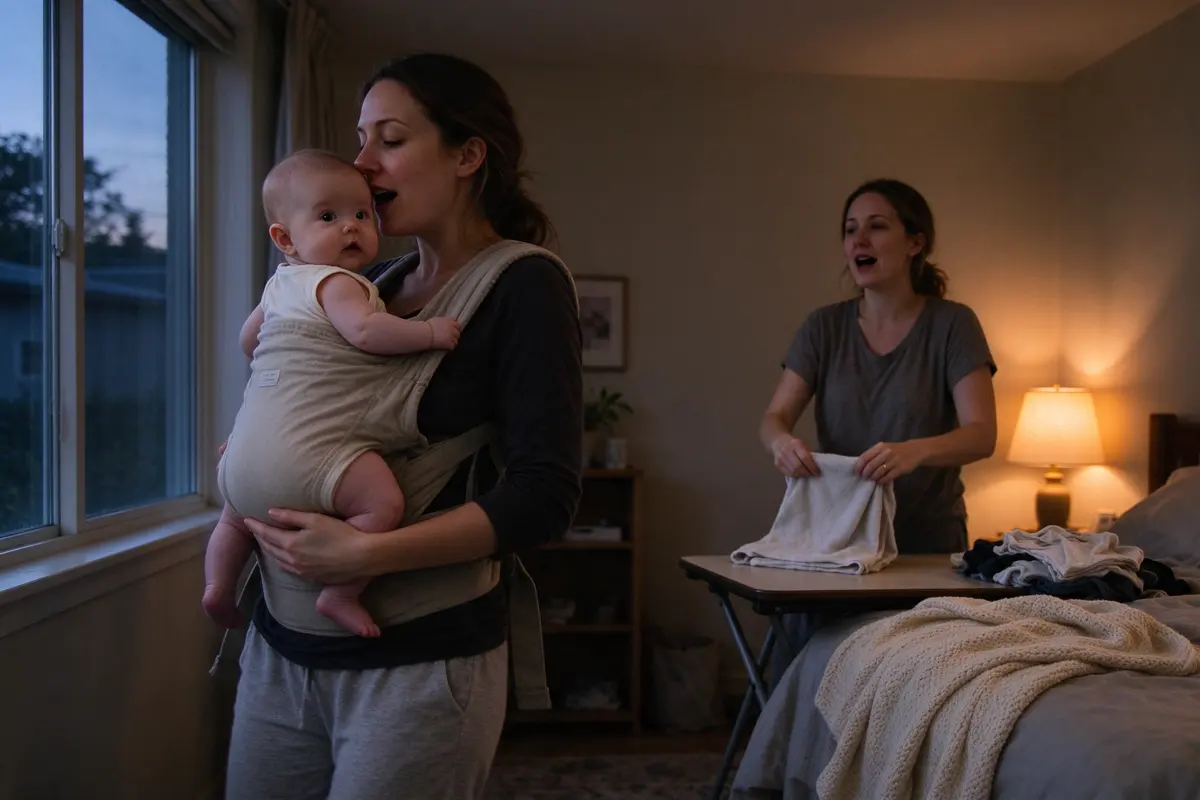
Both parents, one song
Time: One song, a few times today · Parenting techniques in the guide
Pick one song you can both stand, and agree on it out loud.
Each of you sings it to the baby at least once today: at a change, a cuddle, the start of the wind-down.
Hold them with the head supported and sway in rhythm; keep movement smooth and gentle, and never shake a baby (AAP).
Keep the same song all week, so it becomes a cue from either of you.
Make it work:Singing is on the AAP's list of ways to soothe a crying baby (AAP); one non-randomized study of about 170 mothers linked singing lullabies to stronger bonding at 3 months (Persico et al., 2017). Whether a shared song does more hasn't been studied.
Watch for
Normal
a hard evening, even now.
Normal
night waking; a good sleeper at this age is one who wakes but can get back to sleep (AAP).
Call 911
if your baby can't be woken up (AAP).
Normal
a baby who calms when sung to, rocked, or walked (AAP).
Call your pediatrician right away
if your baby cries when touched or moved (AAP).
For you

For the mother: thoughts about harming yourself or your baby are on the CDC's list of urgent maternal warning signs, and the answer is to seek care immediately (CDC). Sadness that has lasted more than two weeks means go to the doctor, not wait (OWH). Nothing you tell them will surprise them.
If you're the partner: this day is yours as much as hers. The question is "How are you, really?", asked of you, by her, tonight. Answer it with more than one word. Anyone can call or text 988 (NIMH); the line doesn't check who gave birth.
Sources
- Paulson JF, Bazemore SD. "Prenatal and postpartum depression in fathers and its association with maternal depression: a meta-analysis." JAMA, 2010. https://pubmed.ncbi.nlm.nih.gov/20483973/
- Cameron EE, Sedov ID, Tomfohr-Madsen LM. "Prevalence of paternal depression in pregnancy and the postpartum: An updated meta-analysis." Journal of Affective Disorders, 2016. https://pubmed.ncbi.nlm.nih.gov/27475890/
- Fairbrother N, Woody SR. "New mothers' thoughts of harm related to the newborn." Archives of Women's Mental Health, 2008. https://pubmed.ncbi.nlm.nih.gov/18463941/
- National Institute of Mental Health. "Perinatal Depression." 2026. https://www.nimh.nih.gov/health/publications/perinatal-depression
- Earls MF, Yogman MW, Mattson G, Rafferty J; AAP Committee on Psychosocial Aspects of Child and Family Health. "Incorporating Recognition and Management of Perinatal Depression Into Pediatric Practice." Pediatrics, 2019. https://pubmed.ncbi.nlm.nih.gov/30559120/
- Centers for Disease Control and Prevention. "Symptoms of Depression Among Women." 2024. https://www.cdc.gov/reproductive-health/depression/index.html
- American Academy of Pediatrics. "Shaken Baby Syndrome: Protect Your Infant from Abusive Head Trauma." HealthyChildren.org, 2025. https://www.healthychildren.org/English/safety-prevention/at-home/Pages/Abusive-Head-Trauma-Shaken-Baby-Syndrome.aspx
- American Academy of Pediatrics. "Responding to Your Baby's Cries." HealthyChildren.org, 2025. https://www.healthychildren.org/English/ages-stages/baby/crying-colic/Pages/Responding-to-Your-Babys-Cries.aspx
- Persico G, Antolini L, Vergani P, et al. "Maternal singing of lullabies during pregnancy and after birth: Effects on mother-infant bonding and on newborns' behaviour. Concurrent Cohort Study." Women and Birth, 2017. https://pubmed.ncbi.nlm.nih.gov/28169158/
- American Academy of Pediatrics. "Crying Baby - Before 3 Months Old" (symptom checker). HealthyChildren.org, 2026. https://www.healthychildren.org/English/tips-tools/symptom-checker/Pages/symptomviewer.aspx?symptom=Crying+Baby+-+Before+3+Months+Old
- American Academy of Pediatrics. "Sleeping Through the Night." HealthyChildren.org, 2013. https://www.healthychildren.org/English/ages-stages/baby/sleep/Pages/Sleeping-Through-the-Night.aspx
- American Academy of Pediatrics. "Immunization Reactions" (symptom checker). HealthyChildren.org, 2026. https://www.healthychildren.org/English/tips-tools/symptom-checker/Pages/symptomviewer.aspx?symptom=Immunization+Reactions
- Centers for Disease Control and Prevention. "Urgent Maternal Warning Signs and Symptoms." HEAR HER. https://www.cdc.gov/hearher/maternal-warning-signs/index.html
- Office on Women's Health. "Recovering from birth." US Department of Health and Human Services. https://womenshealth.gov/pregnancy/childbirth-and-beyond/recovering-birth
This guide is general education that summarizes published research and guidance from groups like the American Academy of Pediatrics, the CDC, and the WHO. It isn’t medical advice, and every child develops on their own timeline. Your pediatrician knows your child; if something feels wrong, call them. In an emergency, call 911.
Get each day’s note the morning it applies
Add your baby to a free Chorevia household with their date of birth, and every morning for 120 days the day’s note arrives in the app and by email: what’s developing, one thing to try, what to watch for, and a word for you.
Create your household