Day 74 of 120 · Week 10
Feeding, month three
Last reviewed · 3 min read · 16 sources · Plain-text version
Cues over the clock, what a hand in the mouth does and doesn't mean, the ounces question answered honestly, and a bottle habit that keeps your baby in charge of the feed.

Feeding has probably settled into something you don't think about much. Today is a short check on the habits, because the baby has changed and the routine may not have.
Heart
Follow your baby's cues, not the clock. Repeatedly bringing a hand to the mouth can mean hunger, but babies this age also suck for comfort (Jain & Bunik, AAP), and bringing hands to the mouth is a 4-month milestone in its own right (CDC). So check the timing of the last feed before you assume the hand means more (Jain & Bunik, AAP).
Head
The ounces question has no single answer. The AAP says babies take at least 3 to 4 ounces every 3 to 4 hours by the end of the first month and 6 to 8 ounces by 6 months; a rough daily guide is 2½ ounces per pound of body weight, usually no more than about 32 ounces a day (AAP). Breastfed babies take smaller, more frequent feeds: about 2 to 3 ounces per bottle is typical from 1 to 6 months (Office on Women's Health), and in a study of 71 exclusively breastfed babies, they fed 11 times a day on average, with a range of 6 to 18 (Kent et al., 2006). Talk with your pediatrician if your baby always wants much more or less (AAP).
Body
Two don'ts and a keep. Don't add cereal to bottles unless your pediatrician advises it; it can lead to overfeeding and to gagging or breathing the mixture in (AAP), and in a trial of 106 babies it made no consistent difference to sleeping through the night (Macknin et al., 1989). Never prop a bottle (CDC). And keep giving 400 IU of vitamin D a day if your baby gets any breast milk, or less than 32 ounces of formula a day (AAP).
Try today
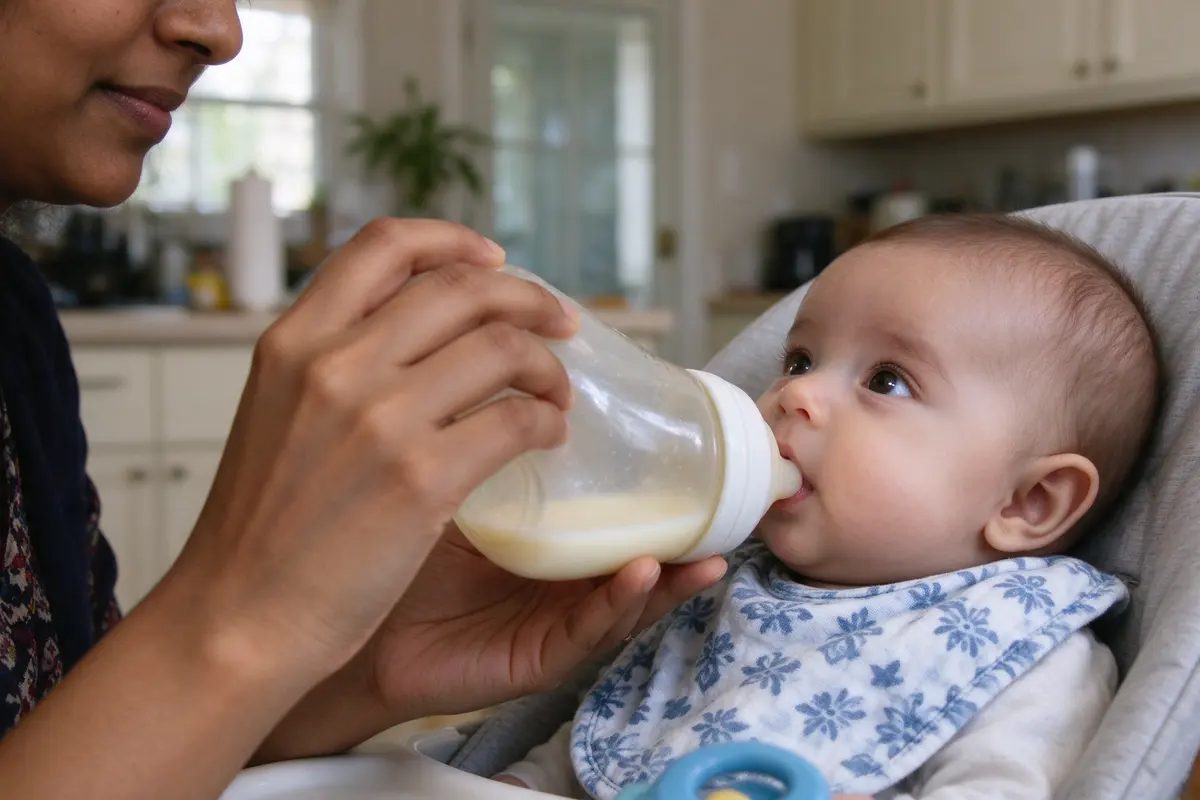
Offer a little less, then pause
Time: One bottle feed · Feeding at 2 to 3 months in the guide
Make a little less than usual. You can always give more (Jain & Bunik, AAP).
Hold your baby close and semi-upright (AAP).
Partway through, tip the bottle down and pause, so your baby can notice whether they're full (Jain & Bunik, AAP).
If they root and fuss for more, make more. If they turn away or seem full, stop, even if the bottle isn't empty (CDC).
Make it work:This works with pumped milk and with formula. If you breastfeed directly, the pause is already built in: your baby ends the feed.
Watch for
Normal
a bit of spit-up that flows out easily after a feed.
Normal
a feed that's smaller than the last one.
Normal
sucking on hands between feeds.
Call within a day
if your baby isn't gaining weight or always seems hungry (AAP).
For you

Eat sitting down. One meal today with both hands, a plate, and a chair, while someone else holds the baby. If constipation is still a problem, plenty of water and fresh fruits and vegetables are the first fix (OWH).
One breast line that doesn't wait: a tender, red, warm area on one breast is a reason to call your provider (MedlinePlus). So is a fever of 100.4°F or higher (CDC). Don't push through either.
If you're the partner: make the plate, then take the baby. The order matters.
Sources
- Jain S, Bunik M. "How Often and How Much Should Your Baby Eat?" HealthyChildren.org, updated 2024. https://www.healthychildren.org/English/ages-stages/baby/feeding-nutrition/Pages/How-Often-and-How-Much-Should-Your-Baby-Eat.aspx
- Centers for Disease Control and Prevention. "Milestones by 4 Months." Learn the Signs. Act Early., updated 2026. https://www.cdc.gov/act-early/milestones/4-months.html
- American Academy of Pediatrics. "Amount and Schedule of Baby Formula Feedings." HealthyChildren.org, updated 2022. https://www.healthychildren.org/English/ages-stages/baby/formula-feeding/Pages/amount-and-schedule-of-formula-feedings.aspx
- Office on Women's Health. "Breastfeeding and Going Back to Work." US Department of Health and Human Services, updated 2025. https://www.womenshealth.gov/breastfeeding/breastfeeding-home-work-and-public/breastfeeding-and-going-back-work
- Kent JC, Mitoulas LR, Cregan MD, et al. "Volume and frequency of breastfeedings and fat content of breast milk throughout the day." Pediatrics, 2006. https://pubmed.ncbi.nlm.nih.gov/16510619/
- American Academy of Pediatrics. "Cereal in a Bottle: Solid Food Shortcuts to Avoid." HealthyChildren.org, updated 2015. https://www.healthychildren.org/English/ages-stages/baby/feeding-nutrition/Pages/Cereal-in-a-Bottle-Solid-Food-Shortcuts-to-Avoid.aspx
- Macknin ML, Medendorp SV, Maier MC. "Infant sleep and bedtime cereal." American Journal of Diseases of Children, 1989. https://pubmed.ncbi.nlm.nih.gov/2672785/
- Centers for Disease Control and Prevention. "About Feeding From a Bottle." 2026. https://www.cdc.gov/infant-toddler-nutrition/bottle-feeding/index.html
- American Academy of Pediatrics Section on Gastroenterology, Hepatology and Nutrition. "Vitamin D for Babies, Children & Adolescents." HealthyChildren.org, updated 2022. https://www.healthychildren.org/English/healthy-living/nutrition/Pages/vitamin-d-on-the-double.aspx
- American Academy of Pediatrics. "Bottle Feeding Basics." HealthyChildren.org, 2012. https://www.healthychildren.org/English/ages-stages/baby/feeding-nutrition/Pages/Bottle-Feeding-How-Its-Done.aspx
- American Academy of Pediatrics. "Vomiting Without Diarrhea" (symptom checker). HealthyChildren.org, accessed 2026. https://www.healthychildren.org/English/tips-tools/symptom-checker/Pages/symptomviewer.aspx?symptom=Vomiting+Without+Diarrhea
- American Academy of Pediatrics. "Reflux (Spitting Up)" (symptom checker). HealthyChildren.org, accessed 2026. https://www.healthychildren.org/English/tips-tools/symptom-checker/Pages/symptomviewer.aspx?symptom=Reflux+%28Spitting+Up%29
- American Academy of Pediatrics. "Crying Baby - Before 3 Months Old" (symptom checker). HealthyChildren.org, accessed 2026. https://www.healthychildren.org/English/tips-tools/symptom-checker/Pages/symptomviewer.aspx?symptom=Crying+Baby+-+Before+3+Months+Old
- Office on Women's Health. "Recovering from birth." US Department of Health and Human Services. https://womenshealth.gov/pregnancy/childbirth-and-beyond/recovering-birth
- MedlinePlus. "Going home after a C-section." National Library of Medicine. https://medlineplus.gov/ency/patientinstructions/000624.htm
- Centers for Disease Control and Prevention. "Urgent Maternal Warning Signs and Symptoms." HEAR HER. https://www.cdc.gov/hearher/maternal-warning-signs/index.html
This guide is general education that summarizes published research and guidance from groups like the American Academy of Pediatrics, the CDC, and the WHO. It isn’t medical advice, and every child develops on their own timeline. Your pediatrician knows your child; if something feels wrong, call them. In an emergency, call 911.
Get each day’s note the morning it applies
Add your baby to a free Chorevia household with their date of birth, and every morning for 120 days the day’s note arrives in the app and by email: what’s developing, one thing to try, what to watch for, and a word for you.
Create your household