Day 71 of 120 · Week 10
Ten weeks
Last reviewed · 4 min read · 10 sources · Plain-text version
Ten weeks old: how fast your baby is growing, the soft spot at the back closing, and a two-minute head-shape check to do while the hair is still wet from the bath.

Ten weeks. Your baby is heavier in your arms than they were at the 2-month visit, and today is a good day to look closely at the head that's doing a lot of that growing.
Heart
The numbers behind the heavy arms: from 1 to 4 months, babies typically gain 1.5 to 2 pounds and grow 1 to 1.5 inches a month, and head size grows about half an inch a month (AAP). The soft spots were still open and flat at 2 months; by 3 months, the one at the back should be closed (AAP). The diamond-shaped one on top usually closes between 12 and 18 months, and gently touching it is safe (AAP).
Head
Flattening most often develops in the first 4 to 12 weeks, which makes this the month to look. After a bath, when the hair is wet, check that the back of the head is evenly round, the ears line up, and the forehead looks balanced (AAP). About 85% of babies with torticollis, tight neck muscles, also have a flat spot, so notice too whether your baby always turns the same way (AAP). Skip "head-shaping" pillows: they can create a suffocation risk, and the FDA says there's no evidence they work (AAP).
If you find something, the tools now are tummy time and position changes. Helmets, if ever, are a later question, for moderate or severe flattening that hasn't responded to other treatment by 5 or 6 months (AAP).
Body
For a baby with a flat spot, the AAP suggests working up to an hour of tummy time a day in short sessions (AAP); for everyone else, WHO's floor is at least 30 minutes a day, spread out, while awake (WHO). For a head that always tilts one way, your pediatrician can show you gentle neck stretches; early treatment usually works and can prevent lasting unevenness (AAP).
Try today

The wet-hair head check
Time: 2 minutes, right after a bath · Head shape and neck check-ins in the guide
While the hair is still wet, sit your baby on your lap facing away from you and look down at the back of the head: is it evenly round (AAP)?
Turn them to face you: do the ears line up, and does the forehead look balanced (AAP)?
Over the rest of the day, notice which way they rest their head, and whether it's always the same side (AAP).
Write down what you saw, and bring the note to the 4-month checkup.
Make it work:Looking is the whole job today. The fix for a mild flat spot at this age is more floor time and more position changes, not a pillow (AAP).
Watch for
Normal
a soft spot on top that looks flat or a little sunken and may pulse with each heartbeat.
Call your pediatrician right away
for a soft spot that bulges, or one that's deeply sunken in a baby who isn't acting well (AAP).
Normal
a slightly flatter patch on one side, or a favorite way to turn.
Bring it up, don't wait,
if your baby always tilts their head one way or has a flat spot (AAP).
Normal
crying through the bath and stopping in the towel.
Call 911
if your baby is struggling for each breath or has bluish lips or face (AAP).
For you
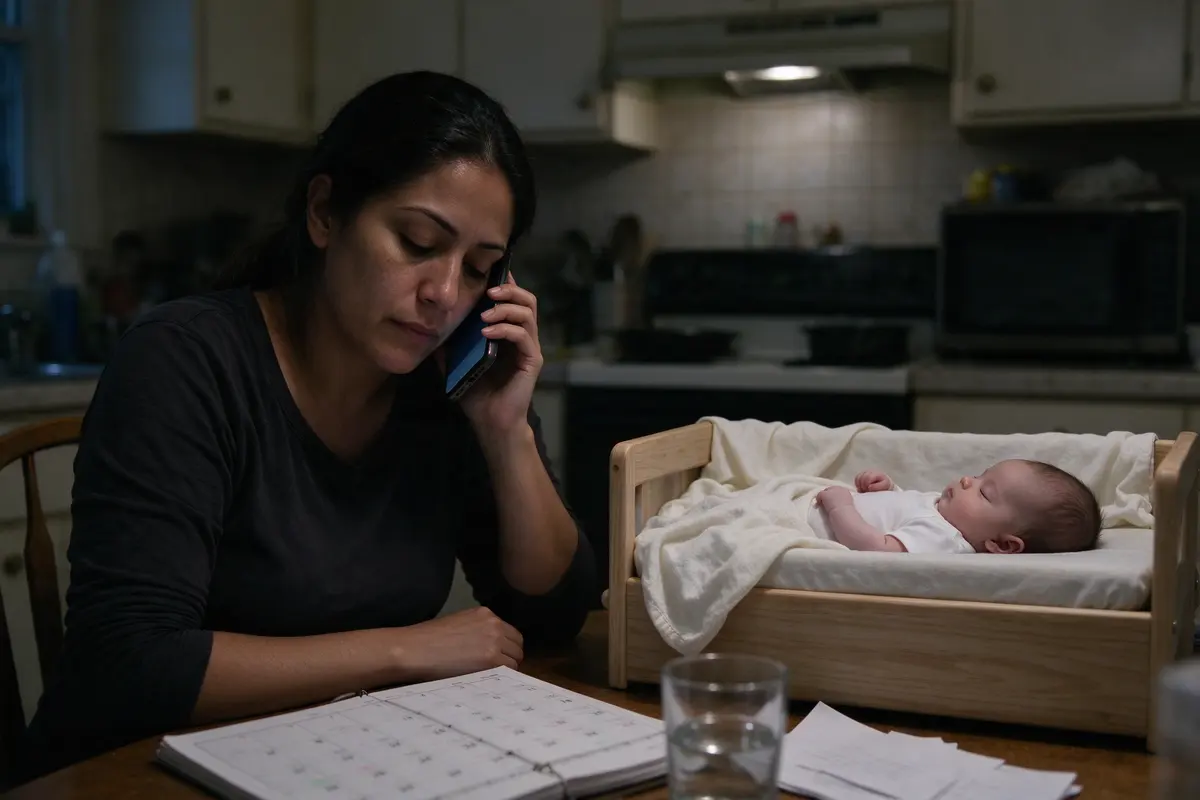
Ten weeks of you. If your own postpartum visit hasn't happened, the deadline is close: ACOG recommends a full visit no later than 12 weeks after birth, covering mood, sleep, recovery, contraception, and chronic conditions (ACOG, 2018). That's two weeks from today. Book it.
Two things that don't wait for it. Overwhelming tiredness, or a headache that won't go away or gets worse, are on the CDC's list of urgent maternal warning signs; seek care immediately (CDC). And if sadness has lasted more than two weeks, go to the doctor now, not at the visit (OWH).
If you're the partner: make the call while she does the bath. Read her the dates, and put the appointment on the calendar you both can see.
Sources
- American Academy of Pediatrics. "Your Baby's Growth & Physical Development: 1 to 4 Months Old." HealthyChildren.org, updated 2026. https://www.healthychildren.org/English/ages-stages/baby/Pages/Physical-Appearance-and-Growth-1-To-3-Months.aspx
- American Academy of Pediatrics. "How Your Newborn Looks." HealthyChildren.org. https://www.healthychildren.org/English/ages-stages/baby/Pages/How-Your-Newborn-Looks.aspx
- American Academy of Pediatrics. "When a Baby's Head is Misshapen: Positional Skull Deformities." HealthyChildren.org, updated 2022. https://www.healthychildren.org/English/health-issues/conditions/Cleft-Craniofacial/Pages/Positional-Skull-Deformities-and-Torticollis.aspx
- World Health Organization. "To grow up healthy, children need to sit less and play more." 2019. https://www.who.int/news/item/24-04-2019-to-grow-up-healthy-children-need-to-sit-less-and-play-more
- American Academy of Pediatrics. "Head Tilt (Torticollis)." HealthyChildren.org, updated 2020. https://www.healthychildren.org/English/health-issues/conditions/Cleft-Craniofacial/Pages/Head-Tilt.aspx
- American Academy of Pediatrics. "Newborn Appearance Questions" (symptom checker). HealthyChildren.org, accessed 2026. https://www.healthychildren.org/English/tips-tools/symptom-checker/Pages/symptomviewer.aspx?symptom=Newborn+Appearance+Questions
- American Academy of Pediatrics. "Breathing Trouble" (symptom checker). HealthyChildren.org, accessed 2026. https://www.healthychildren.org/English/tips-tools/symptom-checker/Pages/symptomviewer.aspx?symptom=Breathing+Trouble
- American College of Obstetricians and Gynecologists. "ACOG Committee Opinion No. 736: Optimizing Postpartum Care." Obstetrics & Gynecology, 2018. https://pubmed.ncbi.nlm.nih.gov/29683911/
- Centers for Disease Control and Prevention. "Urgent Maternal Warning Signs and Symptoms." HEAR HER. https://www.cdc.gov/hearher/maternal-warning-signs/index.html
- Office on Women's Health. "Recovering from birth." US Department of Health and Human Services. https://womenshealth.gov/pregnancy/childbirth-and-beyond/recovering-birth
This guide is general education that summarizes published research and guidance from groups like the American Academy of Pediatrics, the CDC, and the WHO. It isn’t medical advice, and every child develops on their own timeline. Your pediatrician knows your child; if something feels wrong, call them. In an emergency, call 911.
Get each day’s note the morning it applies
Add your baby to a free Chorevia household with their date of birth, and every morning for 120 days the day’s note arrives in the app and by email: what’s developing, one thing to try, what to watch for, and a word for you.
Create your household